According to PitchViz (based on the ball-tracking data) this is the most inconsistent surface for a Test in England since records began. Which is not ideal
Virat Kohli
[VEE-raht KOH-lee]
noun.
Someone with an insatiable, ferocious hunger for winning.
See also:
- Chase Master (targeted form)
- King Kohli (informal synonym)
- Run machine (colloquial)
#ipl
Witnessed Paris when PSG drew the second leg with Bayern to win the UCL semifinal. It was a riotous outpour on the streets.
Can imagine the crazy scenes now.
Well deserved PSG.
Sometimes things just last you a long, long time. And some of those times, to hilarious consequences. Enjoy our ad spot that’s creating big waves and is going viral. Share it with your ganja best friend or even a curly haired friend.
#Ralson#BuiltBetter#TreadNewPaths
During the Cold War, the US stored Soviet encrypted messages they couldn’t break yet. Years later (VENONA project), they decrypted them — exposing dozens of spies who stole atomic secrets.
This is exactly ‘Store Now, Decrypt Later’ #PQC#QuantumComputing”
Project Hail Mary directors Lord and Miller, and screenwriter Goddard have clearly gambled on pace.
You may wish it was shorter, but not without sacrificing the film’s humane heart… if we can still call it so despite the inter-galactic leads.
7/10
From Strategic Ambiguity to Strategic Clarity and settling on Constructive Strategic Stability, as great-power dynamics remain fluid and transactional, middle-powers need to double down on their Strategic Autonomy.
Excellent piece by @SaxenaAnushka_
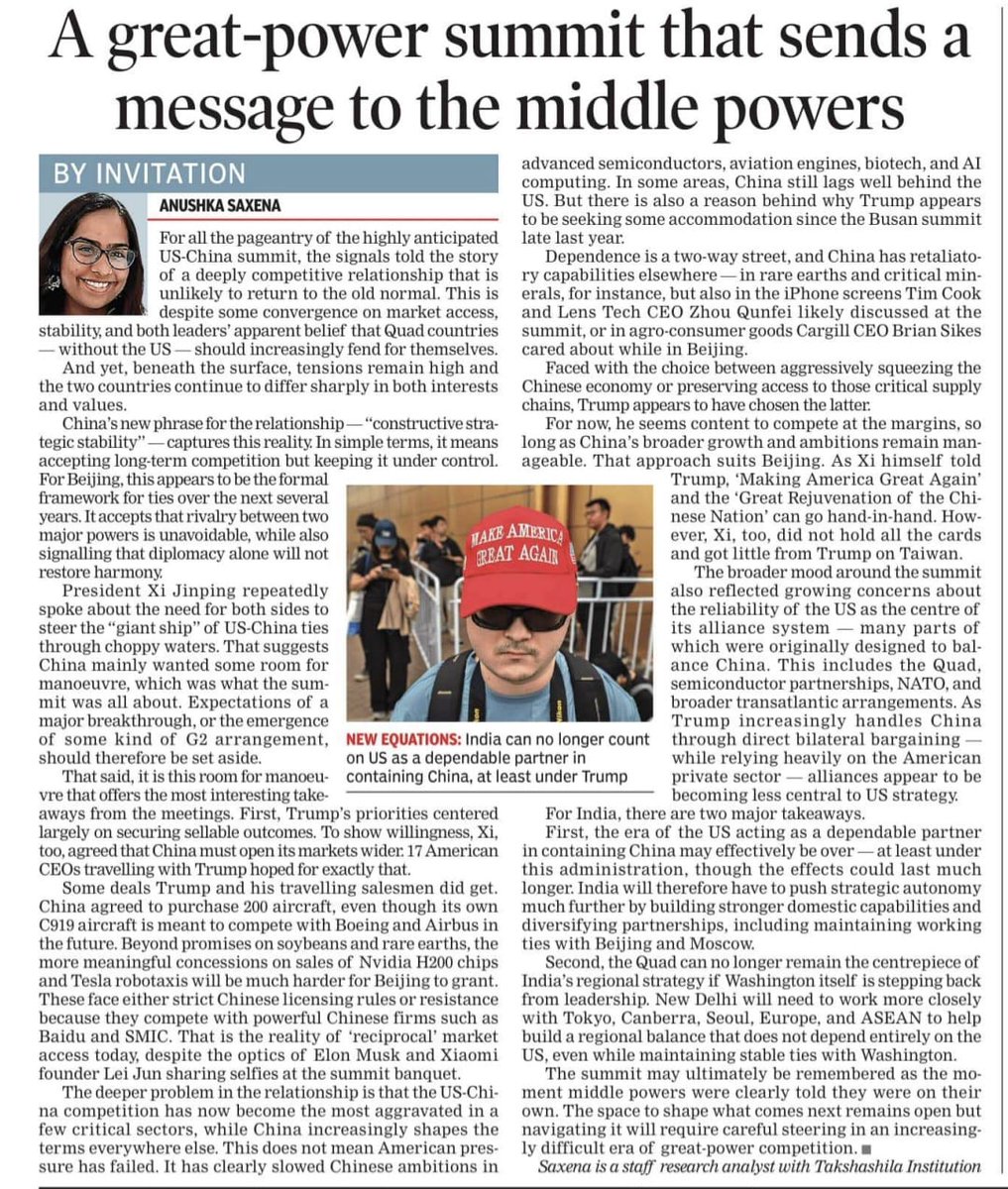
In today's @timesofindia, I argue: Beijing's new phrase for US-China ties – "constructive strategic stability" – captures the reality of a deeply competitive relationship.
In simple terms, it means accepting long-term competition but keeping it under control. For Beijing, this appears to be the formal framework for ties over the next several years. It accepts that rivalry between two major powers is unavoidable, while also signalling that diplomacy alone will not restore harmony.
For more thoughts on Trump's approach to alliances, lessons for India, and the deals of the travelling salesmen, check out the full piece here: https://t.co/HuSD7yB5WF. Appreciate your comments!
Wonderful anecdote about how RD Burman crafted the creepy, iconic background theme for Babu, Amitabh’s negative* character in Satte pe Satta.
*IYKYK ;-)
https://t.co/VV2e5CQIKP
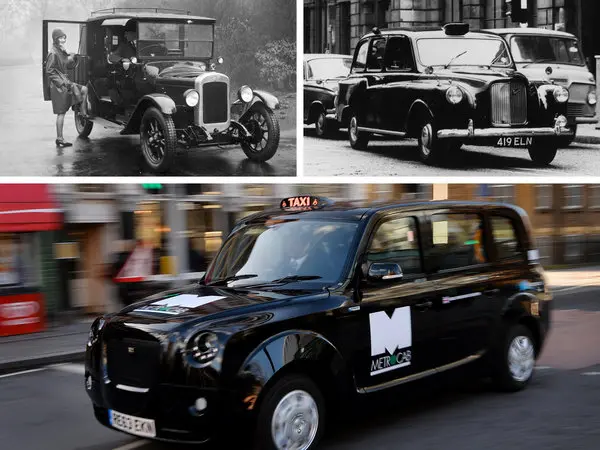
To get a license to drive a black cab in London, you have to memorize 25,000 streets, 20,000 landmarks, and the fastest route between any two points in a six-mile radius of Charing Cross. It takes most people three to four years.
A British neuroscientist asked the obvious question nobody had thought to ask. What does that actually do to a human brain?
Her name was Eleanor Maguire. The study changed neuroscience forever.
The exam is called The Knowledge. It was introduced in 1865, and the format has barely changed since.
Applicants ride a moped around London for years with a clipboard strapped to the handlebars, tracing every possible route between every possible pair of points in the city.
They get tested in person by an examiner who can ask them, on the spot, for the shortest legal route between any two addresses in a database of tens of thousands. Half the people who attempt it fail.
The ones who pass have spent an average of four years studying full time and have taken the test 12 times before getting through.
Maguire was watching a TV movie about it in 1995 when she had the idea. These were not ordinary people. They were people running one of the most extreme spatial memory training programs that exists anywhere on Earth.
If the human brain could be reshaped by experience, this was the cleanest natural experiment anyone was ever going to find.
She put 16 of them in an MRI machine.
Their posterior hippocampi were significantly larger than the brains of matched controls. The longer a driver had been working, the bigger the difference got.
A 40-year veteran had a measurably more developed hippocampus than a 5-year veteran, and both had more than someone who had never driven a cab.
Here is why that finding broke a century of consensus.
Until 2000, every neuroscience textbook in the world taught a version of the same idea. The adult brain is essentially fixed. You are born with a set number of neurons. Childhood is the window where the wiring gets laid down. After puberty, the structure freezes, and the rest of your life is just slow decline.
Maguire's study was one of the first pieces of human evidence that this was simply wrong. Adult brains physically remodel themselves in response to what you ask them to do. Not metaphorically. Structurally. With grey matter you can measure on a scan.
The skeptics had an obvious objection. Maybe people with bigger hippocampi were just more likely to become taxi drivers in the first place. The brains were not changing. The job was selecting for brains that already looked that way.
So Maguire ran the experiment again. Properly this time.
She recruited 79 trainees who were just starting to study for The Knowledge and 31 controls who were not. She scanned all of them at the start. Then she waited four years. Of the 79 trainees, 39 eventually passed the exam and 20 failed. She scanned them again.
The trainees who passed had grown larger posterior hippocampi over those four years. The trainees who failed had not. The controls who never studied had not. The brain change was not selection. It was construction.
The act of memorizing the city had physically rebuilt the part of the brain responsible for spatial memory, and the rebuild only happened in the people who actually did the work.
There is a quieter finding from this research that almost nobody quotes, and it is the one I cannot stop thinking about.
The drivers had a bigger posterior hippocampus, but they had a smaller anterior hippocampus. The brain had not magically expanded. It had reallocated. Tissue that was being used for one type of memory had been compressed to make room for another.
When Maguire ran follow-up cognitive tests, the cabbies were measurably worse than controls at certain visual memory tasks unrelated to navigation. They had paid for The Knowledge with something else. The trade was real.
She also ran a second control experiment that is the part of the story most people never hear. She scanned London bus drivers. Same hours behind the wheel. Same city. Same traffic. Same stress. The only difference was that bus drivers follow fixed routes. They do not have to navigate. Their hippocampi looked completely normal.
The cab drivers had not grown bigger hippocampi from driving. They had grown them from the constant, active, effortful retrieval of spatial information from memory.
That distinction is the entire study.
Then in 2020, McGill researchers ran the inverse experiment. They tracked 50 regular drivers and measured how often they used GPS. The participants who relied most heavily on turn-by-turn navigation had measurably weaker spatial memory. When the researchers retested a subset of them three years later, the heavier GPS users had declined fastest.
The hippocampus, the same region the cabbies had built up by ignoring shortcuts, was being slowly hollowed out in everyone else by accepting them.
The mechanism Maguire spent 25 years documenting works in both directions. Brains grow what you make them grow. They lose what you stop asking them to do.
The taxi drivers were running the most intense spatial memory training program on Earth. Most of the rest of us are running the opposite program without realizing it.
Maguire died in early 2025. UCL's tribute described the cabbie study as a stroke of creative genius. She had spent her entire career on a single question. What does it physically take to remember something, and what changes inside a person who remembers a lot of it.
The answer is the part that should change how you live.
“Distributed leadership is an unavoidable reality for any global enterprise… systemic practices that connect leadership across geographies better ensures that the organization benefits from the expertise and insights from all their leaders.” @DavidLivermore
In many multinational organizations, the biggest factor shaping strategy isn’t market insight or expertise—it’s proximity to headquarters.
Decisions get framed, debated, and often finalized by the people who happen to be awake and in the room, while equally senior leaders elsewhere wake up to outcomes they had no chance to influence. Over time, this HQ‑satellite dynamic quietly distorts priorities, sidelines regional expertise, and leaves global leaders managing the consequences of decisions they weren’t part of making.
Drawing on a 15-month study of interviews, focus groups, and executive roundtables with 150+ leaders across the US, Europe, Asia, and the Middle East, researchers identified two systemic fixes that consistently narrowed the influence gap.
Together, these practices improve decision quality, reduce costly rework, and lower frustration for leaders operating outside the center. https://t.co/J84Bt7xFrG
Time is finite, but energy is renewable.
This HBR piece remains relevant, almost 20 years later.
In fact even more so now, as we expect our AI-enabled workforce to deliver higher productivity, dynamic creativity and sounder judgment - all energy sapping, and needing renewal.
We only have so many hours in the day. But energy can be systematically expanded and renewed. Here’s how to establish rituals that will reenergize you. https://t.co/Z9uImBxvxL