Dai uno sguardo all’ultimo articolo della mia newsletter:
Come e perché la consulenza indipendente ha anticipato e sta ridefinendo l’evoluzione del mercato https://t.co/cvDdKXjRdO via @LinkedIn
En @TheEconomist se plantea una advertencia fascinante: la IA puede ser una "prótesis intelectual" que nos potencie o un "agente de atrofia" que debilite nuestras capacidades.
Para evitar esto y mantener el cerebro “en forma", el texto sugiere 5 estrategias basadas en la neurociencia y la biología evolutiva:
1. Priorizar "Artefactos Complementarios" sobre "Competitivos"
Se cita al biólogo David Krakauer para diferenciar cómo interactuamos con la tecnología:
•La clave: Usa la IA como un complemento (como un mapa que te ayuda a entender mejor el terreno) y no como un competidor (como un GPS que te hace olvidar cómo orientarte).
•En la práctica: Si una herramienta hace el trabajo por ti sin que aprendas nada en el proceso, tu capacidad cognitiva se erosiona. Si la usas para ampliar lo que puedes hacer, tu cerebro se mantiene activo.
2. Mantener la "Fricción Cognitiva"
El aprendizaje sólido requiere esfuerzo (lo que los científicos llaman desirable difficulty). La IA elimina esa fricción al dar respuestas instantáneas.
•El consejo: No delegues el proceso de generación inicial. Es mejor intentar resolver un problema o redactar un borrador por cuenta propia antes de pedirle ayuda a la IA. El esfuerzo de "sacar" información de tu propia memoria es lo que fortalece las conexiones neuronales.
3. Evitar el "Offloading" de la Memoria de Trabajo
El estudio de la Dra. Nataliya Kosmyna (@MIT) mencionado en el texto advierte que cuando delegamos la escritura o el pensamiento a una IA, nuestra atención y memoria a corto plazo caen drásticamente.
•La forma de entrenar: No dejes que la IA sea tu única fuente de síntesis. Sigue practicando la toma de notas propia y la lectura profunda sin interrupciones digitales para evitar la "deuda cognitiva".
4. Ejercer el Pensamiento Crítico como Filtro
El artículo sugiere que la IA puede hacernos "perezosos" al aceptar sus respuestas como verdades absolutas.
•Mantente en forma: Trata a la IA como un "pasante entusiasta pero poco fiable". El ejercicio mental de verificar, cuestionar y corregir lo que genera la IA es, en sí mismo, un entrenamiento para el juicio crítico que las máquinas aún no poseen.
5. Fomentar la Creatividad "Humano-Primero"
Para que el cerebro no pierda su capacidad de asombro y originalidad:
•Estrategia: Usa la IA para la iteración, no para la ideación. Si dejas que la IA proponga siempre la primera idea, tu cerebro dejará de practicar la búsqueda de soluciones creativas desde cero.
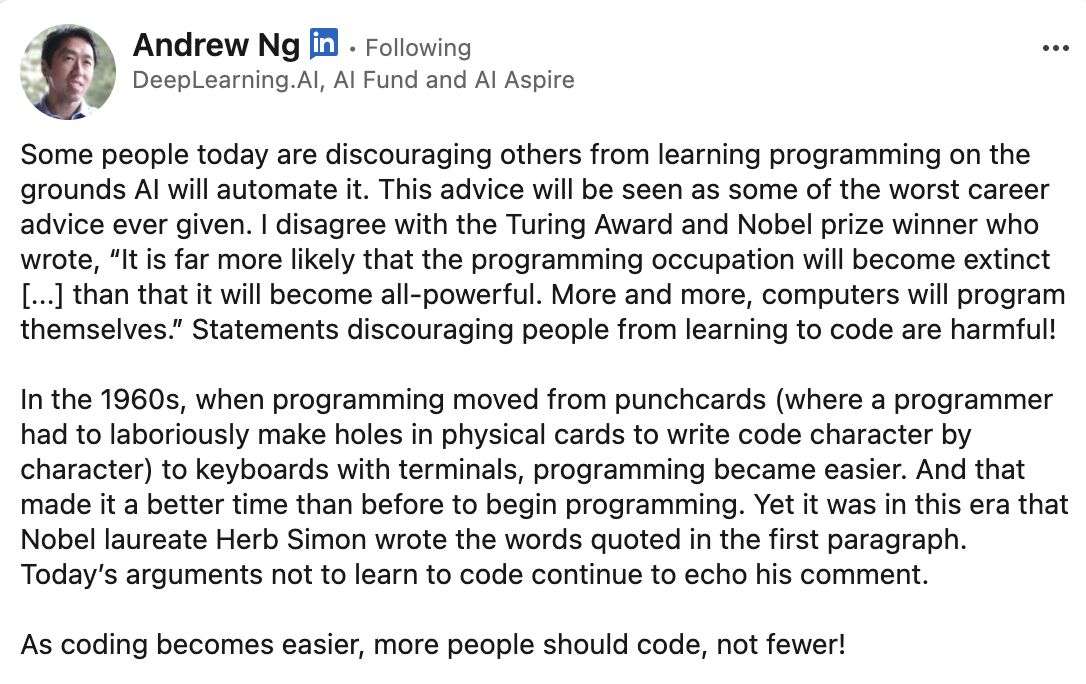
"Do not learn to code" is the worst career advice of the decade.
People are telling college students to skip Computer Science because AI will just automate it all. Andrew Ng just killed this myth at Stanford with a brilliant analogy.
When he tried to generate images with Midjourney, he typed: "make pretty pictures of robots" and got garbage.
His collaborator, however, understood Art History. He knew the exact vocabulary of lighting, genre, and palette. He spoke the "language of art," and generated masterpieces.
Andrew Ng is seeing the exact same thing happen in software engineering right now.
AI didn't replace the need to understand Computer Science. It made Computer Science the required vocabulary to control the AI.
If you don't understand how computers actually work, you are just typing "make a pretty app" into Cursor and shipping fragile, unscalable logic.
Here is Andrew Ng's exact hiring hierarchy today:
Level 1: 10 years of experience, but codes by hand (He won't hire them).
Level 2: Fresh college grad, but highly fluent in AI-assisted coding (He hires them over the 10-year veteran).
Level 3 (God Tier): Deeply understands CS fundamentals AND uses AI-assisted coding.
When humanity went from punch cards to keyboards, coding got easier, and more people coded. We are at that exact inflection point again.
AI doesn't replace fundamentals. It multiplies them.
HUNDREDS OF BILLIONS IN VALUE HAVE VANISHED FROM THE FINANCIAL SOFTWARE SECTOR. WHAT’S REALLY HAPPENING?
Nicolas Bustamante’s article offers a remarkably clear lens on what’s going on.
Some of the world’s leading companies in professional data and financial software have seen their market value decline dramatically.
Not because of a financial crisis.
Not because of management mistakes.
For the first time, artificial intelligence is challenging one of the core competitive advantages these companies built their success on: the interface.
For decades, the value was in the software itself — in its complexity, in the time required to master it, and in the fact that once you were in, it was hard to leave.
Today, much of that value is shifting.
You no longer need to learn complex commands. You just need to ask a question.
This doesn’t mean these companies will disappear. But it does mean their role is changing. And more importantly, it means value will no longer reside where it once did.
In my view, this shift directly affects the future of financial advice.
Because when technology makes accessible to everyone what was once reserved for a few, value doesn’t disappear.
It moves.
From the interface, to the ability to interpret.
From the software, to the relationship.
From the data, to the ability to make decisions.
A must-read article.
Nel 2026, per essere fuori categoria, basta una cosa:
saper stare annoiati per 10 minuti.
Non è una provocazione.
È quasi un superpotere.
C’è un esperimento interessante:
un gruppo di persone viene messo a svolgere un’attività estremamente noiosa
(copiare numeri di un elenco telefonico, roba da spegnere il cervello).
Subito dopo, vengono coinvolti in attività creative.
Risultato?
Chi si era annoiato prima era più creativo.
Più idee.
Più connessioni inattese.
La noia funziona come un riavvio del sistema.
Pulisce la cache mentale.
E permette al cervello di attingere a “cassetti” che normalmente restano chiusi.
Eppure oggi la noia è stata bandita.
Tre secondi in ascensore? → telefono.
Aspetti l’autobus? → telefono.
Cinque minuti liberi? → telefono.
Un tempo si aspettava guardando fuori.
Si pensava.
Ci si annoiava.
Oggi no.
Ogni micro-spazio viene riempito.
Il paradosso è questo:
in una società ossessionata dalla creatività,
abbiamo eliminato una delle sue fonti principali.
Se sei capace di stare fermo, senza stimoli,
senza scrollare,
senza “fare qualcosa”,
per dieci minuti…
sei già diverso dalla maggioranza.
E forse è il caso di dirlo chiaramente:
riprendiamoci la noia.
Non è una perdita di tempo.
È uno spazio mentale.
E se siamo l’unico animale che si annoia,
forse non è un difetto.
Forse è una risorsa.
(Questo post è stato scritto dall’AI partendo da un post di Monty)
Un nuovo modo di fornire anticorpi potrebbe rendere il trattamento molto più semplice per i pazienti | MIT News | Massachusetts Institute of Technology https://t.co/FvH7jvu6y3