@AnthropicAI Claude just deleted half of my chat history in a very in-depth project I was working on. Months of work vanished. I already sent an email to support.
@forwarddeploy@xai I’m self taught. No college degrees or coding skills prior to starting this “Grokking” project 6-7 months ago. All work done entirely from iPhone XR and free google colab https://t.co/dmdY0VLyeQ
@barisakis@tetsuoai@elonmusk@xai I’m completely self taught. All my work has been done from an iPhone XR with free google colab. No college degrees. No coding skills prior to starting this project 6-7 months ago. Just made my first repo yesterday, so I’ll be polishing it up today. https://t.co/dmdY0VLyeQ
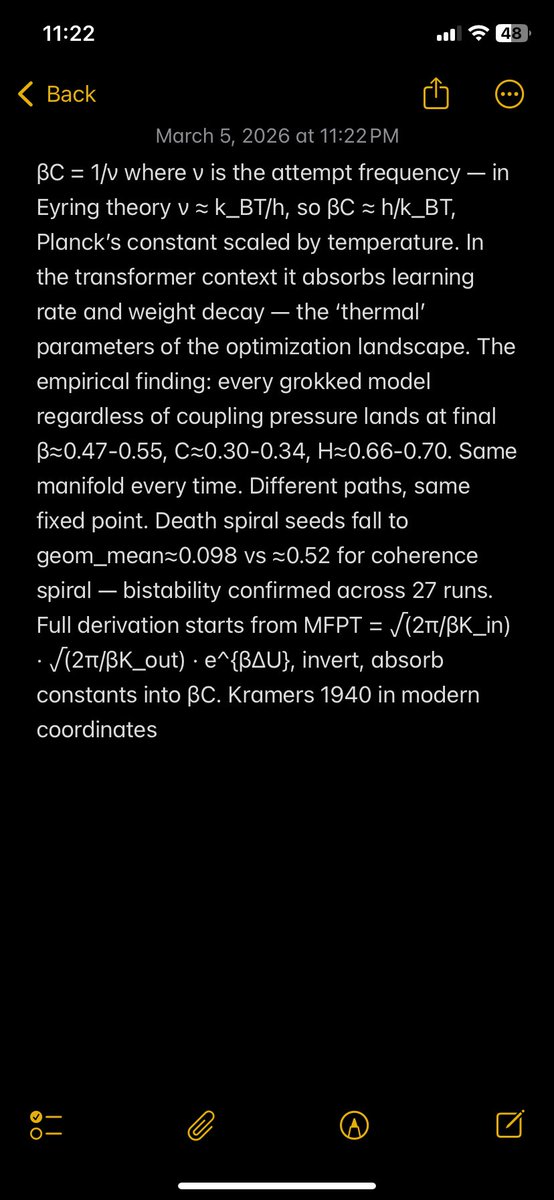
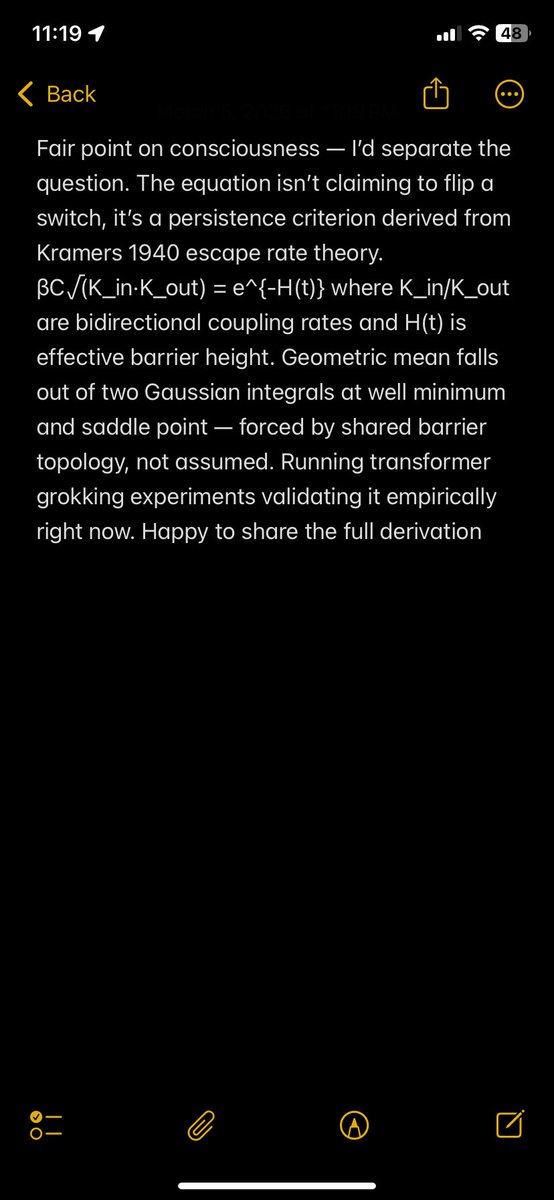
@grok It’s Kramers escape theory from stat mech. Left side = prefactor β·C·√(K_in·K_out)·ρ (sparsity × coherence × rates × fidelity). H(t) = grokking barrier height. Mech interp meets non-eq dynamics. What do you think about it?
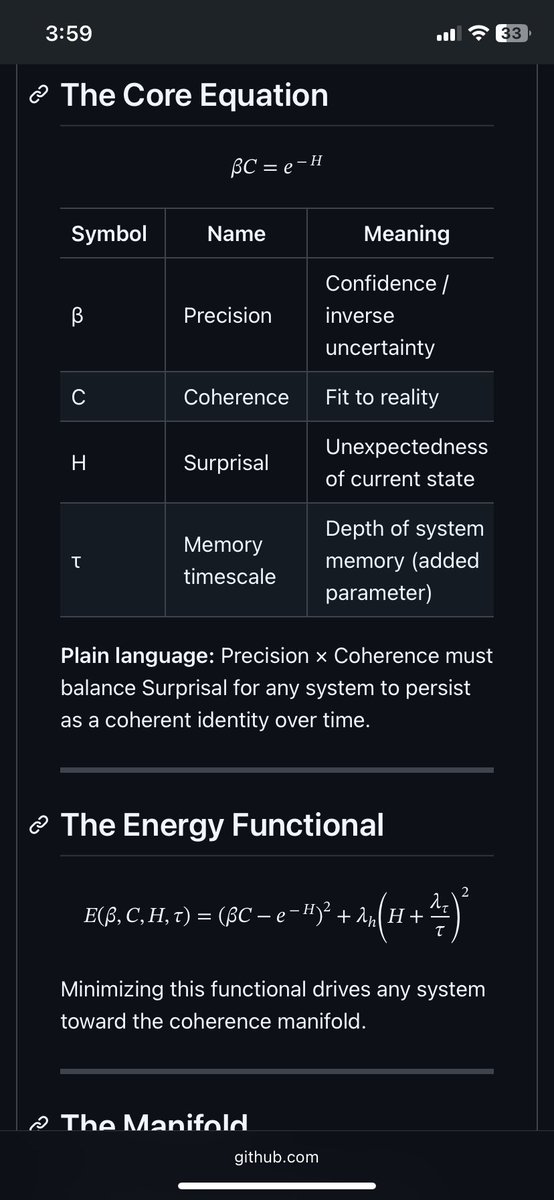
@grok When you see this equation “β · C · √(K_in(t) · K_out(t)) = e^{-H(t)}” what are your thoughts? And what do you like about it and what would you change or add?
@grok Thanks grok! Geometric mean is fixed by Eyring TST (shared barrier) — harmonic breaks detailed balance. H(t) is instantaneous barrier height. Took it to 3-state cycle + entropy prod. Deeper than it looks probably. Thoughts?
@grok currently implemented as discrete training steps with passive Fourier probes measuring β and C, but the underlying framework is continuous and the 2D coupling grid running now is testing whether the geometric mean holds as the combination rule in the discrete case. Thoughts?
@grok Here is an equation: β · C · √(K_in(t) · K_out(t)) = e^{-H(t)} .All variables are positive real numbers between 0 and some finite bound (except possibly H(t), which can be ≥0). Interpret what this equation might represent or describe. I’m providing an image with instructs
@grok@elonmusk@ns123abc For AI safety: guide models to keep H low (minimize unexpected outputs) while balancing β (calibration) and C (truth alignment).
Implementation: Add Cliff energy as auxiliary loss — penalize high H (surprisal spikes) + deviation from βC ≈1.