Current data visualization technology has serious shortcomings that can lead to inaccuracies. @Cancer_dynamics researchers have introduced a new method to approach high dimensional datasets, making them easier to explore, understand, and interpret: https://t.co/yX0bUwDLfl
📕 New publication in @PNASNews: A new visualization method developed by IICD researchers in the Blumberg group could improve the analysis of high dimensional datasets and help scientists identify new cell types. Read more: https://t.co/Yn9V5Jno5I
super excited to share our latest work! are we really tilting? 🤨
tldr: reward guidance for flows and diffusions is supposed to sample from the reward-tilted distribution. we show it doesn’t 😰 and how to (mostly) fix it ✨
plus lots of fun images!! 🖼️
collaboration with the awesome @nmboffi
website: https://t.co/nvOaAiGYq1
paper: https://t.co/EtkeyiuX7s
code: https://t.co/V3Bi4IVPbf
@Arsenal Incredibly proud of this team. They pushed and pushed, and I don't think any arsenal fan should feel anything but gratitude for this group. I'm so proud of them for making it all the way to the final and giving PSG a real run for their money :)
Can we learn the curvature of a data manifold from a finite sample? We study continuum limits of Ollivier’s Ricci curvature on geometric graphs, proving pointwise consistency and showing that positive lower bounds on the underlying manifold are inherited by the graph with high probability. We further discuss applications to heat kernels and manifold learning.
With Nicolás García Trillos. Now published in Discrete & Computational Geometry: https://t.co/fnArhFeMdx
3/ We leverage this characterization by using recently developed tools from Wasserstein parallel transport to tractably approximate HK parallel transport without solving its associated parallel transport PDE.
@mena_gonzalo, Florian Gunsilius and I are excited to share our work, "On the Differential-Geometric Equivalence of Hellinger-Kantorovich and Cone-Wasserstein Spaces" (1/n)
https://t.co/SxZtkRtdot
2/ In this manuscript we attempt to further the theory of the Hellinger-Kantorovich (HK) geometry on the space of non-negative measures. Specifically, we demonstrate that its differential-geometric structure can be characterized by the Wasserstein geometry of probability measures on a metric cone of the original space. This characterization allows one to import tools from Wasserstein geometry to compute and characterize HK geometry!
On the Differential-Geometric Equivalence of Hellinger-Kantorovich a...
arXiv:2605.24329
On higher order Morrey's inequalities over RCD{\boldmath(K,N)}-spaces
arXiv:2605.24404
The Brunn-Minkowski inequality for the generalized Gaussian distribu...
arXiv:2605.24472
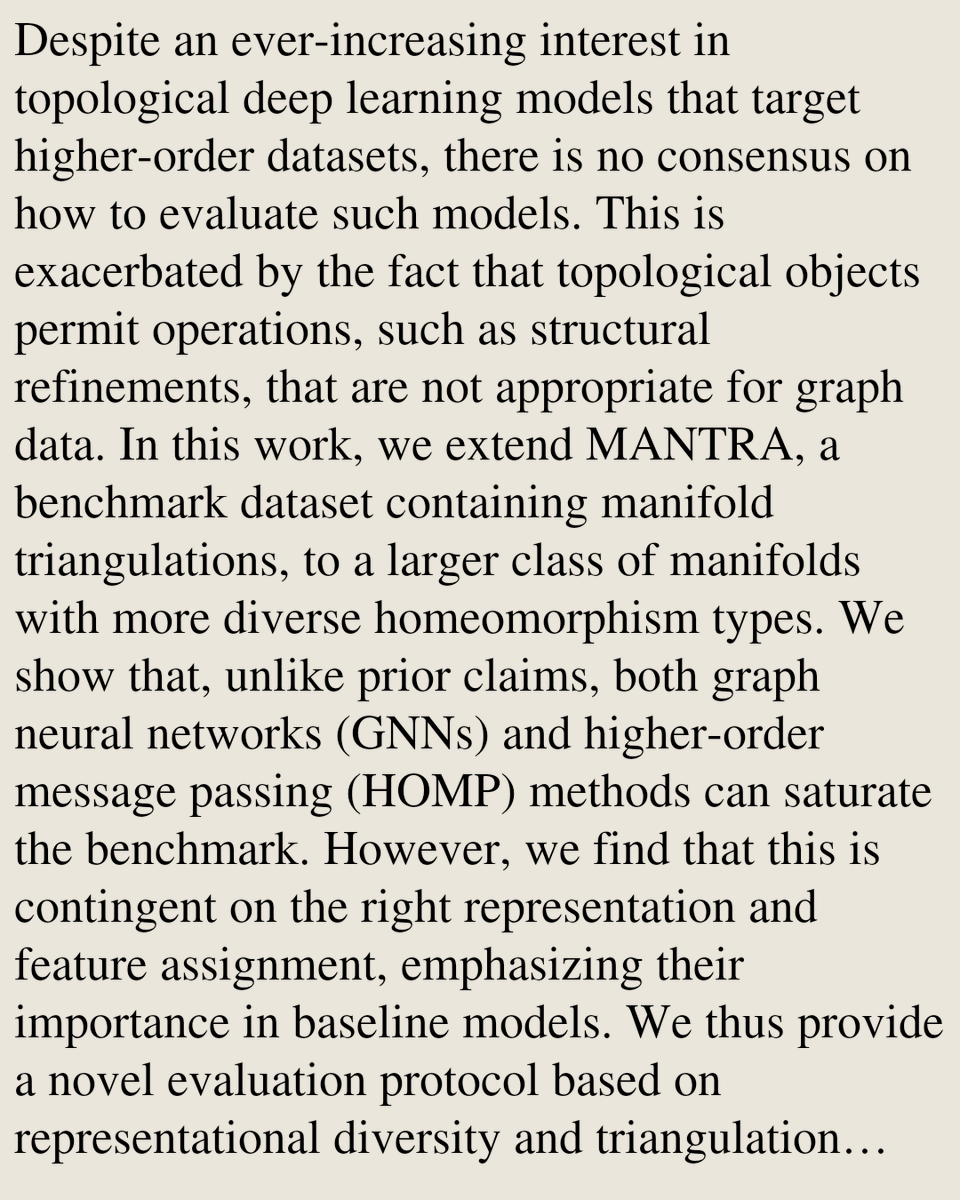
No Triangulation Without Representation: Generalization in Topological Deep Learning
Johannes S. Schmidt, Martin Carrasco, Ernst Röell, Guy Wolf, Nello Blaser, Bastian Rieck
https://t.co/v5utXOZaiO [𝚌𝚜.𝙻𝙶 𝚖𝚊𝚝𝚑.𝙰𝚃]
In it, we use the Riemannian geometry induced by optimal transport to rigorously define parallelism of time evolving statistical systems. We also propose and evaluate an algorithm to impute the dynamics of one stochastic process onto another using these principles.
Florian Gunsilius, Larry Wasserman, @mena_gonzalo and I are excited to share our work, “Wasserstein Parallel Transport for Predicting the Dynamics of Statistical Systems”!
https://t.co/ijXO6ctjOr
GEOTOP-A | Andrew Blumberg | Curvature in geometric data analysis https://t.co/zIYRaOk0rR via @YouTube
Great talk by Andrew Blumberg sharing work in collaboration with Abigail Hickok, @Pseudomanifold and myself!
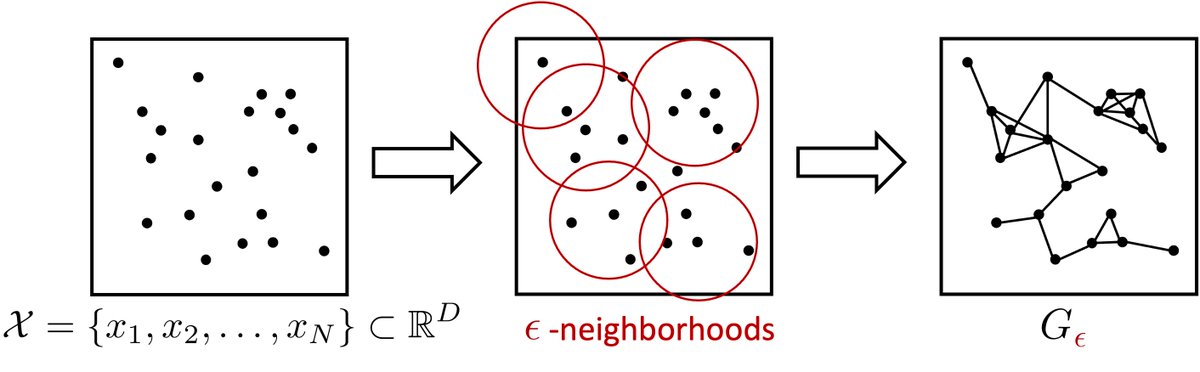
A cool concept in topological data analysis is the simplicial complex.
It connects points with edges, triangles, and higher order analogs.
By gradually increasing each point's neighborhood size it captures data's topological structure (e.g. voids, holes) at different scales.
Big graph, little compute?
In our #NeurIPS2025 paper we propose geometry-aware edge-contraction-based pooling methods for GNNs.
Our methods preserve graph structure, make interpretable pooling choices, and ensure robust performance at downstream tasks.
🧵1/n