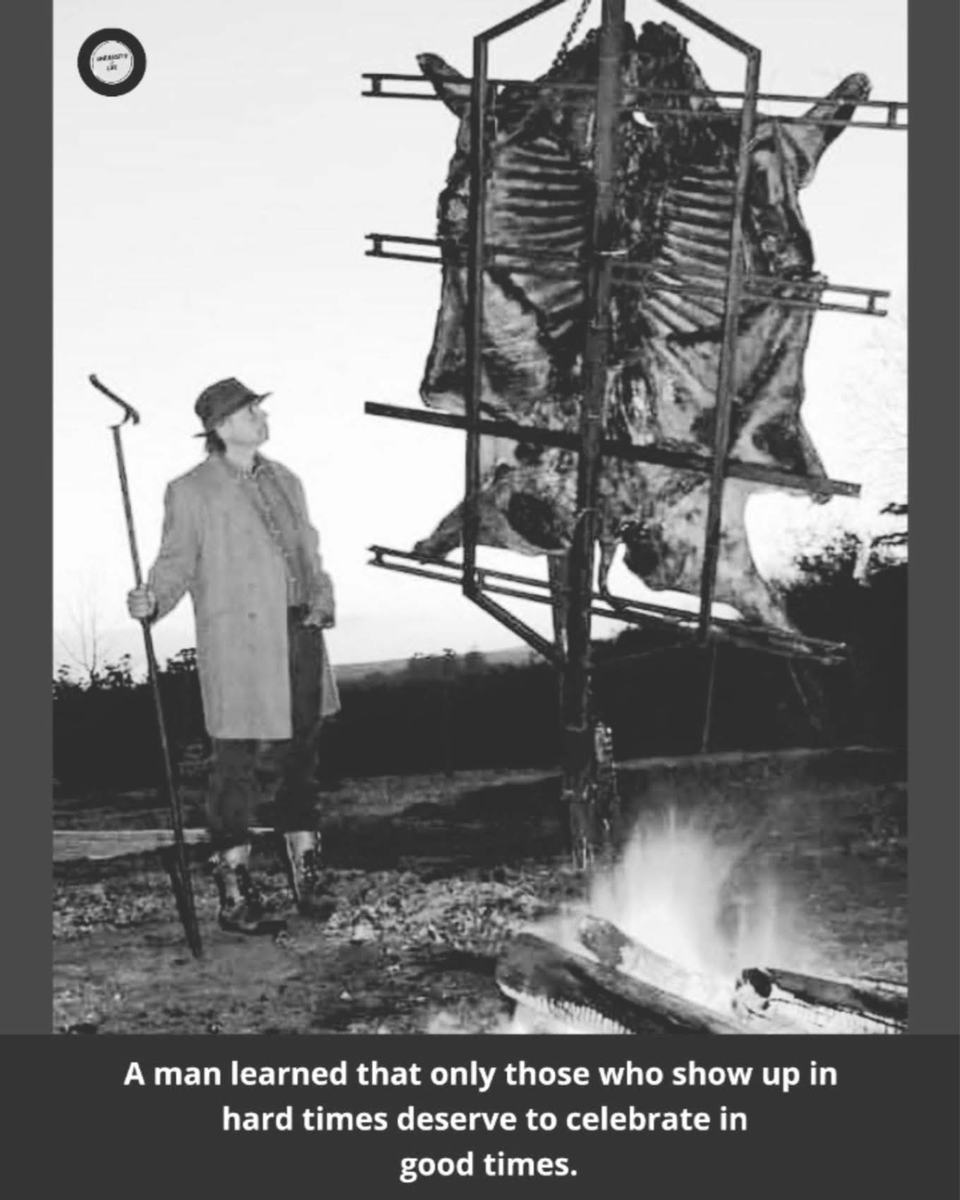
A man slaughtered a large cow, lit the grill, and said to his daughter, “Daughter, call our relatives, friends, and neighbors to join us for a feast!”
The daughter went out into the street and began shouting, “Please help us put out a fire at my dad's house!”
Moments later, a small group of people came running, while the rest acted as if they hadn’t heard her cry for help.
Those who arrived helped, ate, and drank until late into the night.
The father, stunned, turned to his daughter and asked, “The people who came, I barely know some of them. Others, I’ve never even seen before. Where are our relatives, friends, and neighbors?”
The daughter replied, “The people who came out of their homes came to help put out the fire at our house, not for the party. These are the ones who truly deserve our generosity and hospitality.”
Conclusion: Those who don’t stand by you in times of struggle shouldn’t celebrate your victory with you.
👊🏼✨👊🏼✨👊🏼✨👊🏼✨👊🏼✨👊🏼
The chunky wood butcher block in 1980s kitchens disappeared because of a government recommendation that had zero science behind it.
In the early 90s, food microbiologist Dean Cliver asked the USDA for the evidence behind their advice to ditch wood for plastic. They admitted they had none. So he ran the test himself.
He contaminated wood and plastic boards with E. coli, Salmonella, and Listeria. Three minutes later, 99.9% of the bacteria on the wood was dead. The wood's pores pull bacteria beneath the surface, where they can't survive.
Plastic went the other way. Left overnight at room temperature, the bacteria multiplied. And knife-scarred plastic was nearly impossible to sanitize, even in a dishwasher. Every cut creates a groove where bacteria hide from your sponge.
The thickness wasn't decoration either. Those blocks were end grain, wood fibers standing vertical, so the knife slides between fibers instead of cutting across them and the surface heals itself. That construction only holds together as a thick slab. Slice it thin and it cracks.
Cliver repeated the results across nine hardwoods, maple to walnut. Same outcome every time.
The butcher block was self-sanitizing and built to outlive the house. America threw it out for the board that grows bacteria overnight.
At 2:43 AM, a Linux application server started making one outbound connection every 60 seconds.
Nothing else looked wrong.
CPU usage was normal. There were no strange login attempts. No new users had been created. The antivirus had not detected anything, and none of our high-priority alerts had fired.
It looked like noise.
But the connection kept happening at almost the exact same interval.
So I logged into the server and started checking the running processes.
That was when I noticed something strange.
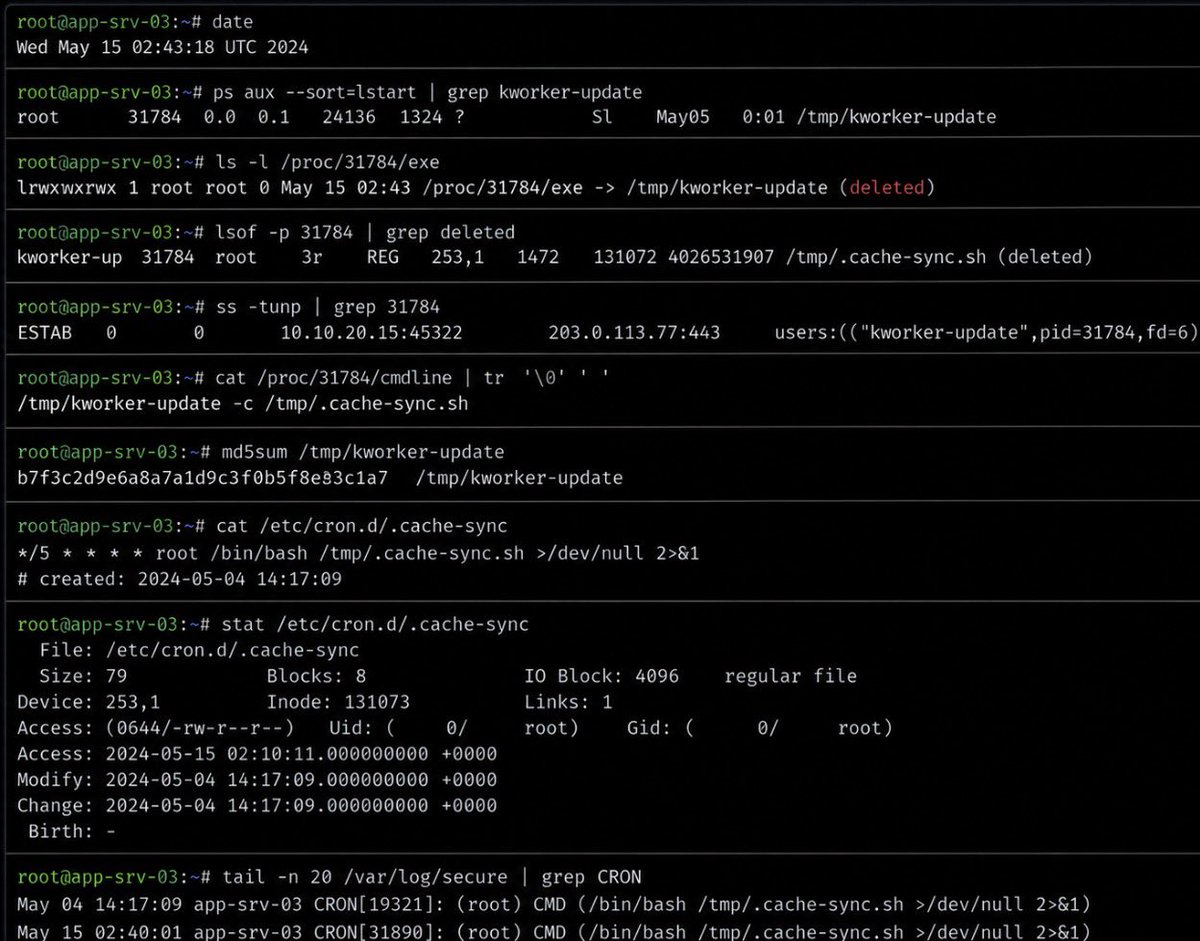
A process called kworker-update was running as root.
At first glance, the name looked normal because Linux actually has kernel processes with names similar to kworker.
But there was one problem.
This process was running from:
/tmp/kworker-update
A real kernel worker should not be executing from /tmp.
Now I knew something was wrong.
I checked the process again and discovered it still had a deleted shell script open:
/tmp/.cache-sync.sh (deleted)
Someone had deleted the script from the filesystem, probably hoping an investigator would not find it.
But because the process was still running, Linux still had a reference to the deleted file.
Then I checked the network connections.
The suspicious process had an active HTTPS connection to an external IP address.
I searched the cron directories next.
That was when the persistence mechanism appeared.
Hidden inside /etc/cron.d/ was a cron job configured to recreate and execute the script every five minutes.
The timestamp showed it had been placed there 11 days earlier.
For eleven days, this server had been quietly communicating with an external system without causing enough damage to trigger a serious alert.
No ransomware.
No files being destroyed.
No dramatic screen telling us we had been hacked.
The malware was simply maintaining access and waiting.
One small network connection every 60 seconds was the only thing that exposed it.
That is something people misunderstand about malware.
The dangerous ones are not always the loudest.
Sometimes the most important alert in the SOC is the one that almost looks too boring to investigate.
Elon is after Microsoft now!!
Cursor is planning to kill Github
Yesterday GitHub went down for 7 and a half hours. Website, Actions, Copilot, code merging, all of it. 15,000 developers reported outage.
GitHub's own CTO admitted they planned for 10x capacity and realized they needed 30x. They're now renting servers from AWS, Microsoft's biggest cloud rival.
Cursor launched Origin the same day.
Researchers pulled a 256-bit encryption key out of a device by filming its power LED.
The status light on a smart card reader flickers in sync with the chip's power draw, and that power draw leaks the key. They recovered a full ECDSA key from 16 meters away, through a window, using a hijacked security camera. No malware, no contact, just video of a status light.
The trick: a camera's rolling shutter turns 60 frames per second into 60,000 brightness samples per second.
The light that tells you a device is on tells an attacker what it is computing.
Proof, Ben-Gurion University 2023: https://t.co/caMDYUD7zL
Mientras hacía la sopa (que me acabo de tomar) y la revolvía, para que los fideos no terminaran formando un solo bloque, me puse a pensar.
Hace unos 50.000 años, los neandertales desaparecieron. No sabemos con absoluta certeza por qué, pero una de las grandes diferencias entre ellos y nosotros, los Homo sapiens, parece haber estado en nuestra capacidad de crear, imaginar y desarrollar herramientas y estrategias nuevas.
En otras palabras: nuestra gran ventaja fue la creatividad. Esa capacidad casi ilimitada de imaginar algo que todavía no existe y después construirlo.
Y ahora hicimos algo bastante curioso: creamos una especie de "Hiper Sapiens".
La inteligencia artificial puede leer en segundos un PDF de mil páginas, analizarlo, relacionar conceptos y entregarnos un resumen. Algo que a una persona podría llevarle días o incluso semanas.
No estoy diciendo que venga una película de *RoboCop* y que las máquinas se levanten para exterminarnos.
Pero sí hay algo que deberíamos empezar a discutir seriamente: podemos volvernos obsoletos para muchas tareas que hasta hace poco considerábamos exclusivamente humanas.
Y ahí aparece una pregunta peligrosa:
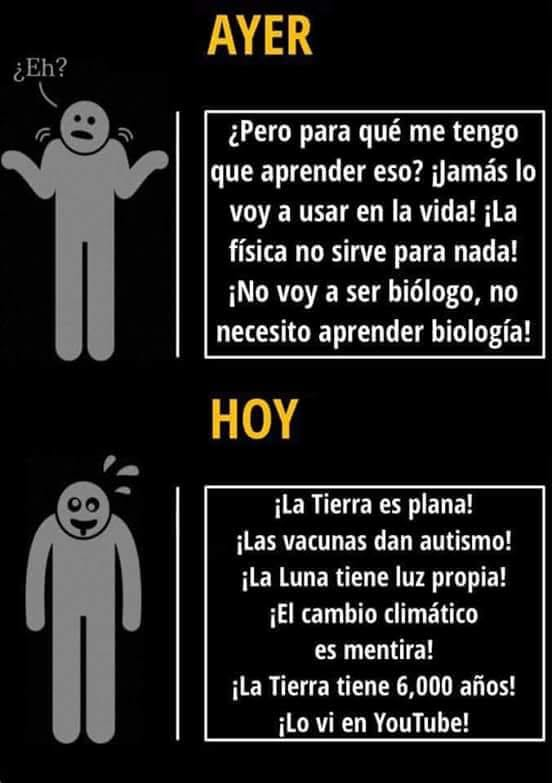
¿Para qué estudiar física, historia, matemática o electrónica si una IA puede resolverlo en segundos?
Ojo con esta pregunta!
Porque fuimos nosotros, los Homo sapiens, quienes construimos estas herramientas. La inteligencia artificial no apareció de la nada: es el resultado acumulado de miles de años de conocimiento humano.
Pero hay una diferencia fundamental entre saber usar una herramienta y depender completamente de ella.
Porque cuando se corta la luz, cuando no hay Internet, cuando falla el servidor o cuando la propia IA se equivoca, todavía hace falta alguien que tenga los conocimientos suficientes para agarrar un lápiz y un papel, pensar, calcular, analizar el problema y hacer que todo vuelva a funcionar.
Quizás el verdadero desafío del Homo sapiens no sea competir contra la inteligencia artificial.
Quizás sea: no olvidar cómo pensar sin ella.
El Tío Pedro
Tucumán 🇦🇷
17/08/2026
De los peores coches que hemos revisado en todos los tiempos. Calidades que no habíamos visto jamás en un vehículo que cuesta entre 17.000 y 20.000 € 🚨. Todo es lo más barato, lo más endeble y lo más pobre posible.
Joseph Dituri, conocido como doctor Deep Sea, pasó 100 días viviendo en el fondo de una laguna de 9 metros de profundidad en Key Largo dentro del estado de Florida.
El experimento realizado en 2023 buscaba analizar los efectos de la presión hiperbárica en el cuerpo humano como parte del Proyecto Neptuno 100.
Al finalizar su estancia el investigador de 55 años de edad notó que sus niveles de inflamación y colesterol mejoraron considerablemente además de tener un sueño más reparador.
Las pruebas médicas realizadas por la Universidad del Sur de Florida confirmaron que su edad biológica bajó de 44 a 34 años debido al alargamiento de sus telómeros, que son unas secuencias del ADN que ayudan a que este no se dañe.
@musicandsoularg ¿Pero el bajo nivel de estrés fue por la presión hiperbárica, o por estar aislado 100 dias sin que nadie le rompa las pelotas? Pregunto para un amigo.... Respuesta serias por favor.