📌 A quick intro — what I do and what I share here.
Hey, I’m Connor Zhou 👋
I share insights, strategies, and tools around digital marketing and global growth.
Here’s what you can expect:
🎯 Meta Ads — Facebook & Instagram advertising, campaign optimization, and performance marketing.
🌍 Social Media Growth — TikTok, Instagram, Facebook & YouTube content strategies.
🤖 Vibe Marketing & Vibe Coding — Exploring how AI is changing marketing, content creation, and product building.
⚡ AI & Automation — Productivity tools, smarter workflows, and ways to get more done with less.
My focus is simple:
Helping brands and businesses reach global audiences, acquire customers, and grow.
I’ll share what I learn, what I test, and what actually works.
If you’re working on global expansion, paid advertising, or social media growth, feel free to DM me.
Thanks for stopping by!
Wishing you more traffic, more leads, and more sales. 🚀
Today I’ll share another small but useful tip for growing followers on RED.
The day before yesterday I talked about how to collaborate with brands so they can run ads for your account and help you gain followers. If you haven’t seen it, you can check my profile.
The basic logic behind that method is these four steps:
1. Your note gets exposure
2. People click and read it
3. They enter your profile
4. They find you interesting or valuable, so they follow
Brand collaborations mainly help with step 1 and step 4.
But if you don’t want to rely on brands, is there another way?
My approach is to start directly from step 3.
Forget the internet for a second. In real life, have you noticed that in every small circle, there are usually one or two people that others naturally turn to when they have a problem? These people usually have one clear trait: they think independently and have real practical experience. People tend to respect them.
Can we turn this behavior into a follower-growth method on RED?
Yes.The process looks like this:
Someone has a clear, specific question.
You analyze it and give your own conclusion and structured breakdown.
They feel convinced, or they gain a new perspective, and they thank you.
On RED, this mainly happens in the comment section.
Two years ago when I was training clients, I already said that RED has three real fields: the feed field, the search field, and the comment field.
The comment section is the true soul of this community. You’ll often see great comments getting more likes than the original post.
I’ve watched how people use RED on the subway. No matter what content they’re watching, they spend a surprisingly long time in the comment section. And they love clicking into the profiles of people who left high-like comments.
This natural behavior solves the third step we talked about earlier — getting strangers to enter your profile.
So how do you actually do it?
First, it still has to match the value you want to provide. When you come across a relevant post, share some information-gap knowledge.
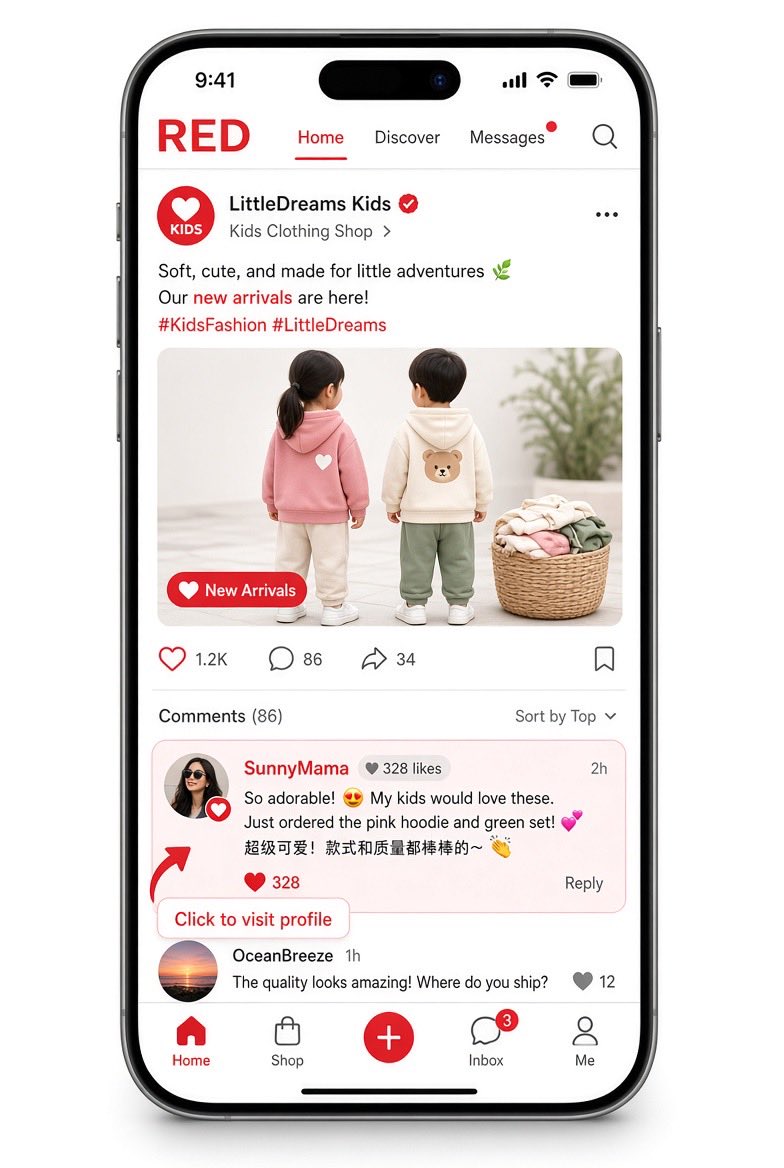
Here’s my own example. Over the past year, because I worked with different industries and spent time in supply chains, I picked up a lot of insider information. One day I saw a mom asking how to buy comfortable, well-fitting clothes for her child.
I left a comment sharing several practical tips that people in the industry actually use. That comment quickly became highly liked by many moms, and quite a few people messaged me to ask more. During that period I gained several hundred followers.
That whole year I posted fewer than 25 notes, and during that specific time I didn’t post any new notes at all. So I’m very sure the growth came from that one comment. My profile visits also increased clearly during that period.
It’s a small trick, but it works. Hope this helps.
My friend asked me: "How do you deal with people online who dislike you or are hateful toward you? Doesn't it make you sad?"
Me: "A little. Then I quickly ignore them, and block them while I'm at it."
My friend: "How are you so calm about it? Doesn't being criticized by strangers stress you out?"
Me: "Well, put yourself in my shoes. When I dislike someone, I haven't invested anything in them. So I shouldn't spend my precious emotions on a stranger who has invested nothing in me, either."
I need to save that energy for the people who love me, and the people I want to love.
We should be fair about it, right?
Yesterday, an ordinary creator messaged me asking for advice on how to run RED (Xiaohongshu).
She said she is a typical creative-driven person with many interests: photography, handicrafts (sewing, embroidery, beads), painting, outfits, journaling, daily plogs, writing, travel, and life reflections. She wants to post all of them. But she noticed that when she does this, the platform treats her account as “not vertical,” and her traffic is very unstable. She is currently preparing a personal handmade brand and wants to build a personal IP on RED, then drive traffic to the brand to get orders. Her own idea was to open a second account and only post handmade-related content there.
After listening, I told her that people like her are actually very suitable for content creation, but the real difficulty is that they have too many interests and struggle to stay consistent with one thing.
I gave her two directions:
The first is to find a reliable person to help supervise the IP system building (basically someone who keeps you on track). But in reality, such people are hard to find.
The second is more practical: don’t rush to build a personal IP yet. Rank all your interests and ask yourself one direct question — which one is most likely to make people place orders with you? You probably already know the answer. Then build a commercial closed loop around that one thing.
A closed loop means: the content you post makes people willing to pay for your product after watching it. You keep trying different methods until you go from the 1st customer to the 100th customer. Only then do you truly understand how a simple business system works. This process is tiring. It requires you to pay attention to small details every day and also needs mental strength. If you’re doing this full-time, I suggest giving yourself three months and focusing only on this one thing.
She was quiet for a moment, then said she had already thought about it — the one most likely to generate orders is handicrafts. But she was worried that if she only posts about that, the account would become boring and she would lose other parts of herself.
I told her she could split it like this:
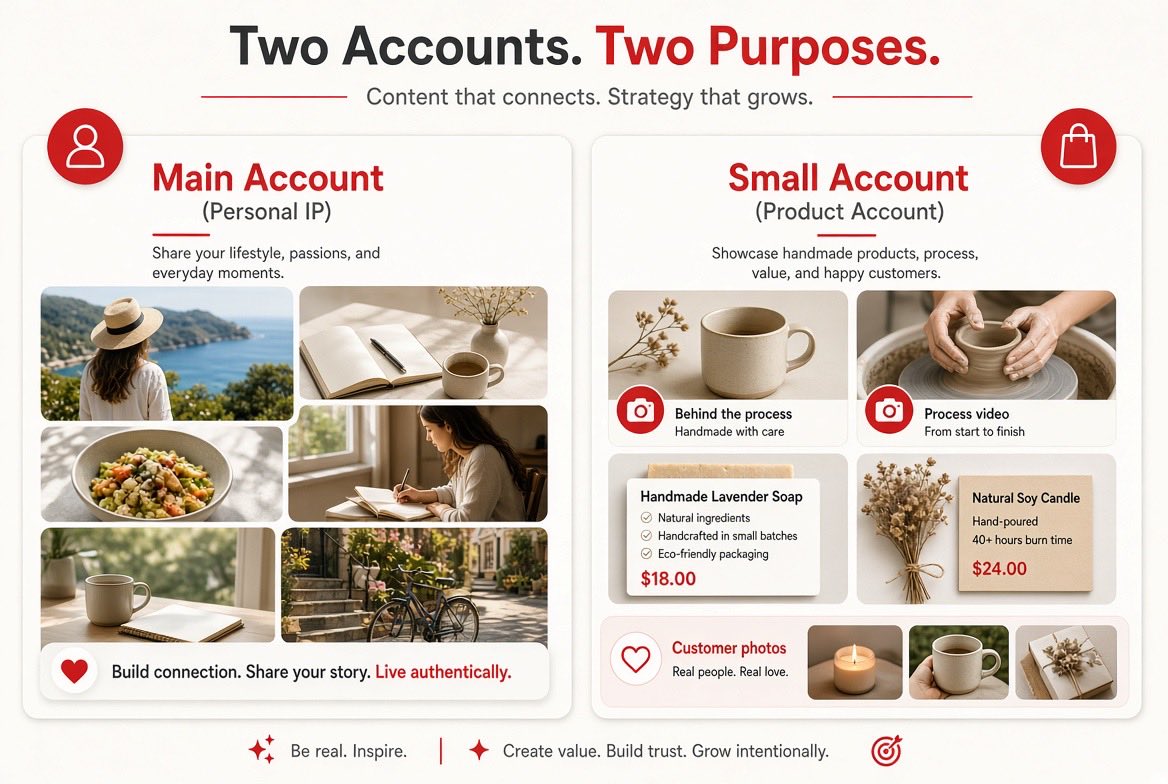
Keep the main account as “you.” You can still post photography, daily life, thoughts, and occasional crafts. Let people like you first.
Use the small account purely for the handmade brand. Only post the making process, finished products, pricing, how to order, packaging, and customer photos. The job of this account is not to be likable — it’s to sell.
The main account can occasionally mention the small one softly, but eventually the small account needs to convert on its own. Don’t put all your hopes on the main account.
She then asked: if I want to sell to foreigners or overseas Chinese, what should I pay attention to?
I told her that foreigners are usually more interested in the process than just the final product. So film more of the making process. Write captions in Chinese + simple English. Clearly state which countries you can ship to and roughly how long it takes. Price in USD, or clearly write that worldwide shipping is available. Most importantly, don’t aim to get big at the beginning. First get the first 20 people to actually pay. Follower count is vanity; orders are real.
After the conversation, I was also thinking: the reason people like her often get stuck on RED is not because their content is bad, but because they keep trying to express all their interests at once, and end up going deep on none of them. Choose one thing that can sell, run the closed loop first, then slowly bring the other interests back. That’s usually more stable.
@Amit_Dobal14 I isolate AI-generated touchpoints via A/B testing. The core metrics I watch are CAC, activation, and cohort retention, to gauge AI’s real impact.
Day 2 on X 👋
I'm Connor. 5 years in social media, now working on AI marketing & product growth.
I'd love to meet friends from every country who are learning AI or already building products with it.
Say hi and drop what you're working on below 👇
@Serin10212721@uriel_builds@X I’d suggest starting with customer pain points first. Master ICP, value prop and positioning before touching channels and distribution.
Signal is a strong option if privacy matters most — fully end-to-end encrypted, no ads, and simple group chats that feel less overwhelming than Discord and less corporate than Slack. It’s widely available in the US and more private than WhatsApp or iMessage.
Downsides: groups are smaller (not ideal for very large communities), and it lacks the channels/rooms structure of Telegram or Geneva.
Geneva is still great if you want more community features (rooms, events, voice). Telegram if you need scale + organization. Signal if privacy is the top priority.
@gaooofy I lean more toward positioning and user research. Distribution is important, but solid positioning and user insights lay the foundation first.
🚨About Gap: Young Friends, Let’s Stick Together
I think most of us have felt worn out at work: out of place, unrecognized, unseen, or even put down and dismissed. It drains us physically and mentally. We start out full of drive, only to burn out little by little. Eventually, we choose to take a gap to catch our breath.
Having worked for roughly six years and taken three gaps myself, I’d like to share a gentle message to anyone who resonates with this.
(1) Let go of chasing approval from your managers
From my experience, the generational gap can be nearly as wide as a class divide. The term “generational exploitation” is often talked about these days, and I know exactly what it means. I don’t want to stir up conflict, so I won’t name specific generations. Still, if your manager is from a vastly different generation and has already built wealth, chances are they cannot empathize with you. They carry the mindset of a survivor who got lucky.
(2) Shift your focus back to yourself
Young people, learn to trust and validate yourselves unconditionally. Even if we haven’t accumulated wealth or built extensive networks yet, our open minds and capacity to understand and empathize with one another are our most precious assets for the future. No matter what, trust yourself and lift each other up.
I once had an older colleague say to me, with a hint of smug resignation: “Your generation has no opportunities left.” He was referring to missing out on the real estate boom.
I told him opportunities will still come. He looked confused and asked, “What kind?”
I said I don’t know yet, but I will find out in time. That, I believe, is the precious imagination he will never possess.
(3) See one another, and stand united
Young friends, we can stop craving validation from those who already hold advantages, and start seeing each other instead. We have the highest average education level, awareness and empathy of any generation before us. Our existence is valuable in itself; it is beautiful in itself. We can explore ways to collaborate with one another. I will keep thinking about this, such as skill swaps.
And maybe we can start simply by encouraging one another.
A late-night rambling thought. It got me fired up as I wrote.
If you need some encouragement, leave a comment. I’ll send you a warm hug 🤗
Hey Bella!
It doesn’t try to scare people off cigarettes. It makes “I didn’t smoke today” visible, and worth something.
You check in once a day. A clock runs either way, but your rank only moves if you actually tap it — people who quit the same day can see a miss. Early ranks come fast, because that’s when most people relapse. The home screen turns it into cigarettes you didn’t smoke, money you kept, and a one-tap log for when a craving hits.
There’s a recovery page, but it’s a timeline, not a checkup: taste and oxygen come back in days, heart disease and cancer stay near zero for years. And at 11pm you post to strangers on the same day, not your friends. They answer. A couple of books in the feed do the rest — they argue willpower alone fails, so the app counts the days and the book changes why you wanted one.
Happy to show you a build when it’s a bit less rough .