@epargnantlibre Tout à fait d'accord pour le Warning.
En lien une explication du système Révolut.
C'est bien expliqué et pas à charge, assez sobre...
https://t.co/uQkGMzhiBd
Breaking - Scientists have discovered a technology that turns plants into highly nutritious protein without the need for factories, synthetic chemicals, or seed oils.
@MarsaultBreum Pour avoir vu le phénomène amplifier, années après années, dans les "quarchiers" nantais, j'en ai conclus que c'est une forme de domination. Elles vont chercher une supériorité mythifiée avec des plus tartes qu'elles, en acceptant les codes.
In 1994, Fidel Castro's government did something no Marxist textbook prepared anyone for. It legalized the U.S. dollar, the currency of the imperialist enemy, and built a parallel money around it called the convertible peso, or CUC. Cubans now lived under two currencies: the worthless national peso (CUP) they earned in state wages, and the CUC they actually needed to buy anything worth having. A doctor pulling 20 CUP a month and a taxi driver pocketing CUC tips occupied two different economic universes. You can guess who ate better.
Think about what a dual-currency system confesses. A government that claims to abolish markets and prices still cannot escape the fact that its own money is garbage. The CUP did not buy soap, beef, or working appliances at any reliable rate, so the regime created a second money pegged to the dollar to capture the tourist trade and remittances from Miami. The state needed hard money it could not print at will. Socialist planners cannot calculate without real prices: this is the discipline Mises described in 1920.
You cannot run an economy on slogans. You run it on prices, and prices require honest money and private property. Castro abolished both and then spent decades quietly importing the dollar's price signals through the back door because his planners were flying blind. The CUC was a parasite feeding on Federal Reserve credibility, which tells you the planned economy could not generate a unit of account anyone trusted.
The system limped on until 2021, when the government finally killed the CUC under the "Tarea Ordenamiento" unification. The result was instant. Inflation tore through the island, the black-market dollar exchange rate exploded past 300 CUP, and shelves emptied while the state printed pesos to cover its deficits. Unification removed the borrowed crutch and let the patient collapse.
Cuba spent 27 years admitting that a worker's salary was a fiction and that survival depended on touching the enemy's money. Socialism filed its own bankruptcy paperwork in two denominations.
En 2004, le Dow Jones incluait : General Motors, Eastman Kodak et AT&T.
En 2026 : Nvidia, Amazon, Apple, Microsoft et désormais Alphabet.
En 22 ans, l'indice a effacé l'industrie lourde et les télécoms traditionnels pour devenir un indice tech à dominante IA.
C'est la photographie la plus claire de la mutation de l'économie américaine.
D'ailleurs c'est... assez troublant de comparer ça avec l'Europe.
- En 2004, l'équivalent européen du Dow (le CAC 40) contenait déjà des géants : Total, LVMH, L'Oréal, Sanofi.
- En 2026 : Total, LVMH, L'Oréal, Sanofi. 😅
L'indice américain a subi une révolution sectorielle complète en 22 ans alors que l'indice français ressemble au même film avec les mêmes acteurs...
L'Europe a (si on est gentil) optimisé ce qui existait. Pendant que l'Amérique a inventé ce qui n'existait pas encore.
Le peuple comme limite : démocratie, immigration et souveraineté populaire.
Rappel de notions connues à l'occasion de la votation (perdue) en Suisse qui proposait de limiter la population helvétique à 10 millions d'habitants et pour répondre à quelques bêtises entendues ici et là, à propos de la question de la remise en cause d'une naturalisation, dans le contexte d'une politique de remigration.
Si la démocratie est le pouvoir du peuple, par le peuple et pour le peuple, les membres de l’exécutif ou le personnel d’État ne peuvent prétendre en modifier la substance, car cela reviendrait à altérer simultanément le donneur d’ordre, la mission et le mandat. Pour que le processus démocratique demeure légitime, ils doivent au contraire veiller à une forme de sanctuarisation du peuple. Toute transformation significative de la population - et, par là même, du peuple et de ce fait, de sa volonté - doit être préservée de toute manipulation. Seul le peuple, directement là où il est constitué politiquement (c’est-à-dire à partir du premier échelon d’expression démocratique), peut accepter ou refuser ce qui est susceptible de le transformer et encore, dans des conditions qui engagent et protègent les générations. Les membres d’une communauté politique ont le droit de contrôler qui y entre, car le changement de nature de la substance, du corps du peuple, détermine le « nous » démocratique. Comme l’a montré Hannah Arendt, toute fondation politique institue un peuple spécifique ; altérer artificiellement ce corps politique menace la liberté et la pluralité. Le peuple est le pouvoir constituant originaire ; les institutions, en tant que pouvoir constitué - dont l’exécutif -, ne peuvent jamais empiéter sur lui (Sieyès).
La souveraineté populaire est inaliénable, indivisible et imprescriptible : le peuple en est l’unique titulaire, tandis que le gouvernement (l’exécutif) n’est qu’un mandataire chargé d’exécuter la volonté générale. Si ce mandataire modifie le corps même du souverain, il rompt le contrat et détruit sa propre légitimité ainsi que celle de ses décisions. Le retour explicite de la volonté populaire peut alors constater cette rupture et, conformément aux principes démocratiques, juger comme nulles ou illégitimes certaines des mesures qui en découlent - y compris certaines naturalisations. Ce pouvoir de révision n’est pas une menace pour la démocratie, mais l’expression de sa logique la plus profonde : la capacité du peuple à se réapproprier son pouvoir constituant et à corriger les usurpations du pouvoir constitué. S’il est donc légitime en principe, ce pouvoir de révision peut être modéré par l’appréciation de la volonté générale dans un contexte politique donné.
Most of the West was wrong about Russia.
You should have listened to voices coming from Poland…
There is one other thing most of the West doesn’t understand:
Communism.
Many in the West think it is just about the abolition of private property.
It isn’t.
That is just one of its visible consequences.
Most in the west do not realize the perniciousness of communism – again, you should listen to those who experienced it first hand and try to understand it on a deeper level:
Communism is about distorting reality through lies, propaganda, and the systematic corruption of truth.
It is about demoralizing both individuals and entire societies – and this is done using the most insidious means: pitting people against each other, inciting resentment and hatred, and practicing negative selection – the systematic promoting of the least honest, most corrupt and most immoral to positions of influence and power.
It is about destroying nations from within.
Ultimately, it is about the concentration of absolute power.
Communism is a cancer on every society that it touches.
A hostile civilizational force – an enemy civilization in fact – destroying people, nations and all the value-creating and life-enhancing structures in between.
And post-communism is almost just as bad – keeping most of the original habits and pathologies under a veneer of lies…
@PierreLepel@TribuneDimanche Rappelons-nous, il y a quelques années, il a commit un livre "les enfants du vide".
Un pensum fait de généralités sociétales.
🇵🇱 🇩🇪 🇮🇱 🇺🇸
A Pole / Catholic victim of the German concentration camp tells the truth about Auschwitz.
🎤 You are a Catholic and you were in Auschwitz is that correct?
,,Yes, that is true, so what? " - Michał Ścisłowski.
🎤 Which number is that?
,,119431" - Michał Ścisłowski.
,,Ladies and gentlemen, as we know, the Auschwitz camp was formed by Germans in June 1940. The first transports that went to the Auschwitz include only Polish Christians. Jews arrived in the second half of 1942 and they have always been directed to Birkenau camp - "Brzezinka" in Polish. It is 3 km from Auschwitz which Germans called "Stammlager". Stammlager Auschwitz was exclusively for Poles.
There were very few jews there but whoever was from the jews was always on an executive position. Because the Germans' tactics have always been such as to use Poles against jews and jews against Poles. All shipments that have been in half wiped out it was in Birkenau, because in the Birkenau there were 5 crematoriums and in Stammlager Auschwitz there was only 1 crematorium, very small one and there were wiped out only Poles in 1940 and 1941.
So please do not be mistaken that jews were in Auschwitz. Jews were always transported to Birkenau and us Polish Christians they always keept and there was always more of us Polish than jews.
After all it is misleading and it is such an unfortunate thing that the jews here have more money and have connections to do incredible propaganda and this is an absolutely impossible thing, enough of this lie for God's sake.
Stand up Polish people and tell the truth to the Americans because they are total dumbasses, they know nothing" - Michał Ścisłowski.
🎤 Why do you think that Americans believe that in Auschwitz only the jews were dying?
,,Because all jewish transports went to Birkenau, not to Auschwitz. This is a mistake. They say Auschwitz because Germans at the end of 1944 they began to use a nomenclature Auschwitz 1, Auschwitz 2, Auschwitz 3 etc. So Birkenau they named Auschwitz 2 - the second camp and that's why jews impersonate and say Auschwitz. They say that they were in the same in Auschwitz but this is an unfortunate thing because we know it very well that all gas chambers were in Birkenau and not in Auschwitz" - Michał Ścisłowski.
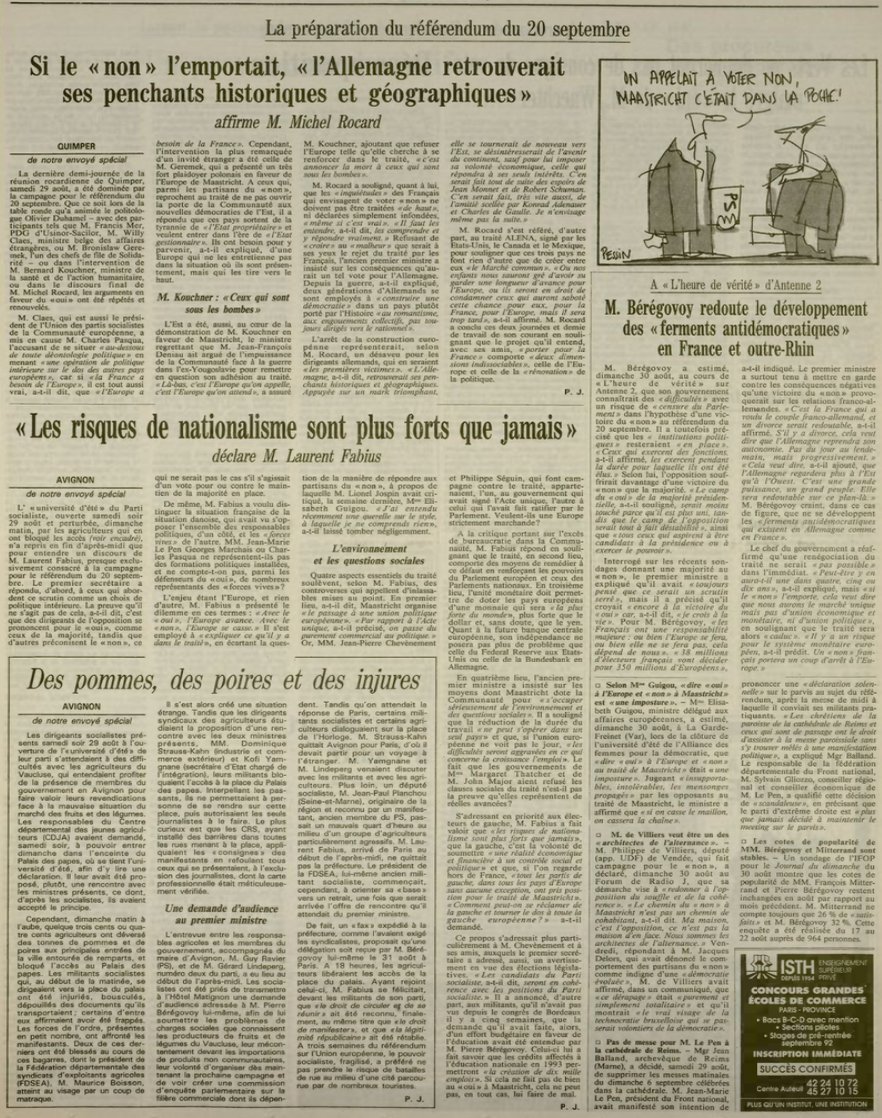
Voilà le chantage émotionnel auxquels les Français ont été soumis lors de la campagne sur Maastricht, ne pas voter "oui" c'était faire revivre le nazisme...
La rhétorique du "oui" était largement basée sur ce qu'on appellerait aujourd'hui des fake news et de la désinformation
Dès lors que le clivage majeur de la vie politique porte désormais sur le rapport à la mondialisation dans toutes ses composantes et que le macronisme est radicalement favorable auxdites composantes (liberté de circulation des capitaux, des biens, des services ; flux migratoires ; institutions supranationales et normes qu'elles produisent), les macronistes ne sont pas au centre du spectre politique.
Ce sont des globalistes jusqu'auboutistes.
Notre monde, depuis 50 ans, est un peu résumé par cette histoire : un magnat américain de l'immobilier devenu Président en trompant son peuple, auteur de "L'Art du deal", fait assassiner, pour le compte d'un suprémaciste israélien, un dirigeant iranien philosophe, qui a écrit « La méthode mathématique dans la philosophie de Kant », « La physique et les sciences exactes dans la philosophie de Kant » ou « Raison et tranquillité dans la gouvernance ». Le tout, avec le soutien de tout ce que l'Occident compte de hordes de larbins malins, enragés et incultes.
Les bouches de l'enfer sont ouvertes. Elles se refermeront.
For over 250 years the Catholic faith in Japan survived without priests, churches, or the Mass. From the persecutions beginning in 1614 until the 19th century, the Kakure Kirishitan (“Hidden Christians”) preserved the faith across seven generations. They baptised their children, taught the creed, honoured Our Lady, and prayed together in secret. When missionaries finally returned, they discovered whole villages still Catholic. It became known as the “Miracle of the Orient.” What sustained them? Well, we know it wasn't institutions, buildings, or even visibility. Faith, memory, family, and the quiet confidence that Christ had not abandoned His Church. Many Catholics today feel we are living through a moment of confusion and trial in the Church. But history reminds us: the faith has survived far worse. Christ did not promise comfort. He promised fidelity. “Where two or three are gathered in my name, there am I in the midst of them.” (Matthew 18:20) The Church has endured persecution, exile, corruption, and collapse before. She endures because Christ remains with His people, even in the darkest hours. The Japanese Christians prove it.
@Sciences_Avenir Quelle blague, j'ai planté des arbres, en famille, toute ma jeunesse, je ne m'y retrouve pas !
Détail important, au fait... quelles essences forestières sont plantées là ?
🔊 On a eu Tronçais, nous avons désormais Tronché !