My bet in the AI era is that learning the basics of math will matter more.
I love the approach described by @antoniolupetti here: memory, repetition, practice, intuition.
Funny enough, AI also helps me turn what I learn into highly visual notes that make things stick. 👇
You can also set a custom history cutoff with `--history.chain <block number>:<block hash>` for `geth prune-history` or snap sync, which skips chain history before that block!
There are a thousand ways to tell the story of Devcon.
We want to see yours 🤳
Introducing the Devcon 8 Creator Fellowship: 10 creators will join us in the lead-up to Mumbai to make stories that spark curiosity, explain big ideas, and bring new people into the Devcon experience.
No single format. No single style. Just your creative lens.
Selected Fellows receive one free Devcon ticket, exclusive perks, recognition across Devcon channels, and more.
Applications are open now through September 20 ↓
I have been accepted to join this year's frontiers conference organized by paradigm.
Looking forward to meeting you all at San Francisco.
@paradigm@gakonst
The most expensive bug in AI infra isn't a crash
it's the GPU that keeps running after the crash.
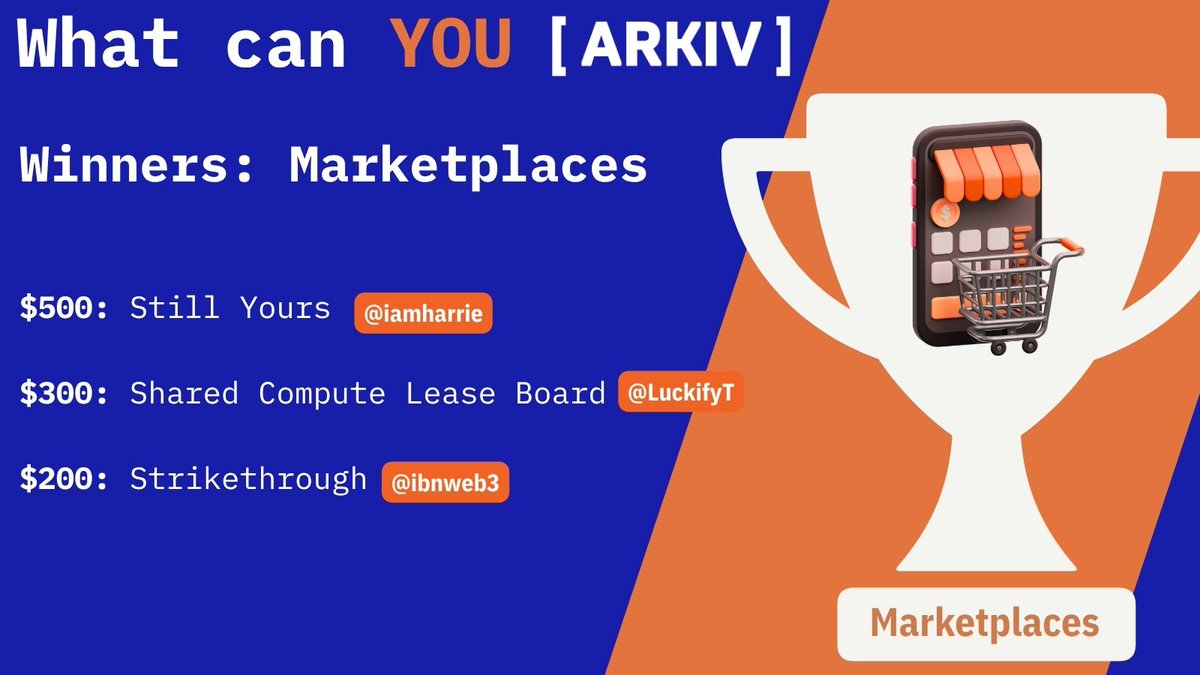
Shared Compute Lease Board: leases that die when the agent dies. Now shipping it
Built on @arkivnetwork@SantiagoDevRel
One positive consequence of all the recent detailed thinking about transaction formats - not just 8141, also "future of state" discussions eg. UTXOs, PBT, keyed nonces, and also recursive STARK mempool - is that we have a much more explicit understanding of how transactions have "actions" and "dependencies", and we can engineer around optimizing the two separately.
An action is an effect that a transaction has.
A dependency is a fact about the transaction and/or the state that must be true for the transaction to be valid.
eg. a signature is a dependency, a Merkle proof of a UTXO is a dependency, a ZK-SNARK (or STARK) is a dependency, a call that sends ETH is an action
Dependencies can be processed in parallel. Dependencies that involve state can be reasoned about by a mempool, especially if the specific state accessed is statically declared. Dependencies that are pure (no state calling allowed) can be processed once at the mempool layer and never need to be processed again - and potentially even replaced with a STARK verifying them, allowing not just execution but also data to be elided.
In principle, dependencies and actions can all be expressed as calls (if needed, calls to precompiles). This would make the transaction format itself very bare-bones and minimalist (a list of calls, flags for the type of each call eg. dependencies would be static or pure calls, and origin, nonce, etc) and allows maximum cross-compatibility even if different EVM chains have different features.
In 2015-era Ethereum, thinking explicitly about these differences was not very important: execution was execution, there were few enough transactions that we could process them all serially, and single-key ECDSA accounts were good enough for everyone.
Ethereum's current scaling strategy, however, requires moving beyond that paradigm. Ethereum is beloved by many developers because the execution and state model is so dynamic and flexible. But dynamic and flexible is not friendly to scaling. Fortunately, >90% of Ethereum's activity by volume does not require anything dynamic and flexible. So, we require contracts, accounts and transactions to more explicitly specify what is dynamic and flexible and what is more statically-analyzable but more restrictive, and more statically-analyzable things get the lowest gas cost and thus scale the most. Effectively, learning from the best of both the 2015-era Ethereum model and a more Bitcoin-like model (reminder: Bitcoin has had what I call account abstraction since the beginning), and making a mixture of both (really, the full spectrum between both) available, with gas costs appropriate for the level of scale involved.
New state types, the recursive STARK mempool, keyed nonces, etc all go in this direction.
This all relates to transaction types, because a general-purpose transaction type is a very natural interface layer on top of which all of this can be implemented, and the current thinking around the EIP-8141 transaction type is going in this exact direction that is friendly to these kinds of future generalizations.
So in that sense, 8141 done well is not just a culmination of 10 years of account abstraction work, it's also preparation for the next few years of responsible decentralization-friendly hyper-scaling.
FairRail has officially been submitted.
my take on Sustainable Liquidity & MEV Protection on Uniswap v4:
⚡ Match compatible intents before they hit the AMM
⚡ Auction residual MEV competitively
Match privately. Auction MEV. Reward LPs.
@Uniswap@AtriumAcademy
Fingers crossed 🤞
From an idea to a win 🏆
Shared Compute Lease Board
@arkivnetwork's Ideathon.
This one means a lot
Now, we build.
Shared Compute Lease Board, chapter two starts now
@arkivnetwork@SantiagoDevRel
BIG GIST!
13 teams. 13 ideas. 10 minutes each to make their case.
Friday was Pitch Day at the @QuaiNetwork × @blippay Buildathon @blockfuselabs.
Here’s what the builders put forward. 🧵