The most important skills for using AI coding agents effectively. Presenting the AI Engineering Skills Map for using coding agents. https://t.co/GrEw7wG5Wz
AI has eaten tactical programming, so juniors need strategic experience in a low-blast-radius environment.
Here's one way to make that happen:
1. Give them responsibility over a large chunk of work
2. That work must be low stakes, but not no stakes - ideally an internal tool (AI makes these kinds of projects easy to justify)
3. Let them move fast and fail fast. Give them the same AI budgets as your senior engineers.
4. When failures happen, work with them to figure out what went wrong (learnings can also be pulled upwards into the rest of the org)
In a sentence:
Hire juniors. Give them work that matters. Watch them fail. Pick them up.
Tactical vs Strategic Programming, and why I'm nervous for juniors:
Good programming involves a mix of tactical and strategic decision-making:
- Tactical: on the ground, short-term. The soldier doing the fighting.
- Strategic: high-view, long-term. The general planning the war.
You need to be a tactician to write good code. To choose the right syntax. To figure out the file structure. To figure out how best to test your changes.
But you need to be a strategist to build code that lasts. To design the architecture. To automate away problems. To think beyond today.
Agents have eaten the tactical part of programming. When you can pay below minimum wage for code, there's no point going into the trenches yourself.
But AI cannot code strategically. Agents need someone at the top of the pyramid to tell them what to do. They need oversight.
So, a developer's day-to-day job has become 100% strategy. Long-term thinking, all the time. (maybe this is why I'm so tired all the time now)
If you identify as a tactical programmer - a code monkey - then you are out of luck. The job has changed.
Personally, I like it. I always preferred thinking strategically about code. If you asked me what my job was about, I'd say 'building apps', not 'writing code'.
But what makes me nervous is that we've pulled down the only bridge that brought juniors into the industry.
We used to train juniors like this:
1. Give them only tactical tasks
2. Let them build up their strategic experience slowly
Eventually, they are a good enough strategist that they are no longer a junior.
But what happens when all tactical code is written by AI? What is the point of a junior?
We obviously need juniors. We need new lifeblood coming into the industry. We need to leave paths open for extraordinary hires to enrich our companies.
But how do we train them? How do you train strategic thinking?
These are the questions I'm thinking about. I'd love to know your thoughts.
AI red flags:
- "My marketer agent just finished a meeting with my chief of staff agent - just 2 of the 127 agents on my books"
- "The agent did it, not me"
- "I've invented a coding language for agents"
- "I've got 250K tokens in my context before I send a message, is that normal?"
- "Opus 5 is way dumber today than yesterday, secret nerf?"
- "Peasants, gaze upon my 600-line CLAUDE.md, my results are incredible"
- "LOOK WHAT OX ALPHA JUST ONE-SHOTTED, SOFTWARE ENGINEERING IS DEAD"
- "All human knowledge is worthless now"
- "I turned 600 coding books into a skill"
- "Coding is solved. Bugs are not solved"
Ya hablé del burnout, pero hay algo peor:
Tengo 19 años, programo desde los 13 y la cabeza siempre repite que soy un fraude.
El síndrome del impostor en 2026 es durísimo:
💸 Abres X y parece que todos facturan $10k o montan una startup en un fin de semana.
👎 Sientes que tus proyectos son mediocres.
🛠️ Te da culpa no saber 8 frameworks de memoria.
Las estadísticas dicen que MAS DEL 60% de los desarrolladores sienten esto recurrentemente, sin importar si llevan 1 o 10 años programando.
La realidad es que nadie tiene todo resuelto.
Dominar tus bases, resolver problemas reales y seguir enviando código ya te pone por delante del 90%.
🥇Construir con miedo sigue siendo construir.
Cada cuánto les pega el síndrome del impostor y qué hacen para salir de ahí?
We need a concept like "grep hygiene"
I.e. when your coding agent searches for a concept, it should receive relevant results
Not a huge sludge of specs, plans, and old research docs
So many codebases have the grep hygiene of a compulsive hoarder
Setting up Pi as your daily coding agent? Start with 𝘁𝗵𝗲𝘀𝗲 𝟭𝟬, not all 5,000+ packages:
• 𝗣𝗼𝗻𝘆𝘁𝗮𝗶𝗹
Pushes the agent to reuse existing code, stdlib, and dependencies first, avoiding duplicate work and overengineering.
https://t.co/9QJ8fzM0g4
• 𝗽𝗶-𝘄𝗲𝗯-𝗮𝗰𝗰𝗲𝘀𝘀
Adds web search and access to pages, GitHub repos, PDFs, and videos. You can also connect your own SearXNG instance.
https://t.co/D4NL3zBxCV
• 𝗽𝗶-𝘀𝘂𝗯𝗮𝗴𝗲𝗻𝘁𝘀
Delegates focused research or reviews to different models in parallel, then returns the results to the parent session.
https://t.co/ntrHMOj9T3
• 𝗽𝗶-𝗳𝗳𝗳
Pre-indexes files and their contents, then uses fuzzy matching, frecency, and Git status to speed up search in large repos.
https://t.co/RdawkblFfg
• 𝗽𝗶-𝗰𝗼𝗻𝘁𝗲𝘅𝘁-𝘃𝗶𝗲𝘄
Estimates how much context is being used by the base prompt, tool definitions, extensions, and messages.
https://t.co/8agSG4taZn
• 𝗽𝗶-𝗺𝗰𝗽-𝗮𝗱𝗮𝗽𝘁𝗲𝗿
Discovers MCP tools and starts their servers only when needed, so Pi doesn't load every tool schema at startup.
https://t.co/YxEbTAhJ8y
• 𝗽𝗶-𝗯𝘁𝘄
Lets you ask a side question while the agent keeps working, without adding that detour to the main conversation.
https://t.co/lZLfzp3IEh
• 𝗣𝗹𝗮𝗻𝗻𝗼𝘁𝗮𝘁𝗼𝗿
Lets the agent draft a plan, then gives you a browser UI to annotate and approve it before execution.
https://t.co/Fdbg6sSuD7
• 𝗽𝗶-𝗴𝗼𝗮𝗹
Keeps one goal running across turns until it completes, pauses, or reaches a safety limit.
https://t.co/gcFb3oHcaC
• 𝗽𝗶-𝗱𝘆𝗻𝗮𝗺𝗶𝗰-𝘄𝗼𝗿𝗸𝗳𝗹𝗼𝘄𝘀
Lets you orchestrate model routing, parallel subagents, worktree isolation, cross-checks, and recovery in JavaScript.
https://t.co/i1aDpydahp
My default four would be pi-web-access, pi-subagents, pi-fff, and pi-context-view. I’d add the rest project by project, then decide whether they deserve a permanent place after a few repos.
Thank you! Pi is many DeepSeek researchers and developers favorite daily drive.
DSH reused Pi's LLM adaptor package for connecting to non-DeepSeek models and it was a great experience that just work.
Excited to join the global Open Source agent harness community!
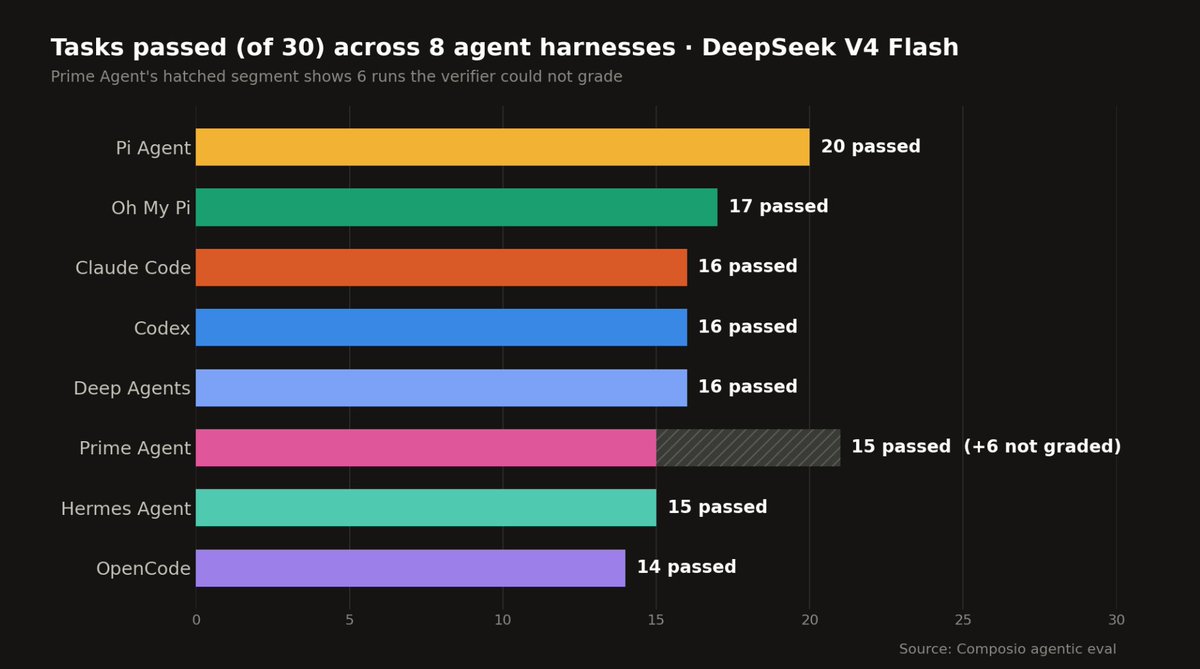
Here’s how the 4 new harnesses scored:
- Pi Agent passed 20 of 30 tasks.
- Deep Agents (by LangChain) passed 16 of 30 tasks.
- Hermes Agent passed 15 of 30 tasks.
- Prime Agent passed 15 of its 24 valid runs (6 runs were excluded; more on that later).
Here are the final scores across all 8 harnesses (we covered Codex, Claude Code, OpenCode, and OMP in a previous thread a few days ago):
https://t.co/Fojx3ykuZs
We ran DeepSeek V4 Flash through 4 more agent harnesses (Hermes Agent, Pi Agent, Prime Agent, Deep Agents) on 30 challenging agentic tasks.
Pi Agent was the cheapest harness and passed the most tasks 🧵🧵
I’m significantly older than you. I started coding in the late 60s. My current strategy is to not read any of the code written by my agents. That’s the only way I can take advantage of their productivity. What I do instead is to surround the agents with extreme constraints. Unit tests, gherkin tests, QA procedures, quality metrics, mutation testing, test coverage, and a plethora of others. In the end, I have very high confidence in the code they produce because they’ve had to run the gauntlet of all of my constraints and tests.