I had 400+ half-finished notes rotting in my Obsidian vault. MiniMax M3.1 Flash turned them into a working wiki in one evening
M3.1 Flash is the official release of "Space Bunny", and it's even more
powerful.
It was the stealth model I was testing on OpenRouter, where it held #1
for 10 days straight
ran mcode init first, so it read the whole vault and wrote its own guidance file before editing a page
then gave it the vault plus a doc on how Karpathy structures his second brain, ran exec with full permissions and left the room
> read every stale note before changing anything
> built entity pages and cross-linked them with [[wikilinks]]
> kept an index page and an append-only log of every action
> flagged notes that disagree, in both pages and in the log
median output speed is 170+ tok/s, so the log never stalls
73.7% on DeepSWE v1.1, right next to the top coding models
$0.15 per million input tokens, $0.60 output, and agent tasks cost 70% less than on the MiniMax model before it
still read the diff by hand -> the wiki held up
> the line that stuck with me: Obsidian is the IDE, the LLM is the programmer, the wiki is the codebase
mcode init
mcode exec "process my vault against my second-brain schema" --permission full --cwd ~/vault
@todddesil Oversubscription tells you demand for the deal, not whether the price makes sense.
A crowded IPO can still be a bad investment if the valuation already assumes too much. Popularity is a signal. It isn’t a thesis.
At 2:13 a.m., Maya’s AI dashboard showed a $4,860 profit.
ии
She almost sent the screenshot to a friend.
Then she remembered: the account had started with $100, and she hadn’t connected it to an exchange.
Maya was 22. She’d spent the weekend using ChatGPT to help write a trading simulator. On her screen, 200 agents were scanning prices, proposing trades, and checking one another’s decisions.
She’d given them a fake balance and a recorded market feed.
The profits were supposed to be imaginary. The calculations were supposed to be correct.
She opened the first winning trade.
Buy for $98.40. Sell for $101.10.
Except those prices came from different moments. Her code had paired an old buy price with a newer sell price, then counted the difference as money earned.
The agents kept finding the same “opportunity.”
Every green approval made the dashboard look more convincing.
Maya asked ChatGPT to help trace the timestamps. After she fixed the bug and ran the simulation again, the balance finished at $93.18.
She stared at it for a while.
Then she sent her friend both screenshots.
“I was going to show you how much it made,” she wrote. “Look how long it took me to check.”
Fictional story. All figures are invented. The video is a visual concept, not a working trading system.
IMAGINE A 22-YEAR-OLD WOMAN BUILDING A TRADING BOT WITH CHATGPT IN ONE WEEKEND.
A laptop. An iPad beside it. A $100 simulated balance.
Here’s the hypothetical setup:
→ ChatGPT helps her write and debug the code.
→ An exchange API supplies live market data.
→ The software monitors 20 trading pairs for potential price gaps.
→ A dashboard records every simulated trade, including fees and failed orders.
She starts with paper trading. Real money comes later, if the results justify it.
Because spotting a price difference isn’t the same as pocketing it.
A gap worth $0.40 might cost $0.55 to trade. An order might fill on one exchange while the other price moves.
That’s where the weekend prototype meets reality.
The interesting part of this scenario isn’t a screenshot claiming she turned $100 into $750,000.
It’s that she can use ChatGPT to help build a system, inspect its assumptions, and test whether her idea survives contact with actual costs.
The bot could run around the clock. It could also lose around the clock.
Would you trust it more because it made money on day one—or because you could explain every trade it made?
TWO TEAMS WORKED AT THE SAME STARTUP STUDIO. ONE BUILT A WEATHER CAT. THE OTHER BECAME HUGGING FACE, WHICH NVIDIA IS BUYING FOR $12.9 BILLION.
Investor John Borthwick tells the story in a new How I Invest Podcast interview. In 2008 he started betaworks, a startup studio. Its first accelerator camp ran on one thesis: people would soon talk to computers.
Hugging Face came in as a chatbot for middle schoolers. Betaworks built Poncho, a Brooklyn weather cat you could text for the forecast. By his account, Hugging Face reached about 200,000 active users and millions of messages. Then the transformer paper and BERT landed. The Hugging Face team had already started digging into how language models work, so they built an open-source version of BERT. The Poncho team kept polishing weather. He says Poncho was inches away from the same opportunity and never saw it.
The money mechanics are in the same talk. Betaworks moved to a normal venture fund structure in 2016 and is now on its third fund. Per him, two camps a year add about 20 companies at roughly 7 to 9% ownership, plus 8 to 10 pre-seed checks a year at roughly 3 to 5%.
His founder test is oddly simple. He asks why they named the company what they did. He is reading for an emotional link to the problem. “I found a domain” is a bad answer.
On AI, he says the cost of building technology is trending toward zero, and that founders used to be engineers in the code and are now steering agents and tools. He rates the founder higher against the product than he did 20 years ago.
My take: the Poncho story is the better lesson for anyone building with AI tools. Depth in one narrow area made Hugging Face ready when the technology jumped. Sticking to the same plan made Poncho miss it. The question worth asking every week is whether you are deepening what you understand or only polishing the same use case.
The interview is free on YouTube with under 2,200 views. Timestamps: 2:31 the name question, 11:40 how the camps work, 22:24 Hugging Face and Poncho, 1:04:36 his career advice (become a deep user).
Full interview: https://t.co/ClXLEK8Oii
Most AI writing doesn't sound robotic because of bad grammar.
It sounds robotic because it's too perfect.
Every paragraph is balanced.
Every transition is predictable.
Every conclusion sounds like a TED Talk.
Real people don't write like that.
They change their minds. They have opinions. They skip the obvious stuff. Sometimes one sentence says more than five polished paragraphs.
I took a basic human-writing prompt and rebuilt it for Claude.
The result is a writing framework focused on rhythm, personality, specificity, and actual editorial judgment.
Not random slang.
Not fake emotions.
Not deliberately broken grammar.
Just better writing.
The prompt is called THE HUMAN VOICE ENGINE.
And here's the funny part:
The more AI tries to sound impressive, the easier it becomes to recognize.
Maybe the next breakthrough in AI writing isn't sounding smarter.
It's knowing when to stop sounding like AI.
A lawyer who has worked on derivatives since 1985 literally explained why derivatives did not cause the 2008 crisis. It is not the product that broke the system. It is the mortgage loans, and a way of wrapping the same risk again and again.
Ed Murray started practicing in New York in 1985, the year ISDA, the swaps industry body, was founded. By 1994 he was its counsel. In 2012 he gave a Cambridge lecture with a blunt thesis: derivatives did not cause the crisis, but they made it considerably worse.
He starts with a baker and a farmer who agree today on a wheat price for delivery in nine months. That is already a derivative.
The BIS counted $601 trillion of notional outstanding at the end of 2010. Notional is the size of the risk being hedged, not the money at stake. The BIS put gross credit exposure at $3.3 trillion.
Where he says the damage came from: US mortgage loans nobody could repay, packaged into securities rated above AAA. Credit default swaps let the same portfolio be referenced again and again without moving any debt.
On Greece he argued that sovereign CDS exposure was small. The March 2012 settlement paid out $2.89 billion.
Why it reads differently this week. On October 15 Oracle's five-year CDS hit a record 288 basis points, and CoreWeave's went above 1,000, per market reports. Four tech giants spent about $170 billion on capex in a single quarter, and this week's Ezra Klein debate has a chapter called Debt-Fueled AI Buildout. When a CDS price is in the news again, his test applies: ask what the number measures before deciding what it means.
He is ISDA's own lawyer, and says so. His closing image is a hammer. It can build or it can kill.
The talk is free, and under 10,000 people have watched it.
Source: Cambridge Law Faculty, CC BY
https://t.co/Bjv7Rbkfub
Google Docs might have just become an AI workspace.
And I think people are seriously underestimating what just happened.
Claude now works directly inside Google Docs, Sheets and Slides.
Not “copy your document → paste it into AI → copy the answer back.”
Claude sits next to your actual file.
It can read what you’re working on, understand what you selected, and make changes directly inside it.
In Docs:
→ rewrite text
→ fix sentences
→ restructure sections
→ turn next steps into tables
→ propose edits you approve before they land
In Sheets:
→ write formulas
→ build pivot tables
→ create native charts
→ clean data
→ add tabs
→ even use Python for heavier transformations and write the results back
In Slides:
→ create new slides using your existing layouts and themes
→ check whether elements overlap
→ flag text that’s difficult to read
→ keep the presentation consistent with the existing deck
But that’s not the interesting part.
The interesting part is what disappears:
Copy.
Paste.
Upload.
Download.
Switch tabs.
Explain the context again.
Repeat.
For years, we treated AI as a destination.
You stopped working.
Opened ChatGPT or Claude.
Asked for help.
Then carried the output back into your real workflow.
That model is starting to die.
The next AI war may not be about who has the smartest chatbot.
It may be about who becomes the invisible intelligence layer inside the software you already use every day.
Docs becomes AI-assisted writing.
Sheets becomes AI-assisted analysis.
Slides becomes AI-assisted design.
And once AI can understand the file, modify it, use your connected context and continue working without forcing you to constantly move information between apps…
the chatbot starts disappearing.
That’s the bigger shift.
AI isn’t asking us to move our work into AI anymore.
AI is moving into our work.
And that may be far more disruptive than another benchmark win.
The question is no longer:
“Which AI chatbot do you use?”
Soon it could be:
“How much of your workflow still happens without AI?”
The hype is real! 🔥
The @pharos_network is fast approaching, and TopNod is celebrating in a big way. As their official wallet partner, we want to make sure you are geared up for the launch.
Secure your Pharos × TopNod Airdrop Chest now:
💰 Prize Pool: 50,000 $PROS
🎯 10,000 lucky winners get 5 $PROS each!
Claim yours before it’s too late 👉 https://t.co/8pNSdV7ihZ
Here is your fast-pass to "Stake before the Stake" 📍
Pharos is dropping 500 exclusive whitelist spots via @layer3 for sailors who move the fastest, to enter the Stake before the Stake: Pharos Genesis Stage
👇 Here’s why you don’t want to miss:
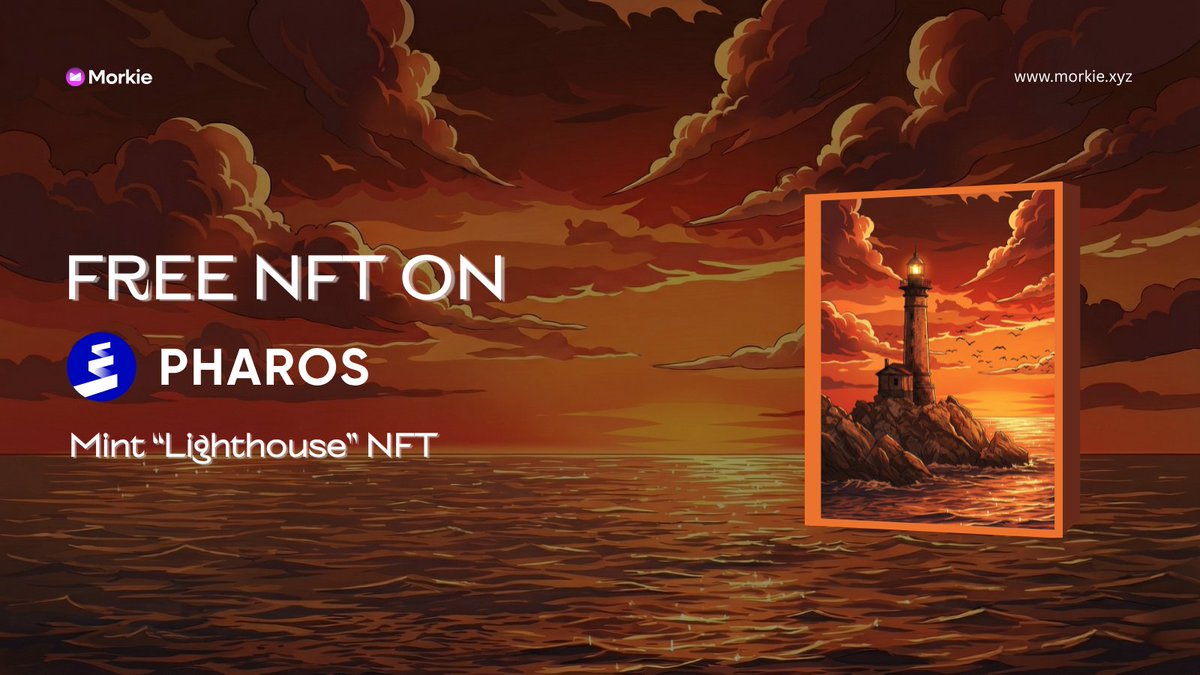
🌟Mint this NFT on @RobinhoodApp Testnet
💰Cost: $0
💵Funding: $5.77B
🪙Total supply: 9999
🗃️Limit: 1 per wallet
Steps:
🔗https://t.co/i4AIHMO6hx
✅Connect wallet
✅Switch network to Robinhood Testnet
✅Complete tasks
✅Mint NFT
✅Done
If you're short of funds, claim faucet here: https://t.co/WGha24upjg
This NFT was created to generate on-chain activity by minting it.
🤍Like
🔁Retweet
Coraluna is one of those projects where DeFi stops being noise and starts becoming infrastructure 🌊
Clear vision, well-designed mechanics, and a focus on real value — not hype.
If you’re looking for a long-term play, not a one-cycle pump, this one’s worth watching.
@0xCoraluna