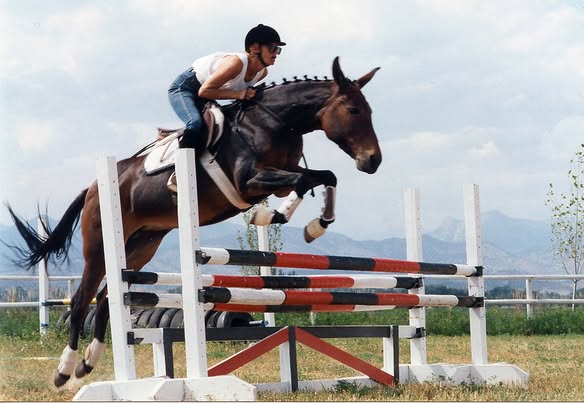
Official account for champion equestrian and mule and donkey expert, Meredith Hodges. Tweets about equine training for horses, donkeys, mules and other hybrids.
INSECT CONTROL (Page 85) Here is some information about insect control that you might find helpful! We worm our equines in January, March, May, July and September with Farnam Ivermectin and then break the cycle with Strongid in November to prevent internal worms and parasites. This insures that your animals are safe despite what your neighbors may be doing with their livestock. Fields and pastures should be harrowed in the spring and fall, and between hay cuttings. Keep all tack and equipment clean so it does not attract flies to your tack room and grooming area. Spray the tack room when you leave with a household flying insect spray for any residual flies.
1) First and foremost, a regular grooming schedule at least every other week and preferably
every week is essential for the hygiene and health of your equines. Regular grooming once a
week to remove excess hair, mud, etc. will eliminate places on the animal, including legs that
would be subject to insects laying eggs. If certain body areas begin to get sores, scabs, or
bumps, use Neosporin, or if they are severe...Panalog, also called Animax or Dermalone (by
prescription from your vet). Clean the eyes, ears and nostrils every time during grooming and
fly spray the hairs inside the ears for the best bug-block after cleaning.
2) We use Tri-Tech 14 by Farnam fly spray weekly for bugs and insects that can pester your
equine. This seems to be the best and longest lasting spray (Herbal remedies and fly
predators do not work as well!). Scrub flies and eggs from the legs, cover with Neosporin and
then spray for flies during grooming. Using Johnson's baby oil in the manes and tails helps to
keep the flies at bay and will also discourage other animals from chewing on them
3) Use fly masks for those mules and donkeys that have sensitive skin. Farnam Super Masks
will usually fit most animals. If you groom regularly and clean and spray the ear hairs, the
eared masks may not be necessary (I have never had to use the ones with ears). You can
find them in most tack and vet stores. Just make sure when you put them on that they will
come off easily if they were to get caught on anything.
4) Feeding the right kinds of feed for mules and donkeys. Animals are sweating toxins are more
apt to attract insects.
5) In order to keep flies and other insects under control, all stalls, runs and pens need to be kept
free of manure and debris daily. Barns should be cleaned periodically with disinfectant. Keep
all stalls, pens and sheds free of urine and manure (clean at least once a day, every day!).
This includes larger dirt pen turnout areas weekly. You shouldn’t need to use any PDZ or
chemicals at all if cleaned properly. For good drainage in stalls, we drill a 2’ x 4’ deep hole in
the middle of the stall and fill it with 1 ½” rock. Then we put down 4” of pea gravel throughout
the whole stall and cover with rubber mats.
6) Keep manure collection piles well away from the house and barns (We put manure into a
dumpster behind our hay barn and have it hauled away weekly). Contrary to popular belief,
the manure is NOT suitable for fertilizer unless it is properly composted and used for
appropriate crops. Equines consume weeds and poop seeds that will propagate weeds
anywhere that the manure is used.
7) Keep water sources clean. Check them daily, or clean as needed.
📷 Clean any manure from shed or stall walls daily. Power wash stall walls and alleyways as
needed.
9) Ceiling fans will also help a lot, both pointed into specific stalls and along the top of your barn
alleyways! Just be sure to check them regularly and clean them as needed to prevent any
spontaneous fires from dust gathering in them. Keep them running so birds will not build nests
on them!
10) Do not ever clip the hair inside the ears or muzzle hairs of the equines! Body clip only if you
are showing. Use blankets and fly sheets as needed. Their hair coats will insulate them from
the heat, cold and protect them from insects.
11) Do not clip the hair on the legs unless you absolutely must for showing! Lots of times, you
can get a clean look by using the clippers with the hair rather than against the hair on the
legs to maintain protection.
12) Keeping your fence lines free of weeds will also help enormously! Bugs and insects like to
live in those areas!
SO YOU THINK YOU WANT A MULE
MEREDITH HODGES - LUCKY THREE RANCH
• Where to buy a mule for you?
• What kind of experience do you have as a rider?
• What are your character traits?
• Learn how to select the right mule for you
• Talk to experienced mule people to assist you
• Learn how to evaluate the animal you are looking at
• Have a vet and farrier do exams on the mule
• The option of asking for a trial period with the mule
• Draw up a contract when hiring a trainer
Mule Talk is an Every Cowgirl's Dream production - https://t.co/Kthe8Qsg4m
https://t.co/5be8cVLuYc or https://t.co/4AfDGO5AhL
MAKE SURE THAT YOU HAVE AN ADEQUATE HOUSING FACILITY, THAT YOU ARE WILLING TO BE CONSISTENT WITH YOUR FEEDING & MAINTENANCE SCHEDULE AND THAT YOU CAN AFFORD THE EXPENSE ASSOCIATED WITH CARING FOR AN EQUINE!
CATTLE MULES (Page 20). On a ranch, it is paramount that the cutting and roping horses know how to humanely work cattle. Many have asked me if mules are as capable as cutting and roping horses, and the answer is a firm “Yes!” You can experience mules competing in all kinds of “cattle” classes (Cattle Penning, Working Cow Horse (Mule), Cutting, Team Roping and Steer Stopping) and precision ranch working classes (Reining and Western Riding) at Bishop Mule Days every year over Memorial Day weekend in May. These classes have very strict and humane rules to protect all involved. When seeking a mule with “cow sense,” find one that is bred from a particular breed of horse that is known to have this kind of “sense.” Many mules are actually afraid of cattle because they rarely get that kind of exposure. That doesn’t mean that they cannot learn to work cattle, but they probably won’t be as aggressive as the ones that actually have “cow sense” in the genes and bred from mares whose breeds excel in that skill. When routinely and sedately moving cattle from one location to another, you can sometimes pony your green mule along to get him used to the cattle work in a more calm setting. Mules learn their job quickly, but have as many different personality types as we humans do. Some are respectful when working cattle while others are not and they might go after the cattle with a vengeance. One of the most amazing things I did note during the roping classes is how mules can run down a steer every bit as well as a horse, but won’t generally stop as abruptly as horses do. Rather, they “feel” the steer (never calves in our Longears cattle classes) on the end of the rope and “give” a little bit when stopping them. They seem to know if they stop too abruptly, it will hurt the steer...and them, too! A hard jerk on the saddle could damage their spine. In a mule show, injuries are rare because of the strong sense of self-preservation in Longears. Have fun and learn more about our wonderful Longears and the different things they can do in the various sections under TRAINING and in the VIDEO ON DEMAND section on my website at https://t.co/Gb5UeOv2hK.
SO MUCH TO LEARN, SO LITTLE TIME. Like most people, I started off thinking that leaving equines to just be equines without human interference was the ideal. Oh, how they would just love to exist in a large plot of pasture to live out their days in leisure! I soon found out how deadly that could be to an equine. Equines in the wild will travel for miles, exercising and grazing sporadically, balancing their diet and exercising themselves. Since the majority of the world’s equines are not wild and can no longer run free (no more wide-open spaces available), leaving them alone in a pasture to eat freely only results in obesity and all the ailments that go with it. In reality, allowing this “free grazing” is a passive form of neglect, and is usually the result of just plain human laziness. Equine owners may often feel like they “do not have the time” to do everything correctly, when, in actuality, it takes less time (and is less costly) to correctly feed, manage and train equines. That is how I can successfully be the sole trainer of 30 equines at this late date in my life. Read more at https://t.co/lgXF6HJXbm
See a whole lot more in the various sections under TRAINING on my website at https://t.co/P4vqGNeVmb Lots of sales on products are available in the our STORE at https://t.co/IyeJGpPug9
CONDUCT & GOOD SPORTSMANSHIP. Welcome to the wonderful world of mules! The mule is a product of the successful breeding of a male donkey, called a jack, and a female horse, called a mare. Mules can either be male or female, but they are unable to reproduce because of an odd number of chromosomes in their genetic makeup. When training mules, one needs to take into account the donkey half of the mule as well as the horse half. Horses can often be trained without the benefit of a personal relationship, but mules are different. The donkey is inherently a warm, affectionate and loving creature that thrives on close relationships with their humans. When this closeness is absent, the donkey or mule can seem stubborn and uncooperative. Thus, there is the old saying, “Stubborn as a mule!” Read more at https://t.co/zADKBew9ZQ
MULETALK PODCAST – CONDUCT & GOOD SPORTSMANSHIP
MEREDITH HODGES - LUCKY THREE RANCH
• The importance of developing a bond with your animal - to gain his trust to perform in the show ring
• Competition is fun and exciting - develop the winning attitude to compete against yourself and not others
• A good trainer will train himself, as well as the mule with subtle direction coming from the mule
• Develop respect for your mule
• Yes God gave us "dominion" over the animals, but that doesn't make us a King or a Queen over them. We are keepers of our animals.
Mule Talk is an Every Cowgirl's Dream production - https://t.co/Kthe8Qsg4m
https://t.co/5be8cVLuYc or https://t.co/4AfDGO5AhL