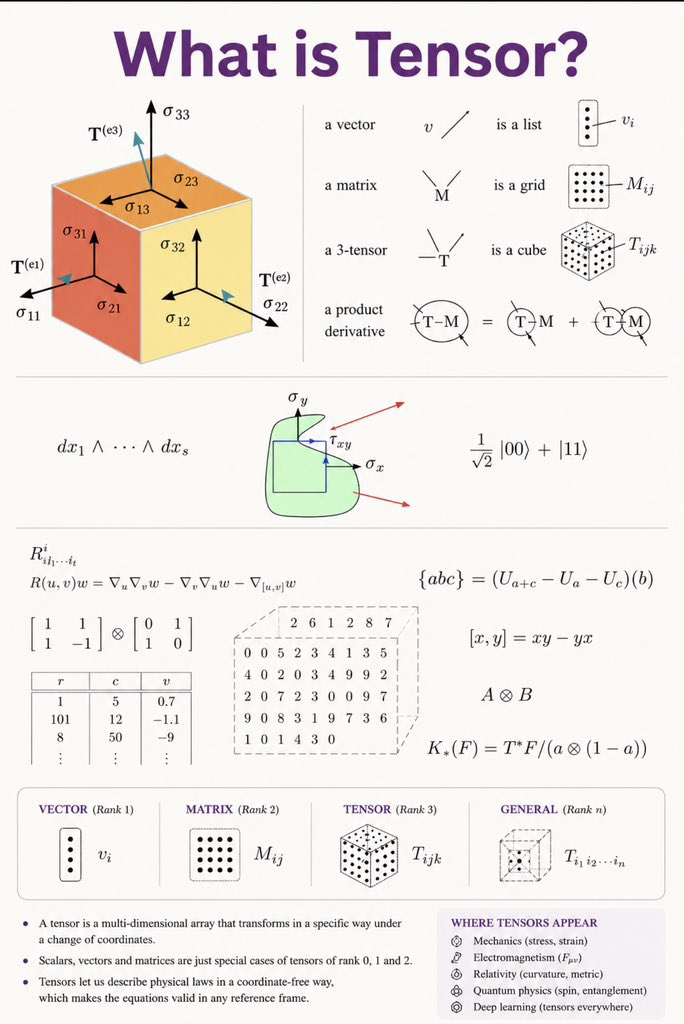
people often think tensors are just bigger matrices.
they’re not.
a matrix is one kind of tensor, just as a vector is another. tensors are the broader idea. they’re mathematical objects that represent relationships across multiple dimensions while preserving those relationships even when you change your coordinate system. that’s why physicists care much more about how a tensor transforms than how it’s stored in memory. the array of numbers is just one representation. the underlying object is independent of your choice of coordinates.
this is what makes tensors so powerful. the stress inside a bridge, the curvature of spacetime, the electromagnetic field, the inertia of a robot arm, and the activations inside a neural network can all be described using tensors. at first glance these seem like completely unrelated problems. mathematically, they’re variations of the same language. tensors let you describe quantities that have direction, interaction, and structure in a way that remains consistent regardless of your point of view.
the deeper lesson is that mathematics evolves by abstraction. numbers describe single values. vectors describe direction. matrices describe transformations. tensors describe relationships in arbitrarily many dimensions. each step isn’t about making mathematics more complicated. it’s about building a language capable of describing a richer reality. that’s why once you understand tensors, you start seeing the same mathematical structure hiding underneath robotics, computer vision, quantum mechanics, relativity, continuum mechanics, and deep learning.
Gemma 4 E2B goes super fast on Intel AI PCs thanks to LiteRT NPU support on OpenVINO!
⚡1.3x faster prefill performance over GPU
📈2.8x improvement in performance-per-watt
🔋Runs background LLM tasks with zero thermal throttling or heavy battery drain
Soon, millions of AI agents will be making decisions, moving money, coordinating work, and acting across organizations. That only works if memory holds up across apps and sessions.
Walrus Memory gives AI agents portable, verifiable memory they can carry, share, and trust.
Built for agent coordination at scale. 👇
https://t.co/JX5lJA7aiC
Gemma 4 12B can now run locally on just 8GB RAM via Dynamic GGUFs.
Google's new model, Gemma 4 12B Unified supports image, audio and 256K context.
You can run and train the model via Unsloth Studio.
GGUF: https://t.co/8cL321pVDh
Guide: https://t.co/odRo9WjRpA