A truly standout website costs tens of thousands of dollars in design.
So we did it for you, with a handful of the world's best designers and agencies. For free.
Introducing the Bolt Template Marketplace: real, full stack apps you can open in Bolt and make yours 🧵
Best model for your local hardware 8GB
- trained in Hermes
- trained on a ridiculous amount of tokens
- can navigate phones, computers and bots
Enjoy ❤️
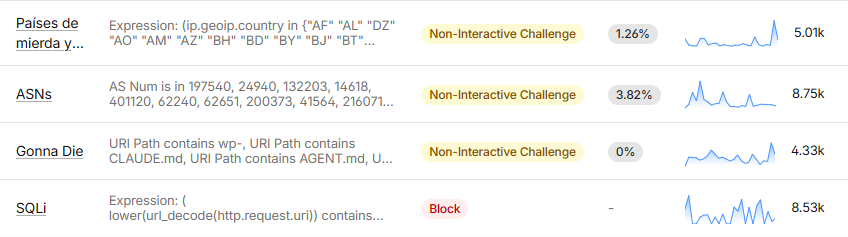
ayer posteé mi configuración de Cloudflare sin explicar:
Primero: "Países de mierda" ¿Quién quiere tráfico de Rusia o China?
Segundo ASN: proveedores de hosting usados para bots
Tercero: urls clásicas de bots
Cuarto: ataques de inyección de SQL
25k requests sucios por día
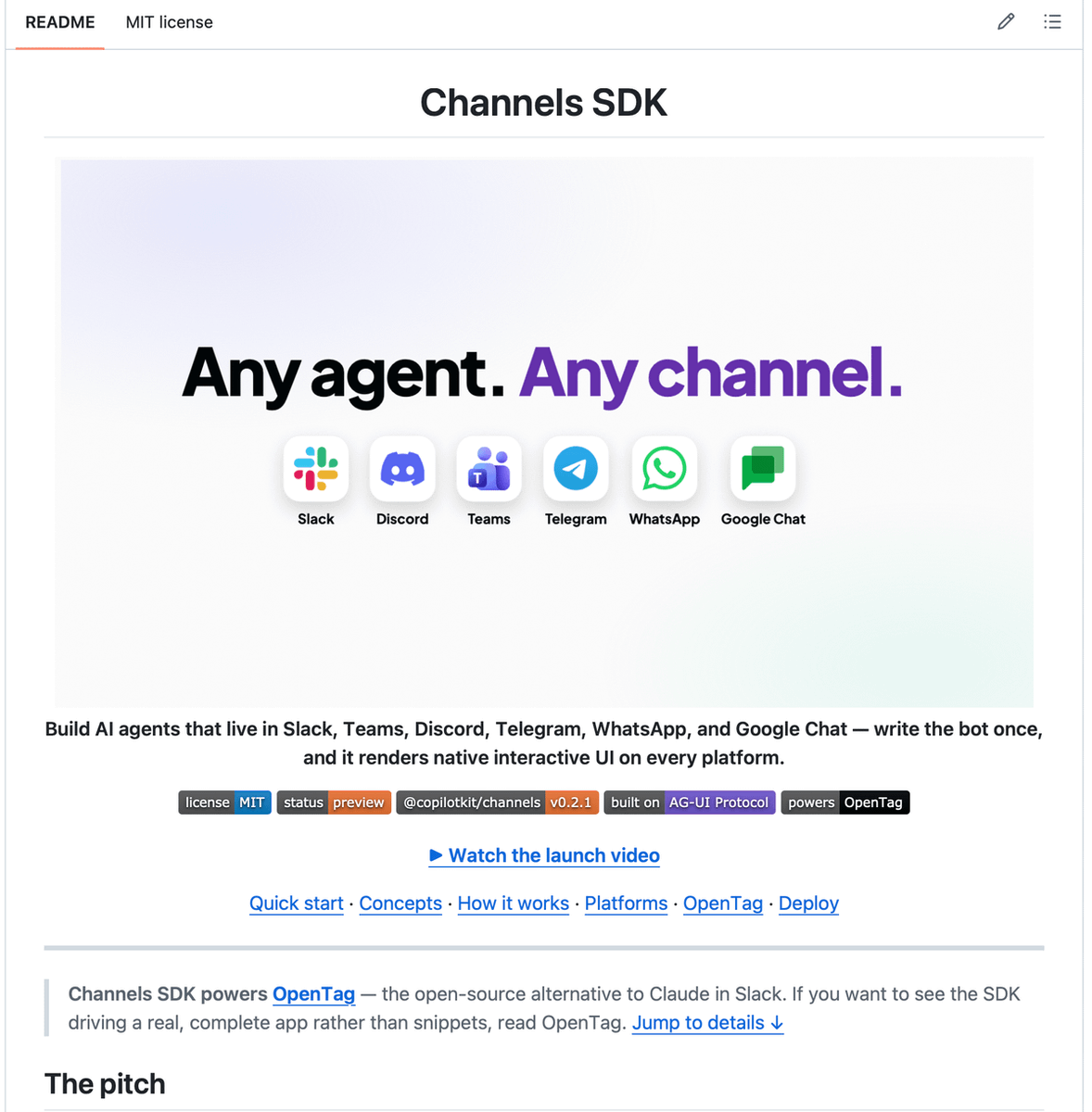
Here is how to build and distribute your agent via Slack, Teams, Discord, WhatsApp, or Telegram.
This is for those of you who are building an agent.
The most popular solution I've seen so far is to build a specific integration for each channel.
This takes a ton of work because each platform is different and you need to maintain all those integrations.
Using the Channels SDK from @CopilotKit will make your life way easier.
The flow looks like this:
1. Build your agent.
2. Create a channel in CopilotKit Intelligence.
3. Add the specific platform adapter you want to support.
4. Copy and paste the runtime snippet into your app.
5. Your agent is now live in that channel.
Basically, their Channels SDK handles all the plumbing that lets you integrate your agents across every messaging platform.
You know the rest from here:
Anyone on that channel can mention the agent directly to ask a question or assign work to it.
Your agent will always get the context of the conversation where the work is happening.
By the way, your agents keep full functionality here: they can use tools, retain memory across conversations, render native UI on each platform, and request human approval before important actions.
GitHub Repository: https://t.co/qmqfUV6QT7
Thanks to the team for partnering with me on this post.
Even the smartest, highest agency people in the world are bandwidth constrained and don't get around to doing most of the things they have the potential to do.
If you do something that someone else could have done faster but didn't, the reality is you've done it and they haven't.
Compound that over and over again in some niche and you get hundreds, thousands, millions of miles ahead of the fastest runners who aren't running down that niche.
Ce soir je lance en opensource ma plateforme de recherche de commerces locaux pour la vente de site vitrine/ecommerce, proche d'un CRM.
C'est devenu mon side project un peu par hasard.
Avec cette plateforme, vous avez la possibilité de :
- tracer une zone pour recupérer tous les commerces de la zone
- récupérer les données via le registre français des entreprise
- récupérer la réputation du commerce ainsi que l'état de son site actuel via l'api Google Places
- définir votre grille de prix, permettant ainsi de calculer un gain environ si vous arrivez à vendre votre site au commerce
D'autres features vont venir mais d'abord j'ai besoin de le lancer en opensource pour avoir un maximum de retours (et peut-être des PRs) d'utilisateurs.
Bien sûr, toutes vos données sont protégées et restent sur votre serveur.
part of the answer is that ai agents are still wildly expensive to justify to the value they deliver for most people. coding agents work because they can save hundreds of dollars’ worth of developer time in a day
i also think we’ll see a completely different behavior emerge for consumers than what we’re seeing with coding agents. most normies won’t wanna manage or prompt agents and they need them to be proactive in offering and anticipating use-cases
which is why i don’t think the breakout consumer product will sell just the access to frontier models but would probably sell outcomes instead
I think if you vibe code a SaaS these days it can just be a self-serve funnel into a more expensive services offering vs. trying to make alot of money with the SaaS itself.
But the only thing about services is it feels like consulting and selling "time for money" again.
DoorDash just published the full structure behind Ask DoorDash, their new AI assistant. And it's the clearest picture of the AI job nobody advertises
Ask DoorDash is the assistant inside their app. You type a question, it answers, finds things and places the order. Millions of conversations so far.
Their problem at the start: no way to tell whether a change made it better. Checking quality meant employees writing feedback by hand, around one note a day. A full test round took over six hours, so it almost never ran.
So they built something that grades the assistant for them:
1. Write down what a good answer looks like, as explicit checks.
2. Rebuild real sessions from logs, so the grader sees what actually happened.
3. Replay them with simulated users and frozen tool responses, so a rerun measures your change and nothing else.
4. Let a model do the grading, after calibrating it against human labels.
Now it grades 2,000 sessions a day, a full test round takes 20 minutes, and error rates dropped nearly by half before the national launch.
Nobody at DoorDash has eval engineer on a business card. Someone still writes the rubric and calibrates the judge. That job is arriving at every company that ships a model, food delivery included.
Bookmark this
the reason that nobody is using agents is because they are still wildly unrealiable even including the wildly expensive frontier models that are far too expensive to put in a mass-market consumer product
the reason it works for coding is because you have a six-figure-salary subject-matter-expert resource sitting there babysitting it all day (and still shipping slop)
The reason agents haven't taken off is because they are still waiting for their "desktop" metaphor and a UI that isn't an open ended chat box.
i use ai daily. I build websites. I do analysis, I do research. I have repetitive processes that i'm sure could benefit from having an 'agent,' but I have no functional understanding of what it is, how to set one up, or what i use it for. If i am in the top 1% of ai users, it is no surprise that the majority is still using it as a better google
Hot take… isn’t it kinda crazy that nobody is really using AI Agents? I don’t mean software engineers or AI early adopters. I mean “college friends talking about it in group chat,” the feeling you got when everyone started using Instagram or TikTok.
These frontier AI models are *insane* (as are the harnesses & tool calls & the like). And every large tech co has an AI agents platform, not to mention all the YC startups doing vertical agents. Yet all of your friends and family outside of tech — who spend all day staring at their iPhones and get paid to work in browser tabs — don’t really care or find themselves using any AI agents yet.
Yes ChatGPT, Claude, etc. are extremely popular… but if you look at the engagement data the vast majority of people are still using these aI chat tools like a glorified Google + Grammarly. That’s why the AGI labs are all pushing desktop apps for Codex, Cowork, etc. so hard to non-technical ppl. And yes exceptions for lawyers and customer service but even those have some asterisks and exceptions to rule.
Look I’m not saying the ChatGPT moment for AI Agents is not coming… it most definitely is! Remember we pivoted from Arc to Dia precisely because we believe computing is going to be radically reimagined around these AI primitives. No doubt. But that’s my point: it’s just so surprising it hasn’t happened yet because all of the tech you’d need is there.
Again if you stop for a second and think about it… for all the press and money and hype and models and crazy ARR numbers… this “AI Agent” moment does not *feel* like the other breakthrough tech moments we’ve lived through (e.g. think the shift to Stories via Snapchat & Instagram, or shift to on-demand via Uber/Airbnb/Doordash).
Which is a long way of saying: if you can figure out the answer to “why” most people don’t care about AI agents yet (and have no enduring interest in using them) — especially since the models and harnesses are here and ready — the answer to that question will allow you to capture a lot of marketshare and make a lot of money in 2027.
Theoretically, the tech is ready for AI Agents to totally transform how we work and live our lives… but alas the general public dgaf… that’s the generational puzzle to solve for the next 12 months for anyone not working on the models themselves.
Do you have a personal assistant style agent set up? If so, which one? If not, why not?
Think closer to Hermes / OpenClaw, not really Claude Code / coding agents
between claude code, cowork, chatgpt work, & codex, most current white collar work is either already automatable or visibly waiting to be automated. you can walk into any small business right now & maybe automate it at least 50%, likely way more.
these four products together are eating the entire knowledge economy.
& nobody else is even in the same cultural or technological orbit at the moment.
Every app I vibe code has the tech stack below
Easy for beginners and free to start
If you've never built an app before, just paste this list into ChatGPT or Claude and you're good to go:
Web framework: NextJS
Hosting: Vercel
Database: Convex
Auth: Clerk
Payments: Stripe
Styling: Tailwind
AI: light logic- ChatGPT Terra, heavy logic/creativity- ChatGPT Sol, cheap tasks- Gemini Flash
Emails: Resend
Design apps with: GPT image gen 2 + Claude Design
AI I use to build it all: Codex desktop app w/ ChatGPT Voice
Any questions let me know!
I found a site that solves pretty much every startup SaaS design problem.
Instead of generic UI templates, it shows you real breakdown flows and landing page designs that actually convert.
Link: https://t.co/bmW6hlGnM9