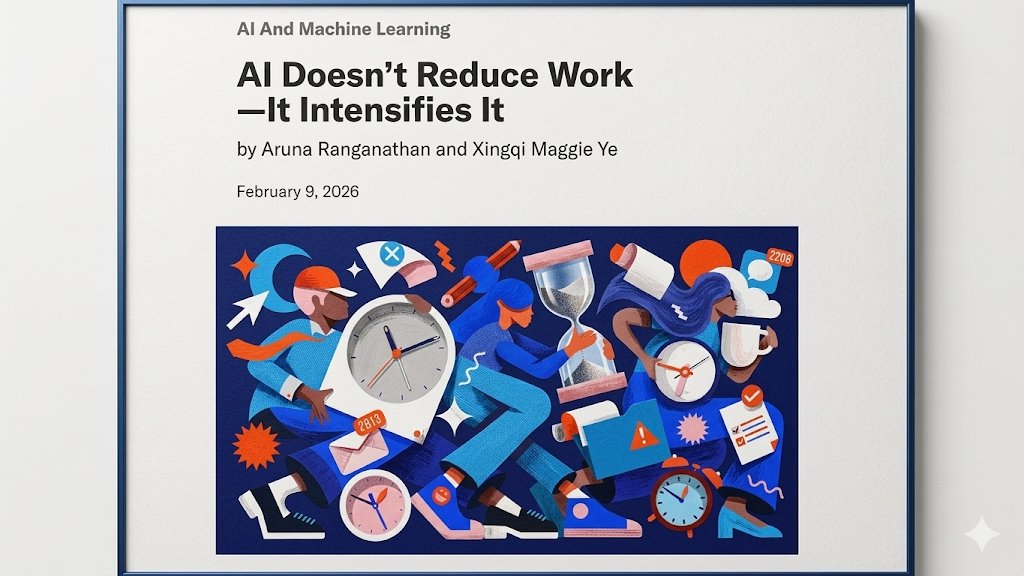
🚨BREAKING: Berkeley researchers spent 8 months inside a tech company watching how employees actually use AI.
The promise was simple: AI will save you time. Do less. Work smarter.
The opposite happened.
Workers didn't use AI to finish early and go home. They used it to take on more. More tasks. More projects. More hours. Nobody asked them to. They did it to themselves.
The researchers sat inside the company two days a week for 8 months. They watched 200 employees in real time. They tracked work channels. They conducted 40+ interviews across engineering, product, design, and operations.
Here's what they found. AI made everything feel faster, so people filled every gap. They sent prompts during lunch. Before meetings. Late at night. The natural stopping points in the workday disappeared. People ran multiple AI agents in the background while writing code, drafting documents, and sitting in meetings simultaneously.
It felt like momentum. It felt productive. But when they stepped back, they described feeling stretched, busier, and completely unable to disconnect.
83% said AI increased their workload. Not decreased. Increased.
62% of associates and 61% of entry-level workers reported burnout. Only 38% of executives felt the same strain. The people doing the actual work absorbed the damage while leadership celebrated the productivity numbers.
Then came the trap nobody saw coming. When one person uses AI to take on extra work, everyone else feels like they're falling behind. So the whole team speeds up. Nobody formally raises expectations. But the new pace quietly becomes the default. What AI made possible became what was expected.
The researchers gave it a name: workload creep. It looks like productivity at first. Then it becomes the new baseline. Then it becomes burnout.
AI was supposed to give you your time back. Instead it's eating more of it. And the worst part? You're doing it to yourself. Voluntarily.
Ask your favorite AI to make a simple US map highlighting a few random states... prepare to be hilariously disappointed 😂
I tried 3 different ones. All failed spectacularly. @Grok actually explained why it's so ridiculously hard for AI (props for the honesty!).
Then, I discovered @mapchart Go support them! 🗺️💙
Claude + MCP + n8n = AI Content Army that replaces $10,500+/month content teams...
(the exact system I've deployed for 7-figure influencers)
→ No more 2-3 week turnarounds for basic posts
→ No more generic copy that sounds like everyone else
→ No more burning budgets on content that doesn't convert
Just one idea input → instant multi-platform content arsenal.
Here's how it works:
→ YouTube Intelligence Scraper (analyzes 1000s of audience comments)
→ Pain Point Extraction Engine (finds exact psychological triggers)
→ Multi-Platform Content Generator (LinkedIn, Twitter, YouTube, newsletters)
→ Content Waterfall Technology (1 idea = 15+ platform pieces)
→ Voice Consistency System (sounds exactly like you wrote it)
→ 24/7 Automated Publishing across all platforms
→ Performance Loop that optimizes based on engagement data
Built with MCP agent architecture.
Runs 24/7 without supervision.
15-minute setup. Insane results.
Results so far:
• 5M+ organic views generated
• 90% time reduction (15 hours → 90 minutes weekly)
• 50+ qualified leads monthly from content alone
• 15x content production speed increase
Want the complete system blueprint?
Like + comment "ARMY" + Repost , and I'll DM it to you.
(must be following)
this guy has been selling AI agents for the last 18 months.
His biggest takeaway: businesses don’t need fancy ai agents.
they need boring AI automations.
$500 workflows that replace $50K employees.
that’s the alpha right now
It's getting harder to tell which replies here on X are from humans and which ones are from AI's. One tip? The AI's answer way too fast. :-)
What's your policy? Do you block AI answer accounts? Or do you hide them? Or do you just allow them as long as they are on point?
Deep Dive Video: Complex image editing used to take hours — now Google's Gemini 2.0 turns advanced ComfyUI & Photoshop workflows into simple text prompts. Here's exactly how to try it (completely free).
Chapters:
00:00 Conversational Editing with Google's Multimodal AI
00:53 Image Generation w/ LLM World Knowledge
02:12 Easy Image Editing & Colorization
02:46 Advanced Conversational Edits (Chaining Prompts Together)
03:37 Long Text Generation (Google Beats OpenAI To The Punch)
04:25 Making Spicy Memes (Google AI Studio Safety Settings)
05:48 Advanced Prompting (One Shot ComfyUI Workflows)
07:19 Re-posing Characters (While Keeping Likeness Intact)
08:27 Spatial 3D Understanding (NO ControlNet)
10:42 Semantic Editing & In/Out Painting
13:46 Sprite Sheets & Animation Keyframes
14:40 Using Gemini To Build Image Editing Apps
16:37 Making Videos w/ Conversational Editing
“Synthetic respondents are enabling us to create personas that simulate and replicate [human] behaviors with a high degree of fidelity,” says @NielsenIQ’s Ramon Melgarejo. And you can use this technology for your product innovation cycle too. #FCIF#ad https://t.co/I2YhUVXdfV
There's a shocking fact about AI that nobody tells you: You can catch up to the public AI research frontier in just 2 weeks. Yes, really.
I've built a $150M annual revenue startup over the last 8 years and If I were to start a company today, I’d drop everything and go all-in on AI.
But like many busy software builders, I felt lost—overwhelmed by the noisy, crowded and fast-moving modern AI landscape. And I wasn’t alone.
So I spent my entire holiday diving deep into AI research—reading 30+ papers, watching hours of lectures, analyzing trends, and catching up to the research frontier.
✨ Here’s what I learned:
- You don’t need months (or years) to catch up.
- You don’t need a PhD or decades of ML experience.
- You need fewer than 20 papers and 2 weeks to understand the major breakthroughs shaping AI today.
It's because the technology is extremely nascent and most techniques that came before are no longer relevant:
- ChatGPT is barely 2 years old and Transformers are only 7 years old.
- Most game-changing discoveries happened within the last 4 years, driven by a few breakthrough ideas, scaling laws, and efficient matrix multiplication.
The biggest secret?
Many groundbreaking AI papers with thousands of citations are surprisingly simple and applied, like adding "let's think step by step" to the prompt, or simply asking the LLM over and over again to improve its answer (Self-Refine).
I realized there are tons of founders and builders in the same boat—wanting to dive deeper into AI but unsure where to start.
I've created an essential AI Guide that helped me catch up, in just 2 weeks, to the frontier of public AI research to figure out where the next opportunities and gaps were:
- Curated list of only the most important papers
- Simple explanations of key concepts
- Clear pathway to understanding the frontier of modern AI
It’s perfect for:
- Founders expanding into AI
- Builders wanting to innovate at the frontier of AI
- Investors looking to separate the signal from the noise
👇 Want the full guide?
- Like and Share this post
- Comment "AI Guide"
- I'll send you the complete guide
(ps, I’m also teaming up with @VishalVasishth, co-founder of @obviousvc with @ev (focused on large-scale societal impact companies like Twitter, Medium, Beyond Meat), to host a small meetup to discuss what's working and needs to be solved in the AI stack in SF. Message me if you're interested)