The most useful page in my week is the one at the back.
I design bridges by day. I like to have the week overview in the front and the weekly review in the back.
At the end of the week on Saturday and Sunday, I sit down and use that as a reference when I'm filling in the tasks that need to happen in the week.
So I'm able to see what didn't work and then how I'm planning for it for this next week.
Whatever didn't get done gets moved to the following week, and hopefully it gets done then.
Then I know what I need to do this week.
The plan for next week is written in last week's review.
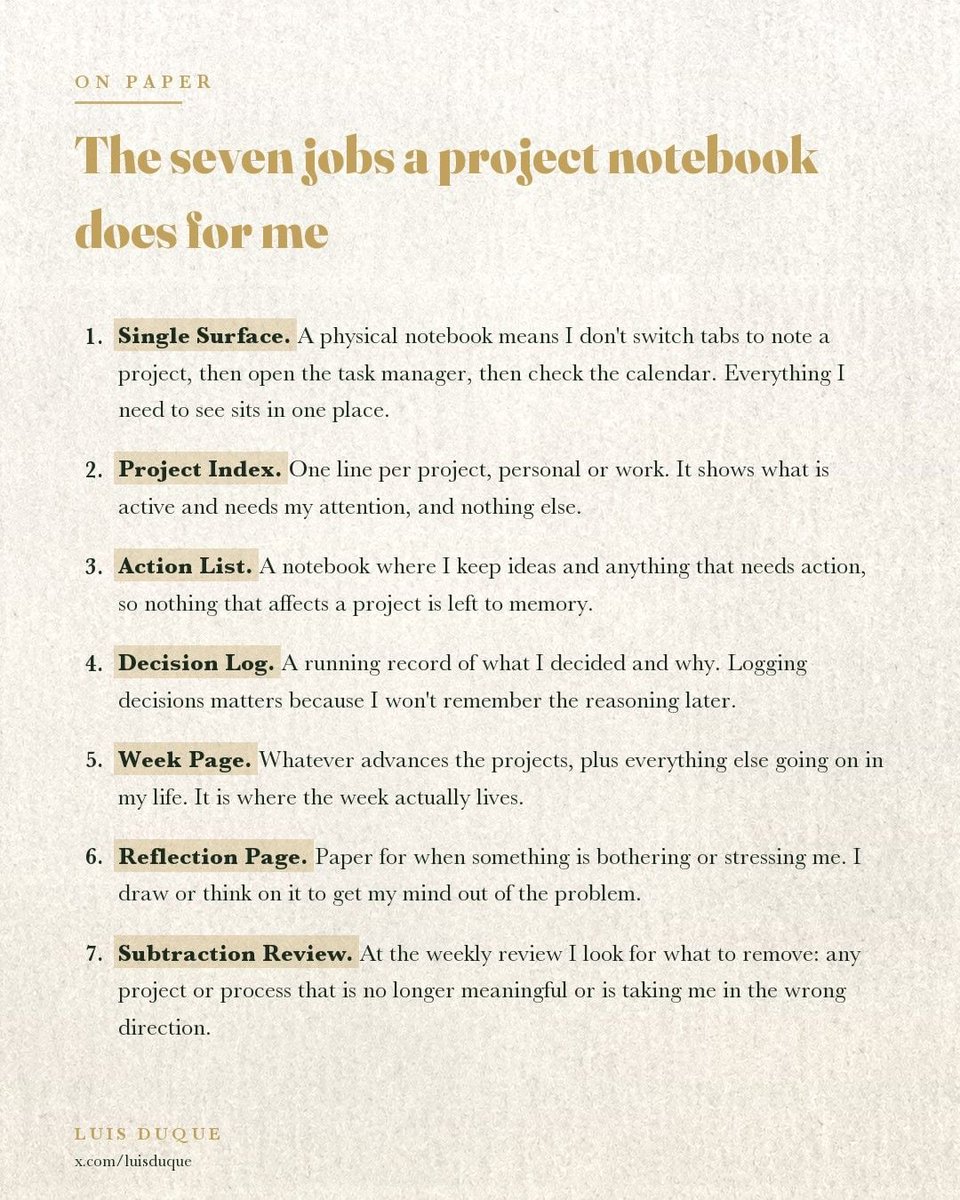
I work on a computer all day, and the notebook is the one place I don't switch tabs to jot a project note, check the task list, then check the calendar. One page holds all three. That's the whole reason I keep it.
@ASCETweets Colorado is rebuilding 12 bridges on I-270 north of Denver, all built in the 1960s.
CDOT made 65 emergency repairs on the corridor's bridges in 10 years, on top of 160 planned jobs.
Deferred maintenance still gets paid for. It just gets paid in emergencies.
@ASCETweets I run engineering models all day. The computer holds the calculations, and what needs action still lives in my notebook.
AI flagging a failing pump early earns its place. The call on what gets fixed first stays with a person.
Your week doesn't live in the boxes.
You still have some boxes that you can fill in.
But paper records on a daily basis what happens, what's keeping me busy.
That's where the week actually lives.
Five habits that quietly kill your productivity, and the notebook page the Stoics would use to fix each one.
1. You don't start the day on paper.
Marcus Aurelius told himself at dawn that he was getting up to do the work of a human being. Before you touch the phone, write three lines: what today is for, the one thing that has to happen, and what you'll do if it goes sideways.
2. You carry what you can't control.
Epictetus opens his handbook with it: some things are up to us, and some are not. Get everything in your head out on paper, then split the page into two columns. Only the column you control becomes tasks.
3. You give your time away without writing it down.
Seneca said people guard their money but hand out their time, the one thing worth being stingy with. Write every request down before you answer it, with the hours it will cost. Answer the next day, not in the moment.
4. You don't choose your crowd on purpose.
Book One of the Meditations is a list of people and what Marcus learned from each of them. Write your own list, one line per person. If a name has nothing next to it, that tells you something.
5. You act like the days will never run out.
Seneca wrote "hold every hour in your grasp," and he reviewed each day at night before he slept. Write what you did, what you put off, and what you would change tomorrow.
Marcus wrote the Meditations for himself, not for readers. It was a man thinking on paper.
Which of these five pages would you actually keep?
I get bored if I use one thing for a long time.
So I think on paper.
That way I'm not distracted, thinking about the next meeting, thinking about the next task, thinking about the emails that are coming in and allows me just to focus on the work.
I was hardcore digital. I was just chucking stuff into folders, and I wasn't really doing anything with that.
When you think on paper, you're processing information differently.
Your brain takes it in, works through it, and then you put it down on paper.
Digital comes after, once all that information is processed.
Paper is for thinking, digital is for storage.
@seawolflog That's the part I'd underline. A typed brain dump still sits next to the inbox and the notifications.
On paper there's nothing else on the page.
One of the best things to really get over the challenge of that constant high cognitive load is just a brain dump. Always trying to have a pen and some paper handy to be able to process that information and get it out of the brain and onto the paper.
When you think about the pocket notebook, it's a very important tool in my kit. I know it's going to be there whenever I'm reading and taking notes. It just allows me to see a personal view of what's going on, what I'm thinking about.
The most quoted claim about handwriting rests on one 2014 study.
Mueller and Oppenheimer found that students who took notes by hand did better than students who typed.
Then two teams tried to repeat it. Morehead in 2019, Urry in 2021. Neither could reproduce the result.
The obvious objection: the pen was never magic, so you can stop caring how you write.
That only follows if you believed the pen was the point.
I break down the systems and tools to help you think better on paper. What those systems share is somewhere to put a thought where it holds still long enough to look at.
When you think about it, the notebook is a very important tool in my kit, and the reason has nothing to do with ink.
So test it on yourself. Take one problem you keep circling. Write it down in whatever you will actually use, and see if it looks different outside your head.
The research can't settle which tool is best. It can't take away what writing does.
Thinking better on paper was never about the pen.
I like to keep a green and a red highlighter for things that I agree with and the things I don't agree with when I'm reading, as well as a pen to mark up everything in the book or write notes. I'm not just reading the book and putting it aside. It allows me to engage with the content, create a mind to hand to paper connection that helps me process what I am reading. To me, it has been a perfect analog kit to just keep me off my phone.
Jeff Su says a long AI chat gets worse as it fills up. His fix is a fresh chat that opens with a short brief: goal, decisions, progress, next action.
Your attention works the same way. The tax on switching is whatever you didn't write down.
Cut two notebook systems this year, and for about a week I still reached for the old one at my desk before remembering it was gone. The goals never told me what to drop. The review did. Do you cut on a schedule or only when something annoys you?