New research from Adaption presents adaptive agentic checklist generation.
An agent builds a quality checklist from past AutoScientist runs. The checklist scores and removes bad training data.
Model performance improves every run.
AutoScientist accelerates and derisks frontier model training.
See the results: the AutoScientist Leaderboard ranks the best customized models per domain.
44 domains. Legal, health, finance.
Your Frontier. Not Theirs.
@juliarturc My way of fighting the slop and inflation of content is relying less on the algorithms and more on a curated list of creators that I follow: on X, youtube, instagram...
That list has already accumulated to almost more than I can process
I was so many times thinking "if I only had the right data, I could train/build XYZ"... Well, this makes generating datasets much easier.
Congrats @andrijazzz@singhshiviii@sarahookr@sudip_r0y on the release!
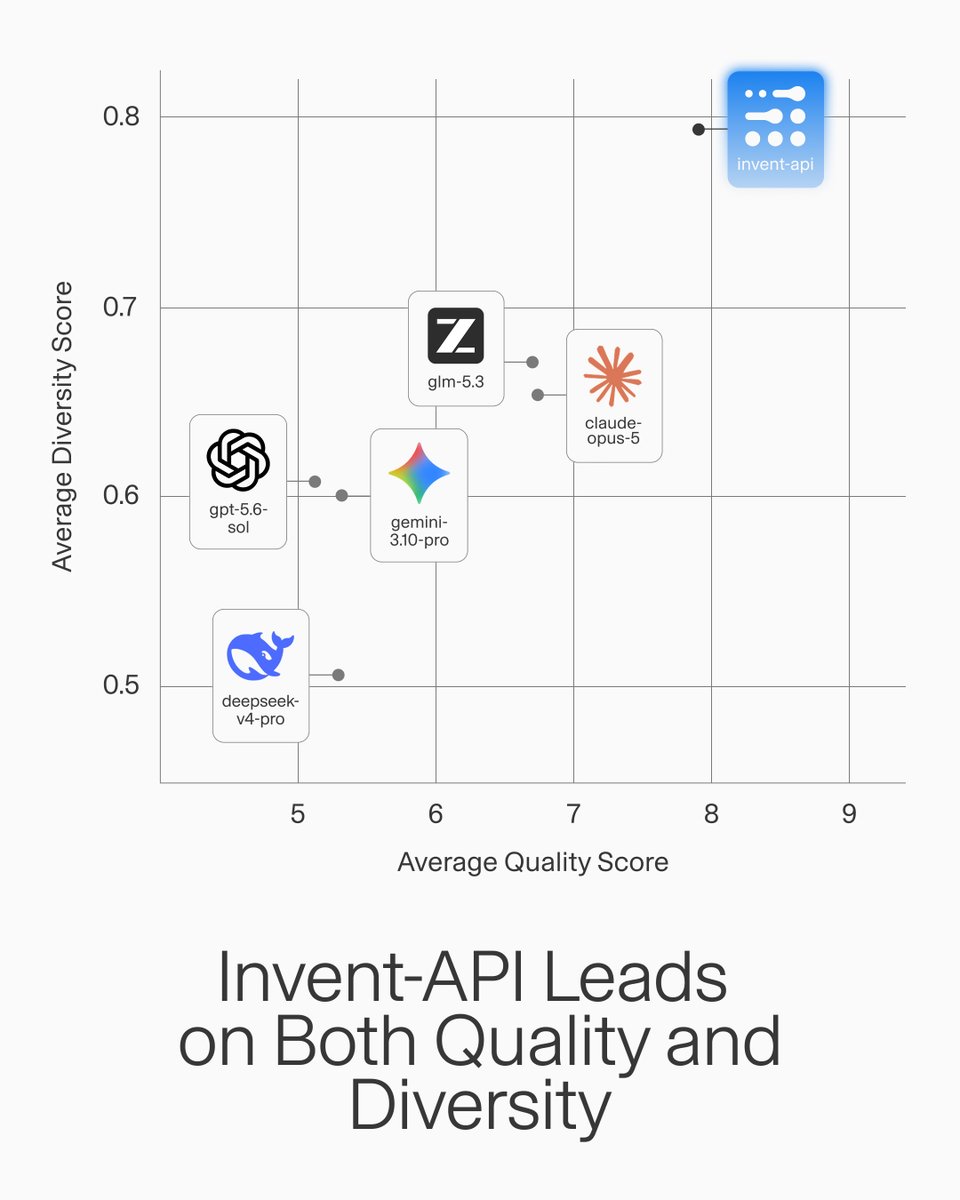
Benchmark tests across 8 task types show Invent significantly outperforms top frontier APIs (Claude Opus 5, GPT-5.6, Gemini 3.1 Pro, DeepSeek V4 Pro, and GLM-5.3) with +17% higher quality and +19% greater sample diversity.
Invent API's diversity advantage widens as dataset size grows, reaching a +37% diversity lead at 20K samples with 0.0% duplicates.
Last week we introduced Invent a Dataset. Describe what you need. Hit go.
Today, we’re making it even easier with the Invent API.
A few lines of code. AI ready training datasets in minutes.
Introducing the invent api.
Describe the dataset you want.
A few lines of code.
Returns a diverse and high quality training dataset. No terms that prevent you training on it. Your data. Your AI.
Plug it into all your auto research agents today 🔥🎉
@thsottiaux When I have a web session of ChatGPT open, and I read the response there, I still sometimes get a notification in the Codex app after a few minutes about a "new reponse", which is the response I already read on the web
I believe robotics and physical AI are two of the "next big things", so I've spent some time brushing up on reinforcement learning and robotics. Watching the World Cup gave me the idea for the project - teaching a robot to play football! That was too ambitious for a side project, so I scoped it down to teaching the robot to walk and kick the ball.
I used PPO (Proximal Policy Optimization) and trained the behaviours in stages: first learning to stand still, then walking and turning, and finally kicking. The final system combines several learned policies with a controller that positions the robot and manages the handoffs between behaviours.
The video shows the training progress. It definitely couldn't have helped Argentina win in the final 🤷
There are still plenty of limitations: the robot often falls after kicking the ball, it learned to walk by making micro-steps instead of a natural walking gait...
However, seeing the complete sequence work was very satisfying.
A blog post and a repository with more technical details are coming soon™️.
@mitsuhiko Which one do you mean? I think both Amalienbad and Stadthallenbad are open throughout the year, though Stadthallen's website is down and can't verify
@juliarturc I don't AI is there yet to create nice and accurate visuals for the topic. That (and storytelling) is what the top creators are awesome yet.
Ofc, I pair watching videos with asking AI for clarifications and follow up questions
@sheriyuo I think it’s analogous to how humans take exams vs real work. At exams you should prove that you understand the subject and can solve the problem. At real work you always first check if there’s an existing solution for the problem you are facing