@Jphiker22@BarnettMPH@madbeatboy@Weather_West You're not only repeating a BS propaganda number, you're misrepresenting it. That fictitious 6% from Sen. Ernst was alleged to be the % of federal employees full-time in the office as of Dec. 5th--*7 weeks* before the RTO mandate.
See https://t.co/bu95VDmoBI
Note there have been several station moves in the >120-year history of the Boulder COOP, so these Tmins aren't quite apples-apples. But 1/16-17/1930 was indeed super-cold; all-time Tmins at Longmont (-38) & Kassler SW of Denver (-32), and #2 at Fort Collins (-38)
On this date (1/17) in 1930, the Boulder COOP station dropped to -33 F, the all-time record Tmin.
The Tmin at Boulder yesterday was -14 F -- plenty frigid, but it barely makes the 50 lowest Tmins since 1893 (see table).
COOP data: SC-ACIS https://t.co/8Hf8Xmost9
@mdettinger I just noticed that last week. Appalling to see important state-level climate-change planning docs get not just ignored but *scrubbed* by a new admin, making them unavailable to anyone. As you say, a big step backwards for NV.
#CRWUA2023 participants and onlookers:
For access/links to
- summaries of key areas of CRB science
- important CRB datasets, tools, resources
- new and recent CRB research papers
- and much more
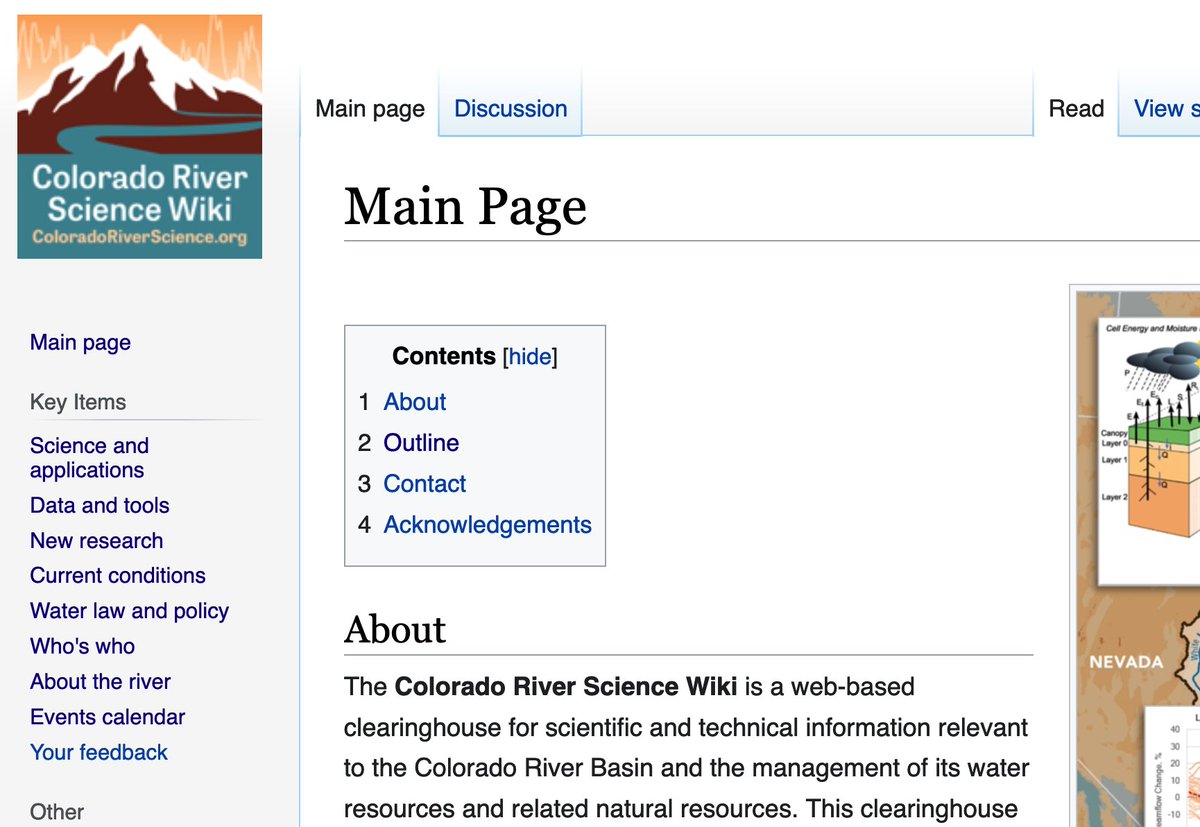
Check out the Colorado River Science Wiki: https://t.co/RCCtBSo7KE
@CReppWx@farflungfoodie@9NEWS @NREL Agree that nearly all cars and trucks have been "supersized" in recent years.
I was surprised to learn that my EV (VW ID.4)--which has a hefty 4900 lb curb weight--was only slightly heavier than my BIL's "normal" 2023 Ford Explorer (4700 lbs).
@LukeRunyon Fun fact: Historically (1895-2022), there is zero correlation between Oct precip in the Upper Colorado Basin and precip over the rest of the snow season (Nov-May).
Having a decent amount of snow by the end of Oct is helpful (assuming it sticks around), but not very predictive.
@CReppWx@BoulderCAST Several years ago, NRCS switched from the average to the median as their default "normal."
I'm guessing that the text on their map that says "average" is a holdover from before. The legend (median) is correct.
@LukeRunyon @KUNC Specific to the Colorado River, you've done a great public service in clearly conveying the nuts, bolts, and devil-in-the-details of some very complex issues. Appreciate all your hard work.
@Protons4B @micefearboggis Thanks for sharing your 'personalized' GMST time series--that's a compelling way to depict the human scale of change.
The depiction of your own lifespan brought to mind this Stephen Wright joke: "I know when I'm going to die. My birth certificate has an expiration date on it."
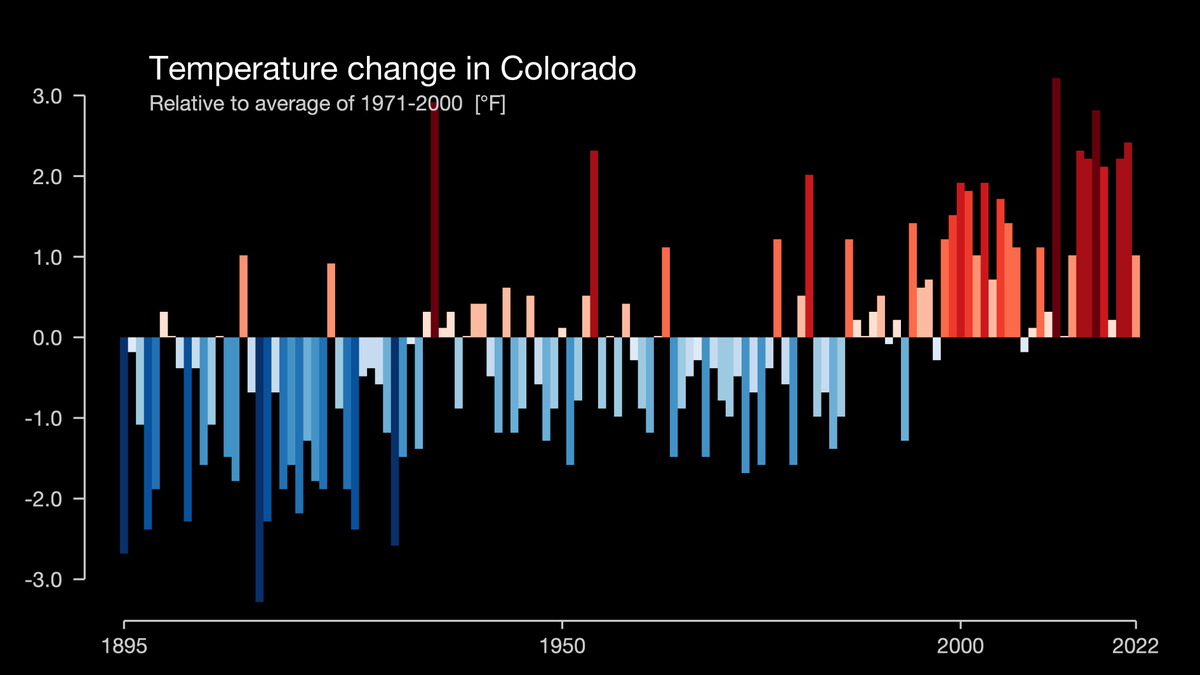
Colorado has warmed over 2 degrees F in the past 40 years, impacting water supply, water demand, wildfire risk, ecosystem resilience, and much more.
#ShowYourStripes
https://t.co/Bv2AFXYWi3
@KeithJGw@ParkCounty Thanks @KeithJGw--the fire perimeter released last night confirms that the 1700 asterisk was correct, but the *1500* asterisk was too far west.
Totally understandable given the winds/terrain/smoke--impossible to locate the head of the fire at that point.
Do you need climate-change information for local decision-making in the West (or elsewhere)? Check out this resource!
And let us know if it's helpful, and how we can improve/update it.
(Julie Vano of @aspenglobal and I developed it; funding: @NOAAClimate & @aspenglobal)
There are a lot of climate portals available. This "User Guide to Climate Change Portals" provides practical guidance for navigating the landscape of climate change portals and resources to find what you need.
https://t.co/KKuY5JJzrE