The program for the 2026 Society for Economic Dynamics Annual Meeting in Athens is out!
It has been a dream to work with Jen-Jen La'O and our amazing committee to put together this year's program.
https://t.co/XwWDVvAirC
*Small logistical changes might still come.
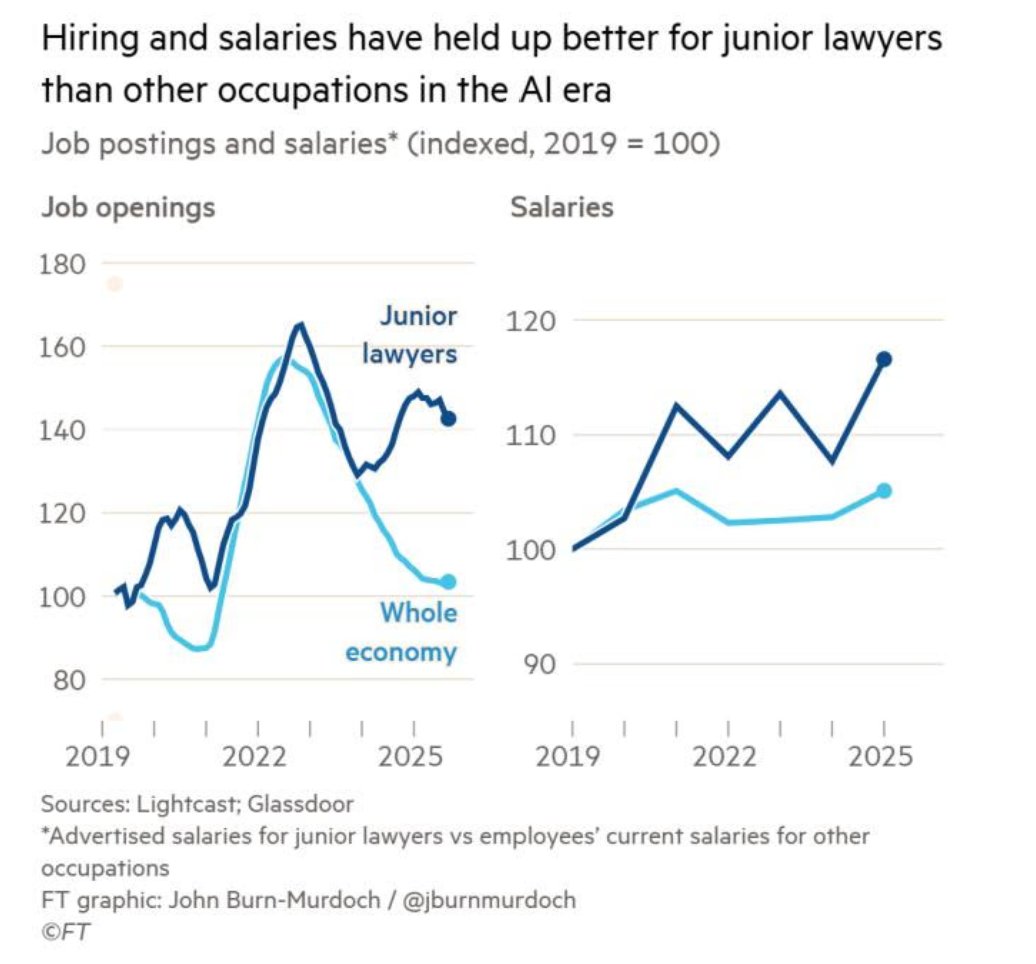
An increasingly coherent picture of the impact of AI on jobs, by @jburnmurdoch@ft:
1. New Fed paper by Crane and Soto now confirms with official labor force survey data what private payroll analysis was showing: roughly 500,000 fewer coders are working than pre-LLM trends would predict.
2. Argues evidence consistent with my work (with Lin and Wu, link in my pinned post) on weak/strong bundles: junior developers and contractors hold "weak bundles" (their work is mostly standalone coding that AI can substitute directly), senior developers hold "tight bundles" where coding is combined with domain expertise, judgment, and cross-functional responsibilities, making substitution much harder.
3. Freund & Mann and Gans & Goldfarb add a second lens: what matters is the value of the tasks that survive automation. Remove coding from a senior role and you free up time for higher-value work; remove it from a junior role and almost nothing remains.
https://t.co/uqkcvtxfvg
The AI job loss story is all about bundles by @jburnmurdoch@madhumita29 in @FT's great The AI Shift newsletter.
"Between the now-consistent picture on junior coding employment and the expanded framework of jobs as bundles of tasks, it feels to me like we’re developing an increasingly coherent picture of AI job displacement." writes @jburnmurdoch.
One important nuance I'd add is that task bundling is important not just for thinking about "job displacement" -- it also implies many workers can experience "job disruption" even absent full-scale displacement as wage returns to different skills shift as AI leads to work tasks being reorganized.
With shout-outs to the recent papers by @crane_leland&Soto, @lugaricano-Li-Wu, @joshgans-& @avicgoldfarb and @lukasfmann& myself on Job Transformation (thank you!).
AI automates tasks. Tasks are bundled into jobs. The labor market prices jobs, not individual tasks.
New paper by @lugaricano-Li-Wu (2026) explains how the labor market effects of AI depend on how easily an automated task can be "pulled out" of a job bundle. Strong bundling "protects" labor.
"Weak Bundle, Strong Bundle: How AI Redraws Job Boundaries"
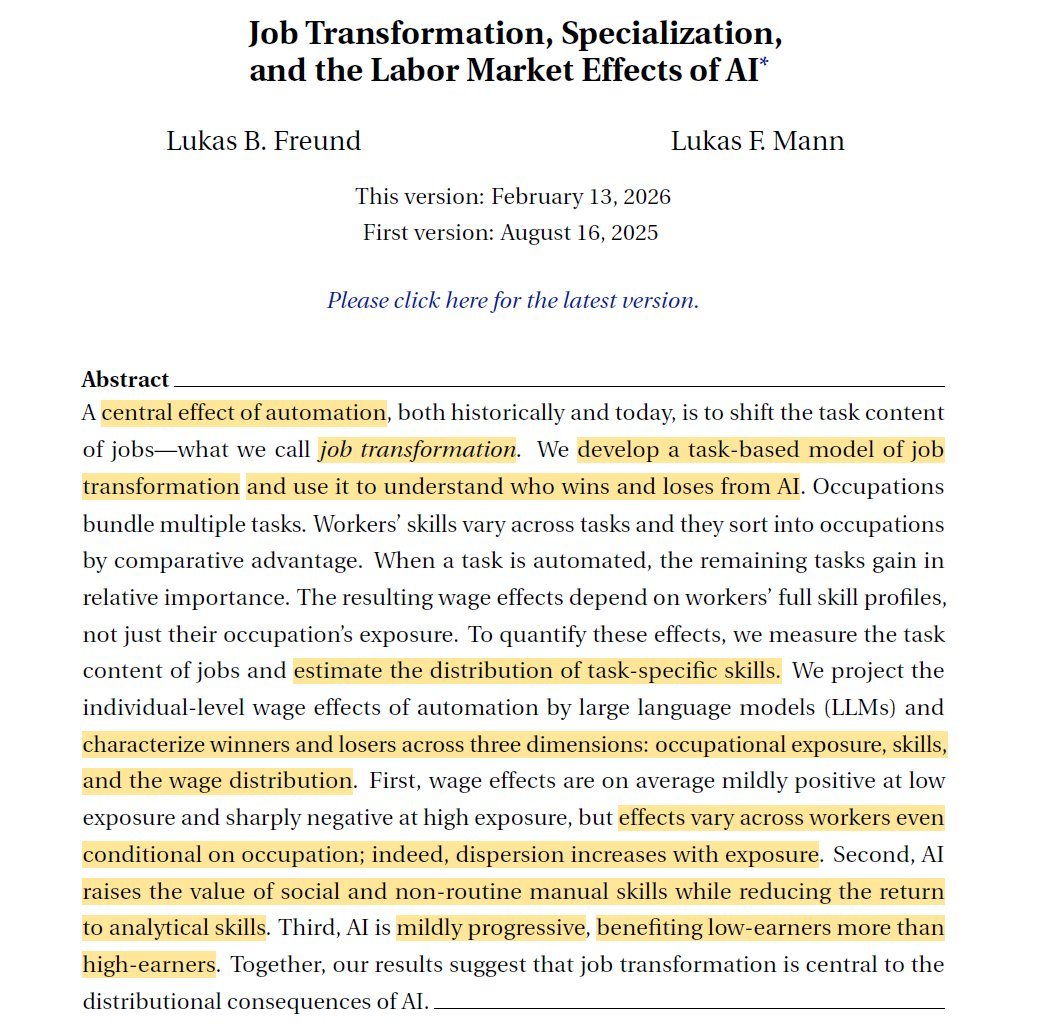
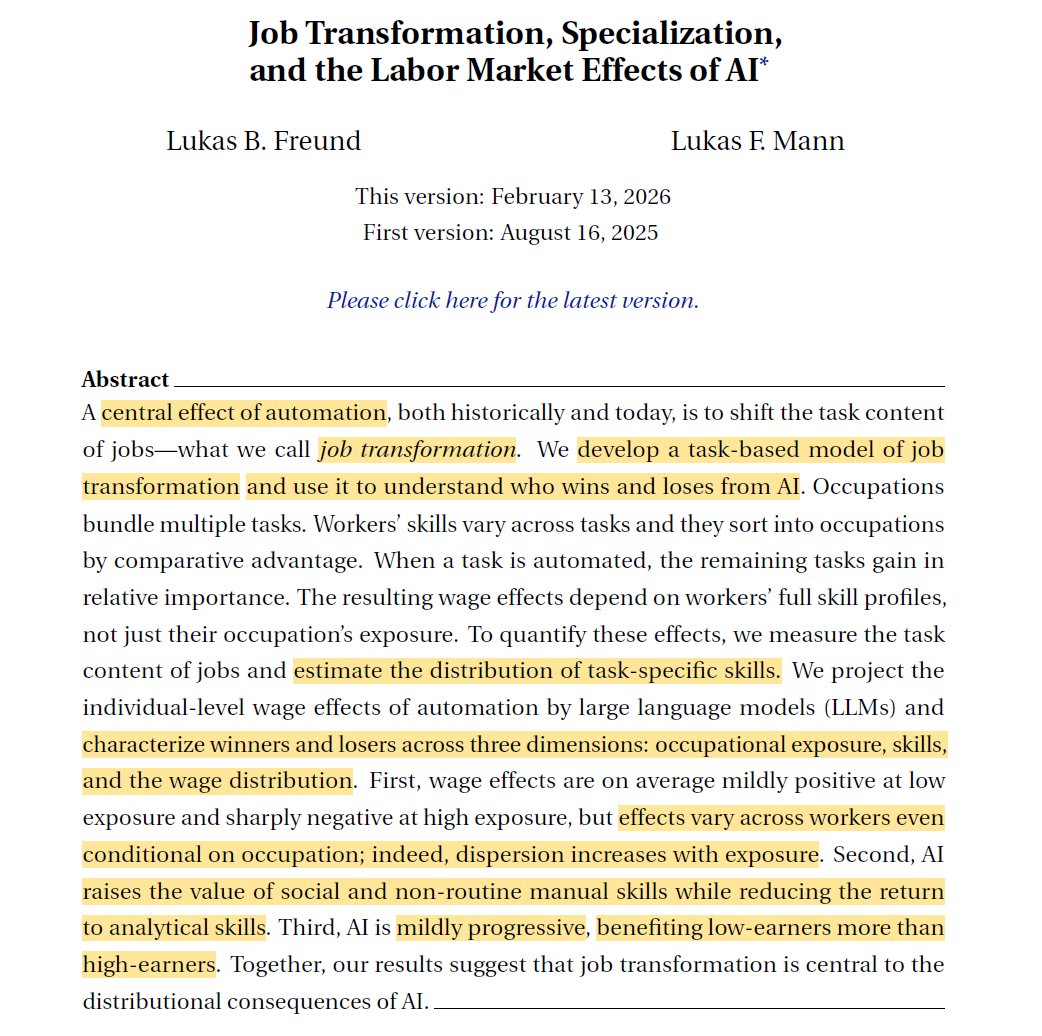
🚨 “Job Transformation, Specialization, and the Labor Market Effects of AI” - new paper with @lukasfmann
💡 AI transforms what tasks we do at work. Our paper shows how, as a result, individuals' wages may rise or fall depending on their skill set.
🧰 We build a framework to quantify the effects of job transformation on wages, and characterize winners & losers in a genAI automation scenario from 3 perspectives.
👉Exposure: Moderate occupational exposure benefits incumbents, on average, while high exposure harms them; but: within any exposed occupation there are both losers and winners.
👉Skills: Value of social and manual-technical skills ⬆️, analytical/information-processing skills ⬇️.
👉Distribution: Low-wage workers gain relatively more than high-wage workers.
🧵 Summary thread & link to paper 👇
The program of the next NBER Organizational Economics Working group is up!
The conference will take place on April 9/10 in Cambridge and will be live streamed on Youtube.
https://t.co/NuSw0o6AKl
Great fun to present "Job Transformation, Socialization, and the Labor Market Effects of AI" (with @lukasfmann) at the @nberpubs AI conference.
Many thanks to @ChadJonesEcon for a great, helpful discussion.
And thanks to @ce_tucker@avicgoldfarb@AndreyFradkin Chiara Farronato for organizing an awesome conference. I learned a lot.
"The current discourse around AI mostly centers on the notion of jobs disappearing. But that seems to capture only part of the picture," @_LukasFreund_ & @lukasfmann observe. Read about their research on how jobs may transform and wages respond: https://t.co/zFhLpoYIrQ
"The current discourse around AI mostly centers on the notion of jobs disappearing. But that seems to capture only part of the picture," @_LukasFreund_ & @lukasfmann observe. Read about their research on how jobs may transform and wages respond: https://t.co/zFhLpoYIrQ
"The current discourse around AI mostly centers on the notion of jobs disappearing. But that seems to capture only part of the picture," @_LukasFreund_ & @lukasfmann observe. Read about their research on how jobs may transform and wages respond: https://t.co/zFhLpoYIrQ
Thanks @_LukasFreund_ . I learned a lot from your work with @lukasfmann on which workers gain and which ones lose post AI.
Incidentally, on the great @jburnmurdoch piece: it is the first use I see by a journalist of Claude Code (rather, "agentic tools") in data analysis. Impressive work.
👇Highly recommended reflections from @lugaricano on how to approach career & learning in the age of AI.
Pairs well with @jburnmurdoch's piece highlighting ~historical continuity in ⬆️ value of *social skills* (consistent with what @lukasfmann & I find): https://t.co/0H2wpegLk3
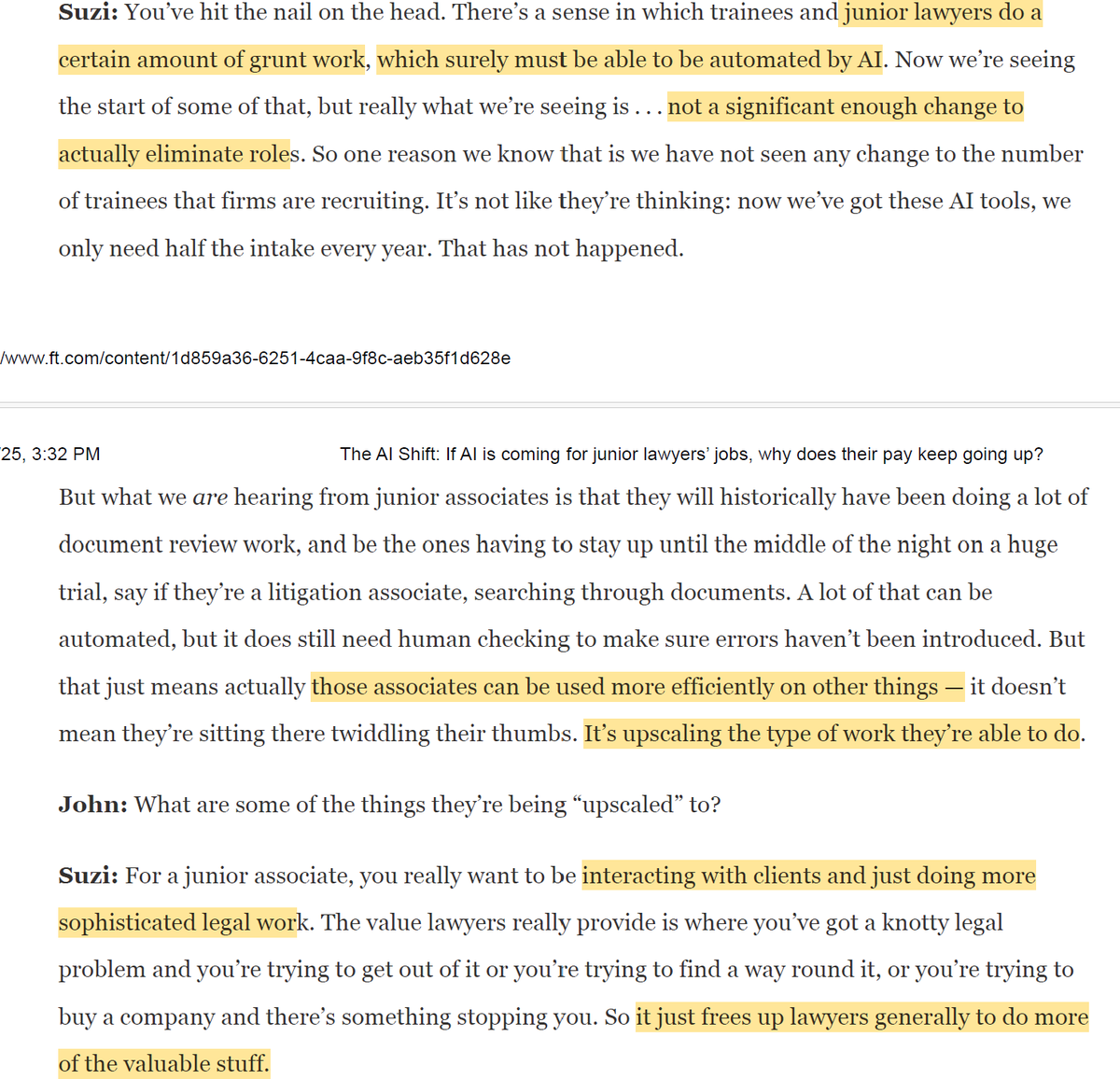
👇Fantastic @FT column by @sarahoconnor_ & @jburnmurdoch with @journosooz — a rich illustration of what @lukasfmann and I call *Job Transformation* due to AI in our paper (link below), through the lens of the legal profession.
Highly recommend the weekly "The AI Shift" column!
🆕 RFBerlin Discussion Paper!
@_LukasFreund_ & @lukasfmann study how AI transforms jobs, shifting tasks, increasing specialization, and altering skill demand. They document who gains, who loses, and how labor markets adapt as AI reshapes work. 🔗 https://t.co/T25qrRleAl
Great fun to present
"Job Transformation, Specialization, and the Labor Market Effects of AI"
(joint with the fantastic @lukasfmann) @nberpubs EFG Fall Meeting today! 🔗to paper in tweet below.
Thanks to @glviolante & Corina Boar for organizing & including us in the program!
HIRING NEWS at @AsuEcon.
At ASU Economics @WPCareySchool, we will have two Open Field positions in this job-market season.
Postings will be up in JOE soon. Stay tuned!