The Qubitcoin Foundation continues to grow.
Please join us in welcoming Dmitrii Khitrin as Director of the Qubitcoin Foundation.
Dmitrii brings a strong background in quantum computing research, with experience at Duke University, the Duke Quantum Center and the Weizmann Institute of Science.
Welcome aboard, Dmitrii!
MIT, 1981.
Richard Feynman presents his paper, “Simulating Physics with Computers”, at the first Physics and Computation Conference.
The paper would become one of the foundational works of quantum computing.
Feynman posed a bold question:
Why can’t we simulate quantum systems efficiently on classical computers?
His conclusion was radical:
If nature is quantum mechanical, perhaps the best way to simulate it is with quantum machines themselves.
More than four decades later, that challenge remains.
And fittingly, the story continues where it began: MIT.
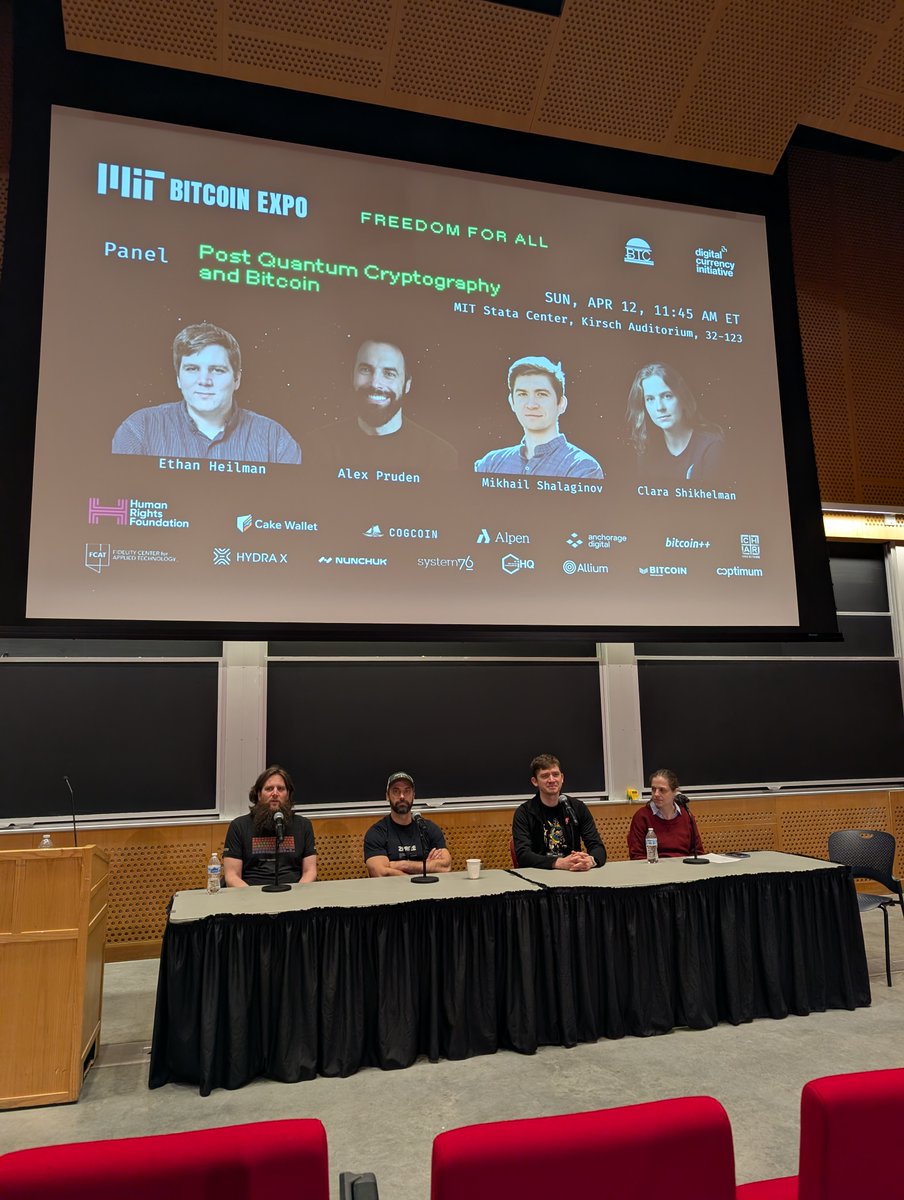
It was great to take part in the @MITBitcoinClub Expo, joining a panel on post-quantum cryptography and interacting with Bitcoin Core developers and leading cryptographers.
As quantum machines mature, running Shor's Algorithm or its variants at scale is becoming increasingly plausible, directly challenging Elliptic Curve Cryptography, which underpins Bitcoin and Ethereum.
Bitcoin’s security relies on private keys. However, once a transaction is made, the public key is revealed. With a sufficiently powerful quantum computer, that public key could be used to recover the private key and take control of the funds. This fundamentally changes the security assumptions of the entire ecosystem.
The solutions are not straightforward. Post-quantum schemes exist (e.g., Falcon and Dilithium), but signatures are often 10–100x larger. Since signatures dominate transaction size, this would mean fewer transactions per block, higher fees, slower propagation, and increased centralization pressure. A naive transition risks disrupting Bitcoin’s economic balance.
Upgrading Bitcoin is also inherently difficult. The system resists change by design, and history (e.g., the 2017 split into Bitcoin Cash) shows how contentious even relatively simpler upgrades can be. A post-quantum transition would require global coordination and a large-scale migration of funds.
There is also a deeper question: a significant fraction of coins that are likely lost becomes vulnerable in a quantum scenario. Should they be left as a bounty, or somehow reclaimed? There is no clear consensus.
Quantum computing is advancing rapidly and poses a systemic risk to digital assets. The window to prepare is limited, and the challenges are both technical and social.
Can Bitcoin be upgraded, or will its core assumptions be tested beyond repair?
P.S.: I believe @qubitcoinx (originally inspired by Bitcoin) will become both quantum-secure and quantum-friendly.
Dr. @MYShalaginov — quantum scientist, entrepreneur, and creator of Qubitcoin.
With a Ph.D. in Quantum Photonics from Purdue and postdoctoral research at MIT, he now leads work on neutral-atom quantum machines at QuEra Computing and previously co-founded 2PI Optics. Join us at #MITBitcoinExpo2026 for a presentation and panel discussion at the cutting edge of quantum computing and Bitcoin.
Get tickets now at https://t.co/k58lzEMLHv
#MITBitcoinExpo2026 #FreedomForAll #BitcoinBoston #BTCxMIT
iQuHACK week at @MIT is almost here!
We’re excited to join researchers, students, and industry leaders for a weekend focused on quantum computing, simulation, and real-world experimentation.
We’re also looking forward to sharing this year’s Superquantum workshop theme, which is closely aligned with current developments in quantum computing … 🔐👀
For participants who are preparing to join, we recommend taking a quick last-minute look at MIT Quantum Winter School 2026 - a series of lectures on quantum computing by students from MIT and Harvard. You can find the resources here:
https://t.co/NjtT4xHHk9
See you in Cambridge (or remotely)!
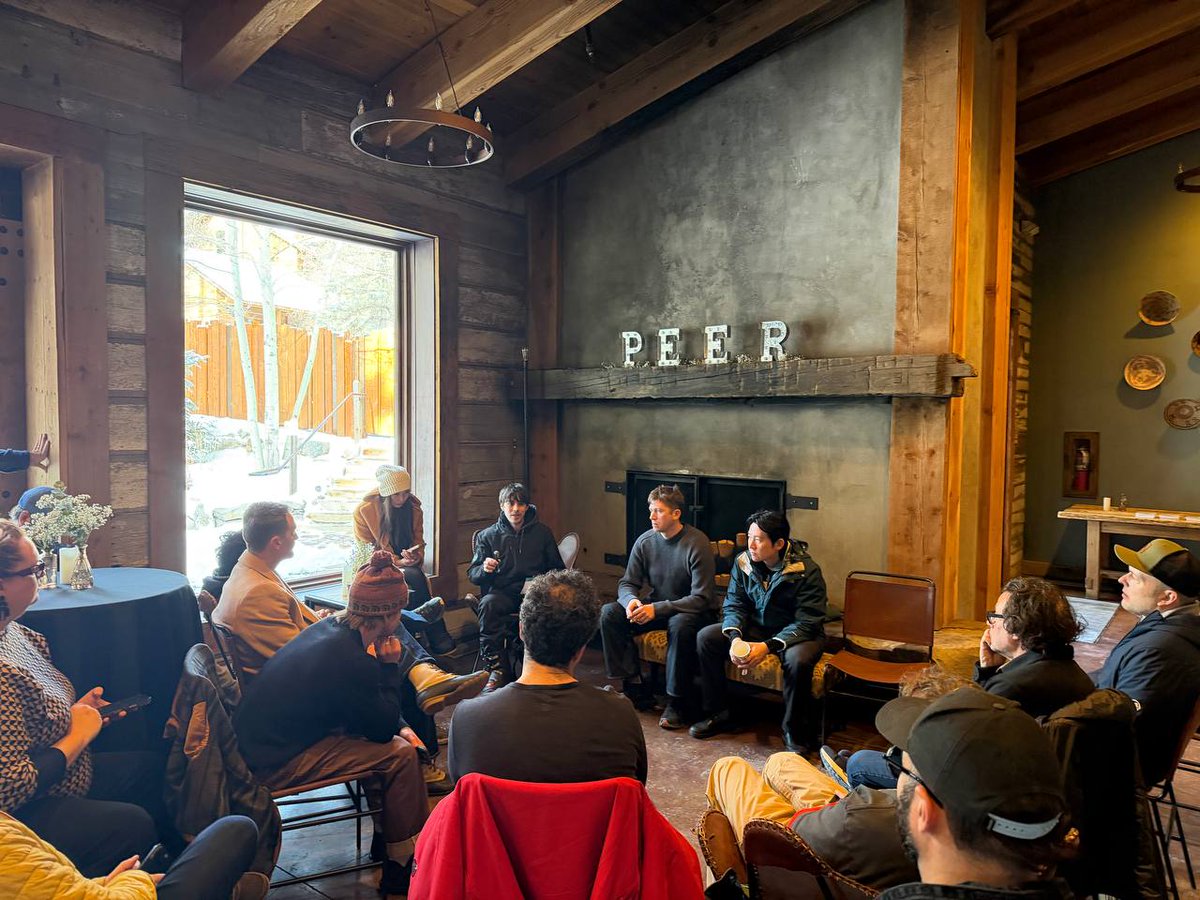
Last week at the PEER Summit:
The Qubitcoin team participated in the event and joined discussions with peers from across the space.
Here, Mikhail is taking part in a panel discussion on quantum, security, and risk, where we had a lively debate on quantum computers compromising Satoshi’s wallets, how ready quantum technology truly is today, and the global race to build scalable quantum machines.
Thank you for having us. It was a pleasure exchanging ideas and perspectives.
We are excited to introduce Superdense Consensus (SDC) - a new and unique multi-task Proof-of-Work architecture.
Qubitcoin can now run multiple independent PoW challenges simultaneously on the same chain, each with its own difficulty adjustment and activation schedule.
The first public code release is now available on the sdc-testing branch:
🔗 https://t.co/AzxgSE9T2S
We invite developers, researchers, and miners to explore the implementation, run tests, experiment with new workloads, and share feedback.
Additional technical details are included in the updated README.
Important notes:
– This is an early-stage release; expect rough edges
– Unit/integration tests and additional features are actively in development
– Do not use the binaries compiled from the new branch in the production environments (critical bugs may be present)