I'd like to understand how @IamCPS weighs the safety of kids walking to school in the cold against the well-being of those same kids, and 1000s of others, who are home-maybe alone; maybe w/o the food they get from school-not learning or socializing. This is a genuine question.
Austin is building housing like crazy.
Rents are down 7%.
But rather than frame this achievement as a win for renters—or for the arg that housing prices respond to supply growth—WSJ frames it pretty clearly as bad news across the board.
Supply is not everything - we will always need gap subsidy for deeply affordable housing. But this is a good reminder that part of the solution really is just building way more housing.
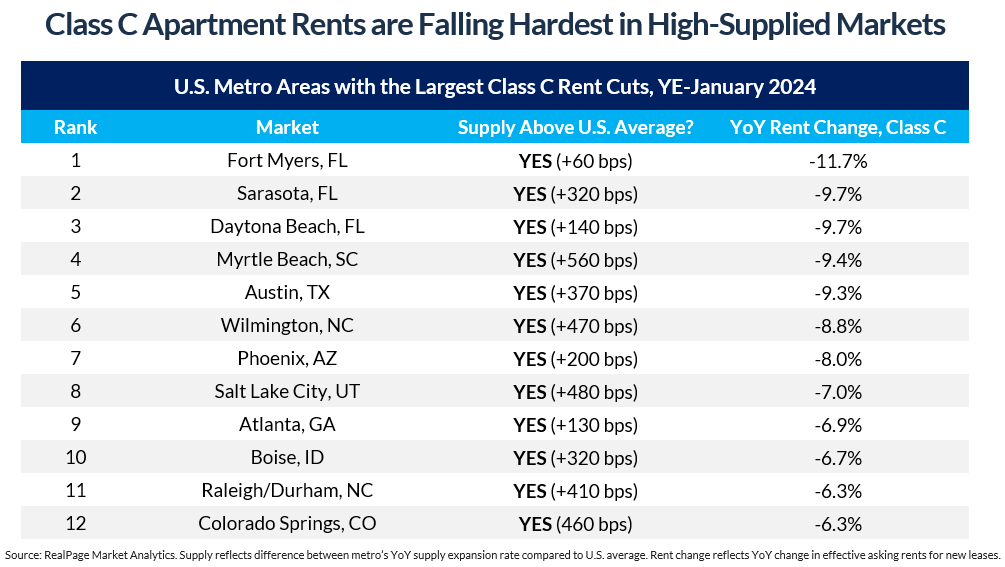
When you build "luxury" new apartments in big numbers, the influx of supply puts downward pressure on rents at all price points -- even in the lowest-priced Class C rentals. Here's evidence of that happening right now:
There are 12 U.S. markets where Class C rents are falling at least 6% YoY. What is the common denominator? You guessed it: Supply. All 12 have supply expansion rates ABOVE the U.S. average.
There's no demand issue in any of these 12 markets. They're all among the absorption leaders nationally -- places like Austin, Phoenix, Salt Lake City, Atlanta and Raleigh/Durham, Boise, etc. But they all have a lot of new supply.
Simply put: Supply is doing what it's supposed to do when we build A LOT of apartments. It's a process academics call "filtering." New pricey apartments are pulling up higher-income renters out of moderately priced Class B units, which in turn cut rents to lure Class C renters, and on down the line it goes.
Less anyone still in doubt, here's another factoid: Where are Class C rents growing most? You guessed it (I hope!) -- in markets with little new supply. Class C rent growth topped 5% in 18 of the nation's 150 largest metro areas, and nearly all of them have limited new apartment supply.
Most new construction tends to be Class A "luxury" because that's what pencils out due to high cost of everything from land to labor to materials to impact fees to insurance to taxes, etc.
So critics will say: "We don't need more luxury apartments!"
Yes, you do. Because when you build "luxury" apartments at scale, you will put downward pressure on rents at all price points.
Spread the word.
An excellent, to-the-point explanation of how homelessness and housing affordability more broadly are impacted by a regulatory system that makes it very hard to build housing.
I’ve attended plenty of confs full of happy talk w/o depth, detail, or realism. @CMReggieHarris and his partners (incl @CinDevFund) did something very different @ Black Developers Conf: real talk of how development and finance actually work. This is so necessary and so valuable
@CincinnatiPort@HabitatCincy Everyone who wants more housing in Hamilton County should be joining hands to do everything we collectively can to make building housing easier. Zoning, permitting, funding, everything. Let's BUILD!
Today we @CinDevFund announced the first phase of aff housing funding through our partnership with Hamilton County. 1) thank you @aliciareece, @DeniseDriehaus, + @summerow_dumas for the commitment of ARPA funds that made this possible! 2) here's a 🧵with more /
Two dozen Hamilton County communities will see more than 550 new or preserved affordable homes under a plan announced by the Cincinnati Development Fund, Hamilton County and private developers. https://t.co/XgQTE1E8Ri
@CincinnatiPort@HabitatCincy We can and must keep at this because the cold hard fact is housing development - and especially affordable housing development - is hard! Costs are higher, revenues are lower, and the funding sources are hard to pin down. So I will end this 🧵with a simple plea: