Excited to share an analysis on “Therapeutic targeting of beta-catenin in cancer” published today in Molecular Cancer Therapeutics @MCT_AACR, an @AACR Journals publication, ahead of the American Association for Cancer Research D3 meeting #AACRdrugdev26
Mutations in CTNNB1 (encoding beta-catenin), together with recurrent genetic alterations affecting the WNT signaling pathway collectively occur in more than 10% of human cancers. Thus, the WNT/beta-catenin pathway represents an attractive drug target, but only a limited number of compounds have entered clinical trials. This Perspective highlights lessons learned and it assesses opportunities and challenges in the development of therapies that directly aim to target beta-catenin. We highlight recent progress based on novel approaches – including stabilized peptides, degraders and condensate modulators, suggesting that cracking this previously considered “undruggable” central oncogenic driver is becoming a reality.
Big thanks to my co-authors at @Boehringer Ingelheim, Paola Martinelli and Peter Repiscak, for great team work in putting this analysis together.
Link to paper (open access):
https://t.co/fFFUgHj5jM
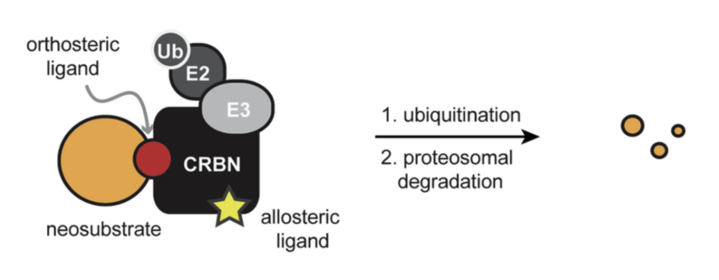
Pour a glass of champagne AND red Bordeaux—Our newest work with @GSK and @scrippsresearch is out in @Nature, where we describe SB-405483, the first allosteric CRBN ligand which potentiates neosubstrate degradation. Congrats Vanessa and all authors! 🍷💫💐
https://t.co/MLj3VOgsOq
Opening applications for a Principal Scientist, Computational Cancer Biology at @Boehringer!
Drive cutting‑edge computational oncology, advance MoA insights, shape biomarker‑driven patient selection, and turn multiomics + clinicogenomics into discoveries.
https://t.co/Y9UTSoO5b7
I am delighted to see our D2B approach for CNS-active degrader discovery is online . KH1 is identified as a rapid, potent and highly selective in vivo active chemical probe. For details: https://t.co/KFvnaxypL1
@FarnabyLab @dundeeuni@UoDCeTPD
& to all the fantastic colleagues I had the pleasure to work with during this time! Keep continuing to #innovate, #collaborate & #inspire, and I look forward to seeing all the amazing science when it comes out! ✨
After an incredible 3.5 years, I recently finished my time at @UoDCeTPD, working as part of the CeTPD-Boehringer Ingelheim PROTAC collaboration team. A huge thank you to Kirsten, @farnaby84 & @alessiociulli for the opportunity to join the Team and all your guidance throughout,
📖 The June-July Journal Club edition is out! Thanks to Aileen, Hiro, Ilaria and Mokhitli, great job editors! Don’t miss out on the latest news in TPD, have a look at the new edition of the Journal Club!
https://t.co/0R2sI6kdzu
#openaccess#TPD#journalclub@UoDLifeSciences
Pleased to share Dr Nur Kocaturk has been awarded a Cross-Sector Experience Award from @acmedsci
This funding will allow them to collaborate with Promega Corp to co-develop a new cellular ligand finding platform for intractable disease related proteins.
#NEWS: We're proud to share the @US_FDA has accepted our first-ever New Drug Application with @Pfizer for an investigational PROTAC ER degrader for patients with ESR1-mutated, ER+/HER2- advanced or metastatic #BreastCancer.
Read the full release: https://t.co/JIKx7PRYXW
Heads up for those working in ubiquitin biology and targeted protein degradation—Lorne Ubiquitin 2025 is happening 20–23 November in Lorne, Victoria, Australia.
Late abstracts are still being accepted—worth checking out!!! 🦘🦘🦘
Excited to share with you our latest preprint on SMARCA2/4 degraders! at the @UoDCeTPD in collaboration with #GeorgWinter´s lab. Here, we show how a Molecular Glue Degrader can covalently and redundantly recruit DCAF16 and FBXO22 to degrade SMARCA2/4
https://t.co/DmM53sXYie
New work introducing PCIPs, heterobifunctional chemical inducers of proximity that inhibit DNA repair by recruiting BET proteins to PARP2. Great work uncovering a new form of event-driven pharmacology by Bryce/Eric/Erin and the rest of the team. (1/3)
https://t.co/SHg4JURfyQ
🧩 New paper out in Nature Communications!
"Unveiling the hidden interactome of CRBN molecular glues"
Huge thanks to our incredible team and collaborators who made this possible!
📖 Read the full open-access article here: https://t.co/iuTyDM24Vs
Our proteomics group is looking for a Scientist who is excited to push the boundaries of chemoproteomics and interactomics at Dana‑Farber!
Apply at the link or message me with questions! https://t.co/csqFoClQQo
Delighted to share that a project 'Green PROTACs – Enabling Small Molecule (Re)programming and Manipulation of Plant Biology' by Dr Piers Hemsley @Hemsley_Lab, Professor @alessiociulli and Dr @HajkDrost has been funded through this scheme.