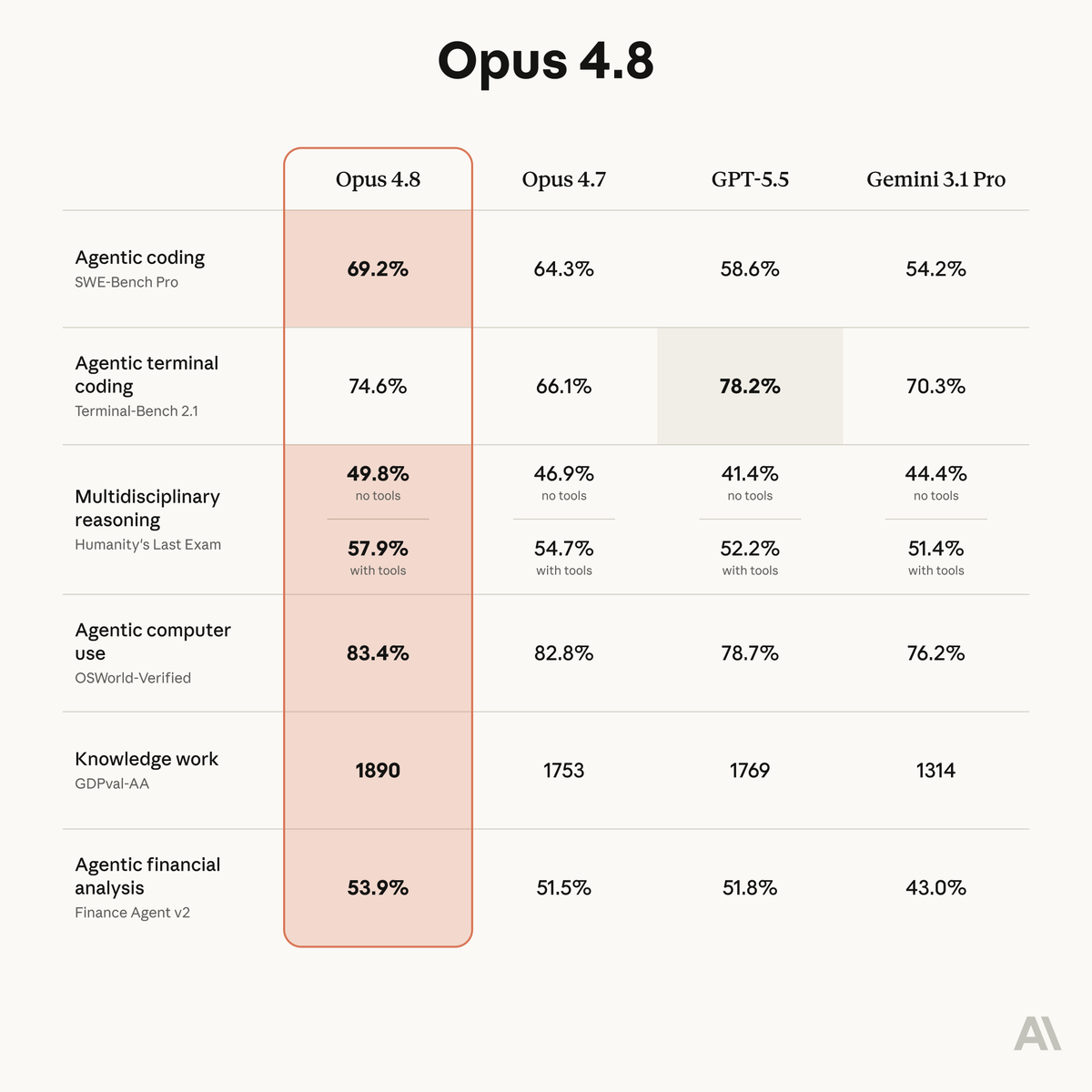
Introducing Claude Opus 4.8: it builds on Opus 4.7 with sharper judgment, more honesty about its own progress, and the ability to work independently for longer than its predecessors.
Available today at the same price.
How to manually enable the 1M context window for Sonnet 4.6 in Claude Code
~/.claude/settings.json:
{
"env": {
"ANTHROPIC_DEFAULT_SONNET_MODEL": "claude-sonnet-4-6[1m]"
}
}
@PanSalut@bridgemindai How to manually enable the 1M context window for Sonnet 4.6 in Claude Code
~/.claude/settings.json:
{
"env": {
"ANTHROPIC_DEFAULT_SONNET_MODEL": "claude-sonnet-4-6[1m]"
}
}
How to manually enable the 1M context window for Sonnet 4.6 in Claude Code
~/.claude/settings.json:
{
"env": {
"ANTHROPIC_DEFAULT_SONNET_MODEL": "claude-sonnet-4-6[1m]"
}
}
GLM-5 is a total miss for me. These BridgeBench scores are spot on—it’s borderline unusable for actual work. There’s clearly a misalignment in the team’s values if they thought this was ready for prime time.
BridgeBench is officially live.
The first vibe coding benchmark built by vibe coders, for vibe coders.
Current rankings:
Claude Opus 4.6 — 60.1
MiniMax M2.5 — 59.7
GPT 5.2 Codex — 58.3
Kimi K2.5 — 50.1
GLM 5 — 41.5
Most benchmarks test models in isolation.
BridgeBench tests real coding workflows: debugging, algorithms, refactoring, generation, UI, and security.
We also track what others ignore: cost per task, completion rate, and speed.
MiniMax M2.5 is 0.4 points behind Opus 4.6 at 1/8th the cost.
GLM 5 looks great on paper but only completes 57% of tasks.
Plans to open source soon.
Claude Code + Agent Teams is a literal cheat code. 🤯 I’ve become so spoiled by this workflow that every other CLI feels broken now. How did we even work before this?





![lukitdev's tweet photo. How to manually enable the 1M context window for Sonnet 4.6 in Claude Code
~/.claude/settings.json:
{
"env": {
"ANTHROPIC_DEFAULT_SONNET_MODEL": "claude-sonnet-4-6[1m]"
}
} https://t.co/2ZvjAVaGY9](https://pbs.twimg.com/media/HBZkMEQbcAAWOEa.png)