We just onboarded a multi-billion-dollar crypto asset manager to deploy an institutional-grade lending market.
@Bitwise is now curating an @ethena market on Jupiter Lend.
A turning point for on-chain lending 👇
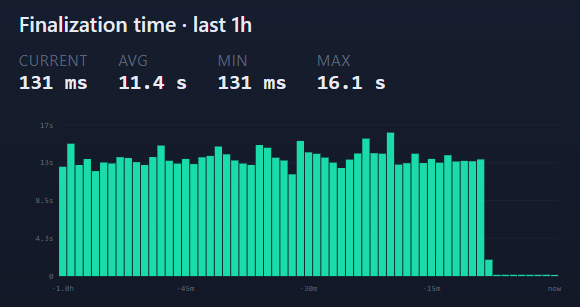
We just had the first successful Alpenswitch on our Alpenglow community cluster! The @solana finalization time improved 100x. Thanks to everybody participating.
Watch it live:
https://t.co/sb4wQkCsfd
https://t.co/WRQ6vE3AVd
We've identified an address poisoning attack targeting Squads users. We have no evidence of any users being impacted at this time.
Attack vector: Since all public keys are visible onchain, attackers are programmatically creating new multisig accounts that include existing Squads users as members. These multisigs appear in the UI because the program indexes all accounts associated with your key. Additionally, attackers are grinding public keys that match the first and last characters of your real multisig addresses, making fake accounts look legitimate at a glance.
Attacker goal: Get you to mistake a fake multisig for one of your real ones — either by copying its vault address (sending funds to an attacker-controlled account) or by signing a transaction you didn't initiate.
Impact: None, if you don't interact. This is not a protocol vulnerability. The attacker cannot access your funds, execute transactions, or modify your existing multisigs. It is purely a UI-level social engineering attempt.
Action required:
— Ignore and do not interact with any multisig you did not create or weren't added to by your team
— Do not rely on matching the first and last characters of an address to verify it — always verify the full address against your own records
— If you're unsure whether a multisig is legitimate, check with your team before taking any action
— Set your Squads accounts as default — this pins them to the top of your Squad list, making it easy to distinguish your real accounts from anything unfamiliar. We encourage everyone to do this now if you haven't already (click on ... next to your Squad in the Squad list).
UI updates shipping in the next two hours:
— A banner alerting users to this attack
— An alert on any multisig you've never interacted with before
In the next few days we are also shipping a whitelist logic where all new multisig accounts initially go to a pending state requiring you to manually add them to your Squad list.
We'll follow up here with updates as we roll these out.
Solana was built for security. As the ecosystem scales, so does our investment in the tools, standards, and support.
Today that commitment deepens with a new security program, active monitoring, formal verification for top protocols, and a new crisis response network.
Learn more 👇
Your onchain balance just became real-world spending-power with Jupiter Global.
Spend, send, and pay directly from your onchain portfolio wherever @Visa is accepted, seamlessly. With @JupGlobal you’ll get access to:
- Visa card accepted at 150M+ merchants
- APAC QR payments on local rails with quick settlement to both personal and merchant accounts
- Onramp and offramp via banking rails, low fees, and same day settlement
Everyday finance, now onchain.
Over the next few days, we’ll break down why Jupiter Global is the most complete onchain payment system ever built.
Just use Jupiter (Global).
Many people have asked over the last few days why we at Jupiter decided to run Harmonic.
The answer is simple.
If Solana is going to keep evolving, we need competition, not concentration.
The healthiest market structure is one where multiple serious teams push each other to raise the bar.
I hope Temporal comes in strong. I hope Jito responds just as strongly.
We’ll continue to support a landscape where performance, resilience, and innovation are shaped by competition.
1/ SIMD-0370, by Jump’s Firedancer team, proposes removing Solana’s fixed compute unit block limit after Alpenglow. This would eliminate static caps on block limits and have validators skip blocks they can’t process in time. Here’s what changes 🧵