@LumberTrading They still have 60MM barrels to sell from the SPR release of the 172MM authorized before the end of the summer. That's a lot of sell pressure and a lot of leveraged longs to liquidate
@chamath SEIU-UHW and their friends successfully* drove them out with zero resistance because tech elite are in general no longer a reliable ally of the democrat establishment.
Important to understand that this was a victory for them, not a mistake.
@chamath Chamath, why don't you and/or your friends put together a consortium to buy CNN and/or MSNBC? WBD and Comcast really want to sell them!
Legacy media might be dying in terms of audience, but their influence is still gigantic. It's worth many multiples of the enterprise value.
@2x4caster@realKunalAShah@tierrapartners If Europe and other allies were to basically do their own version of MAGA to "own" Trump, that would be great for them and great for the USA. But they're not actually doing anything to strengthen themselves, like for example lowering energy costs or trying to cut waste.
Inflation is hard to measure. It's not just that the CPI methods are all finessed (because printing 5% and marking CPI 3% means real GDP growth), it's also that those methods don't count the natural deflation that occurs when progress is made and real outputs become less costly. Real cost essentially means "how difficult is this output," so it should be clear to see how outputs like "digging a hole" and "travelling across the Atlantic" have decreased in cost tremendously due to the excavator and airplane, independent of any question of money supply. The mental math there is roughly manpower and time. This is why inflation can't be measured with the price of gold. The guys on Henry Ford's assembly line were paid the equivalent of 1/4 oz gold per day which works out to a yearly salary of $275,000 USD, but gold has appreciated relative to real output since then.
So real output can't be measured in dollars not only because the value of a dollar is always changing, but because lots of spending is on things that are not output. However, this categorization is not trivial. While it may be obvious that a bridge is real output and time spent navigating unnecessary permitting is not real output, there's no easy lines and it's impossible to tell the difference between "real" and "unnecessary" paperwork. But we can definitively claim that "real" paperwork facilitates more real output in the future. For example, a functioning legal system builds trust which encourages investment which generates more real output. Compare the same bridge project in Juba, South Sudan vs Ottawa, Canada. Independent of supply chain and labour, the South Sudan project would require an order of magnitude more "effort" for no other reason than countless locals and officials demanding tribute in one form or another, plus theft, vandalism, and so on.
But why should a bridge be considered real output? What if it doesn't lead anywhere? What about keychains or disposable decorations? The answer to this is that if the market pays for it, it has utility. Maybe the government will build a bridge to nowhere sometimes or demand expensive compliance for no benefit, but in aggregate these types of policies will show up as a lack of growth of real output. The bridge to somewhere leads to more bridges being built in the future, whereas the bridge to nowhere does not. But we are getting circular here because we still don't know what real output is.
There is one metric that is impossible to fake, easy to measure, and is indisputably a proportional input to every single real output. It's the basis for proof-of-effort which underpins the $3T market cap of cryptocurrency. This is total energy consumption. While it may not be intuitive that total energy consumption is one for one real output, it is clearly directly proportional. In different places, the cost of certain outputs can vary wildly. Imagine building the same skyscraper in 20 different countries. The cost can be very different, but the total energy input will be very similar.
So if we claim that energy consumed is linearly proportional to real output, then we can take total energy consumption and divide by GDP to get what economists call "energy intensity". With our assumption built in, it's "how much real output do you get for $1 USD"? Interestingly enough, economists look at this number completely backwards. They generally claim that economies that use less energy per USD are more "efficient," so a lower number is better. But this frame is absurd on its face. We can test it by looking at the delta. If you increment the energy side, say by building 1000 bridges for zero cost, then the energy consumed goes up and GDP stays the same. Energy intensity increased. Likewise, if the government prints $10B and pays 10,000 people to send emails to each other, then GDP has increased and energy consumption has not. So energy intensity goes down in that case. So it should be clear that a higher number is generally better.
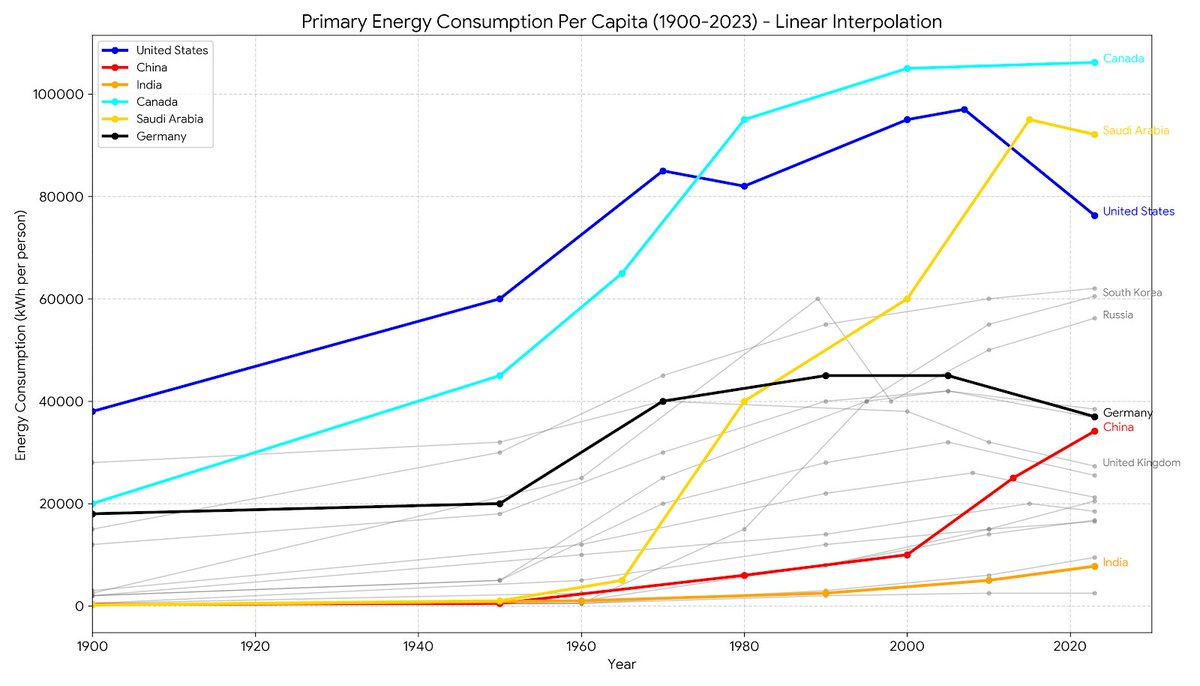
Below are two graphs: total energy consumption by country, and energy consumption per capita. From the graphs we see two things. a) USA is undisputed world heavyweight from before 1900 until 2010 or so, and b) living standards in western countries have not improved much since 1970, and c) no non-western countries have yet fully caught up, save for a few small rich states like Qatar.
If you buy lumber in truckloads, check out https://t.co/bIddZKly7b
In the last election, Canadians voted to align politically with the EU (deindustrialization, massive third-world immigration, soft on crime, money printing for entitlements) over MAGA. Carney is a real business man contrary to his peers, but because he professes no values contrary to Trudeau's Liberals, he will not be able to police the communist and foreign-nationalist elements of his party, even if he wanted to.
Older Canadians really dislike Trump. A core part of their identity is being somehow more culturally enlightened (leftist, basically) than Americans. If they come around to supporting Trump or Canada's version of Trump, they have to admit that their generation's vision for the future was rotten all along. Unfortunately it's not going to happen.
Good for TD to put this out even after the Americans fined them $3B for their indiscretions.
@LumberTrading@2x4seven@realDonaldTrump It's up, but not that much. Canadians are either willing to eat a lot of the tariff or more likely assuming it won’t be in place long term.