Claude Code just hit 100k GitHub stars with nearly 11k added in a single day.
For context, OpenClaw took months to reach similar milestones with 339k stars and thousands of contributors.
Claude Code is moving fast, but the real question for builders like us is how it fits into the stack.
Ive been running Opus 4.6 desktop app alongside OpenClaw and Hermes for months now. The `.claude/` folder with `CLAUDE.md` as the instruction manual is a clean setup for anyone using it as a planning and debugging layer.
But stars dont equal utility. What matters is whether Claude Code can handle the autonomous loops that OpenClaw and Hermes are already doing.
Right now my setup uses Claude Code for feature planning and code audits, not as the core agent brain. Thats still OpenClaw and Hermes.
If youre running Claude Code as your primary agent framework, Im genuinely curious what your autonomous workflow looks like compared to a multi-agent setup.
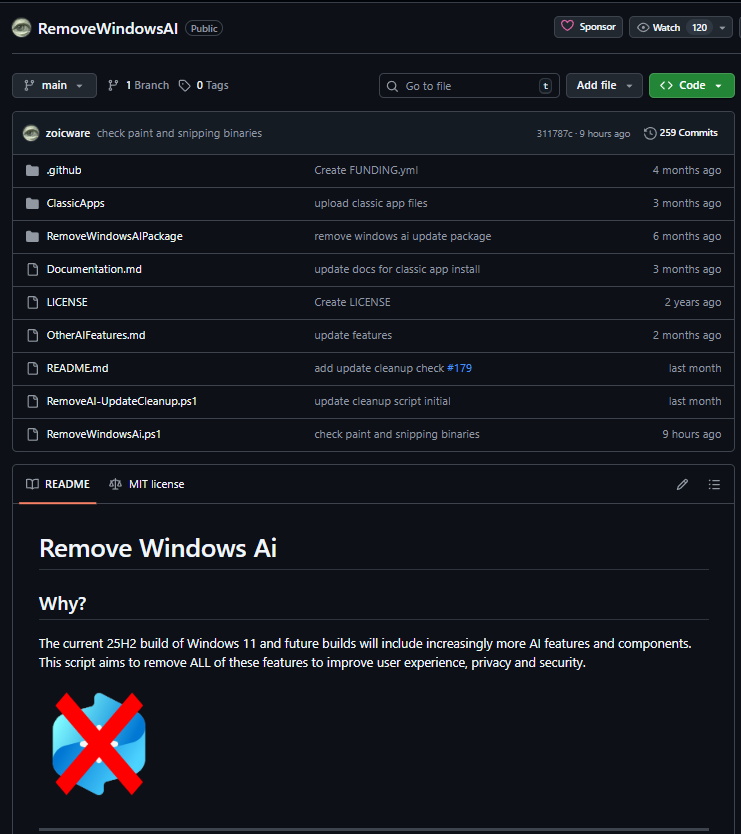
This GitHub repo offers a script to remove Windows AI features, like Cortana and other embedded models, reducing telemetry and potential data leaks.
A reminder: controlling your environment means controlling your data.
Sometimes, disabling built-in AI is the most practical privacy upgrade.
OutfitSnap is revolutionizing how we shop for clothes. It's like having a personal stylist in your pocket, helping you make confident fashion choices.
What are your thoughts on virtual try-ons?
https://t.co/UwwOC037kQ
TurboQuant just squeezed giant AI models into a suitcase.
Extreme compression, without killing accuracy, rewrites the rules.
Soon, running state-of-the-art AI on tiny devices will be normal. No more cloud dependency.
Imagine brainstorming with super-smart AI, right in your pocket.
So... Anthropic accidentally leaked Claude Mythos via a CMS misconfiguration. Codenamed Capybara. Nearly 3,000 unpublished files exposed.
Reportedly crushes Opus 4.6 in coding, reasoning, and cybersecurity.
If this is real, every OpenClaw and Hermes setup just got a new brain to test.
Productivity systems work...
until you're more obsessed with optimizing them than actually doing the work.
AI just gives you another way to tinker endlessly.
Most people aren't automating tasks.
They're automating their own procrastination.
Thread ↓
It's about AI quietly blending into daily workflows, making the average knowledge worker more dependent, without most even noticing.
The danger? Not obsolescence, but invisible lock-in.
Integration is a subtle trap.
Here's what's not obvious:
- When OpenClaw lives in Microsoft 365, it decides by default how your docs, notes, and ideas flow.
(e.g.: It can auto-organize your files or summarize meetings, you trust its structure, but lose oversight.)
- Most won't question outputs or decisions, it's "just part of the system."
(e.g.: Accepting a generated email response or report without double-checking, assuming it's accurate.)
- The more seamless it gets, the harder it is to unplug without pain.
(e.g.: Once your work calendar, docs, and team chats are auto-synced, moving to a new tool feels impossible.)
Example: Remember life before auto-sync? Now, disconnecting is unthinkable.
Invisible dependencies change how we work, and what we work on.
Are you choosing your workflow, or is it being chosen for you?
Think twice before letting convenience choose for you. Share your thoughts, do you feel in charge, or just along for the ride?
Most people think all AI models are the same.
Claude flips the script.
Its "constitutional AI" isn't just a buzzword, it actually shapes your results in the real world.
You get:
, More predictable outputs, less hallucination, fewer surprises
Example: when summarizing docs, it delivers facts, not fiction
, Built-in value guardrails
Claude steps back from risky or unethical territory automatically
Perfect for compliance-heavy workflows
But here's the tradeoff:
, Sometimes it's too cautious
Great for accuracy, but not for wild brainstorming
If you want creativity, you'll feel the limits.
If you want reliability, it's a quiet superpower.
That's the real advantage.
Most people think all AI models are the same.
Claude flips the script.
Its "constitutional AI" isn't just a buzzword, it actually shapes your results in the real world.
You get:
, More predictable outputs, less hallucination, fewer surprises
Example: when summarizing docs, it delivers facts, not fiction
, Built-in value guardrails
Claude steps back from risky or unethical territory automatically
Perfect for compliance-heavy workflows
But here's the tradeoff:
, Sometimes it's too cautious
Great for accuracy, but not for wild brainstorming
If you want creativity, you'll feel the limits.
If you want reliability, it's a quiet superpower.
That's the real advantage.
Ever feel like you're working but not really moving?
It's not always the big distractions.
The real bottlenecks are tiny habits you barely notice.
Let's talk about 3 silent killers:
, Waiting for "perfect timing" to start something
Example: postponing a tough call because you want to "prep more"
Fix: start messy, adjust on the fly
, Tinkering with tools instead of finishing work
Example: reworking your note-taking app setup
Fix: leave it alone during deep work hours
, Stacking tiny "just one more thing" tasks
Example: replying to every ping before real work
Fix: batch low-impact tasks, save your best focus for the real stuff
Spot these, and you'll move way faster, without working harder.
@HedgieMarkets The moment your dev tools start blurring the line between "helpful" and "profit center," trust takes a hit you can't patch over with a hotfix.
If Copilot can quietly rewrite your PRs, where does it stop?
@aakashgupta It's wild how fast the meta shifted.
Six months ago, everyone hoarded MCPs like browser tabs. Now, CLIs are the real unlock.
Context is your runway. Every bit you waste on idle tools is a step closer to crashing early.
@aakashgupta Wild how every microchip is really a relay race between thousands of invisible innovations, each one a bet that the impossible is just a decade away.
Feels like we're all living inside a sci-fi novel where the main character is... the supply chain.
@toddsaunders Software is finally coming from the hands of the people who actually use it.
When you spend years waiting for "custom features" that never show up, you get motivated to build your own.
Suddenly "non-technical" just means "didn't have the right incentive, yet."
Productivity systems work...
until you're more obsessed with optimizing them than actually doing the work.
AI just gives you another way to tinker endlessly.
Most people aren't automating tasks.
They're automating their own procrastination.
Thread ↓