High conviction longs as of 23/09/2026:
- $AMZN : owner of valuable compute - short-term winner due to shortage, long-term winner over neoclouds due to stronger lock-ins and ASICs; efficiency gains from robotics; Prime is one of the strongest consumer subscription plans spanning shopping and video streaming; stake in Anthropic
- $AVGO & $NVDA : the best AI accelerators and networking products for AI training and inferencing
- $HSAI : largest LiDAR maker globally; supports L2 -> L3 ADAS transition, autonomous driving, and humanoid robots; validation from Nvidia & Unitree
- $LITE : duopoly with Coherent in high-end optics (UHP lasers, OCS); scale-up, scale-out, and ultimately scale-across
- $META : far from fully monetizing their large compute reserves; mgmt believes internal uses would eventually carry higher ROI than renting externally, which already has highly attractive ROI; Muse is the way the majority of population will interact with agentic AI as most won't be using Codex or Claude Code, at least for everyday tasks
Other longs I hold: $NOW, $TYL, $GWRE
Come on guys, if you actually believe this, you really don’t understand how a company like Nvidia operates. We’re talking about a multitrillion-dollar company with a board of directors, shareholders and corporate governance. You seriously think they’re going to cut billions in chip orders because of the CEO’s personal scandal? What does his private life have to do with wafer demand? This isn’t some banana republic.
Looks like $COHR is the new sentiment leader in optics.
I don't think we've ever seen this stock outperform the peer group this hard on a green day.
After $AAOI missed guidance and $LITE is in topsy turvy land with its $MRVL deal...
$COHR beta should go way up.
I wanted to test Fable 5.2's quality with one-shot prompts without human feedback.
Everything in this game is from scratch: models, sounds, textures. ~$550 at API pricing, ~2.7M output and 445M input tokens, heavily cached. Took 8 hours!
Play it here: https://t.co/fazOCcyNIH
@ishaa_malhotra Wife. 41 years, two kids, and co-building a trillion-dollar company from a college lab partnership. The other option comes with foreign intel probes and public apologies. No contest.
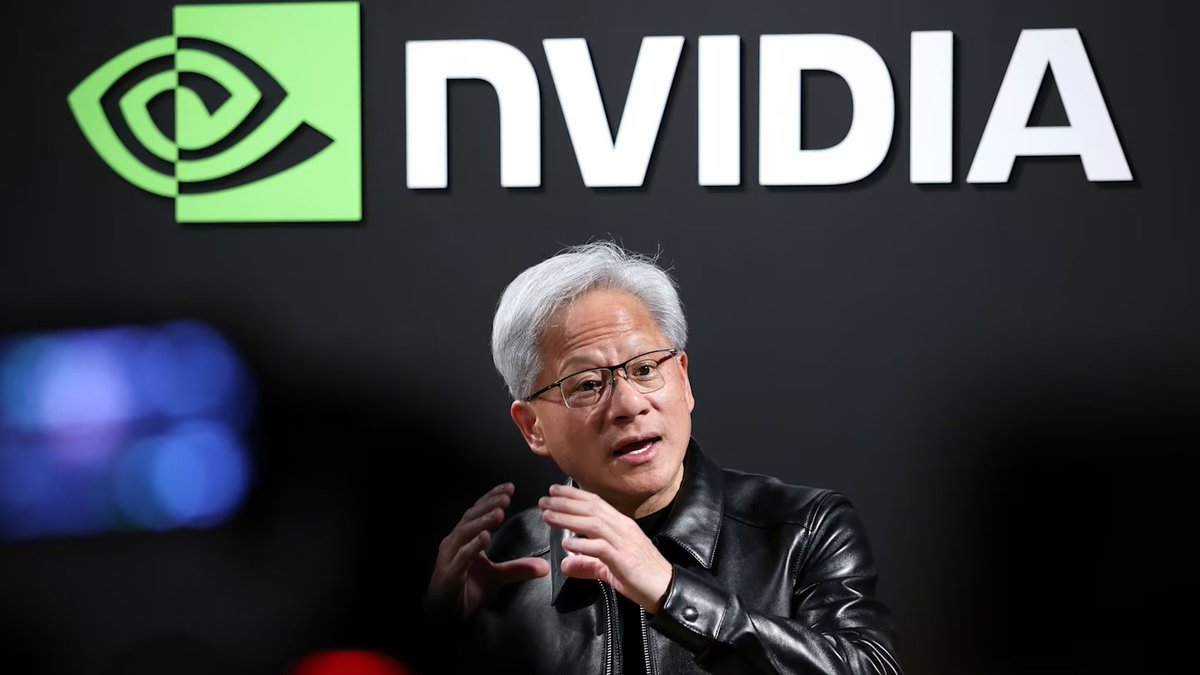
According to The Information, NVIDIA has long lobbied hard against proposals to restrict Chinese companies’ access to its latest chips through overseas cloud providers. But since the scandal surrounding Jensen Huang broke, that lobbying appears to carry less weight in Washington.
The fallout has reportedly made it easier to advance three bills. The MATCH Act would restrict shipments of lithography equipment to China. The Overwatch Act would give Congress greater oversight of the Commerce Department’s decisions to approve AI chip sales to countries such as China. The Chip Security Act would require AI chips to have built-in tracking capabilities.
The National Defense Authorization Act is expected to pass before the new Democratic-led Congress convenes in January. That gives Republican leaders an incentive to help move the legislation forward now, while they still have more say over what goes into the final bill.
Something that merits more discussion amongst those who believe it was a mistake by both the Biden and Trump administrations to allow the export of less powerful GPUs to China:
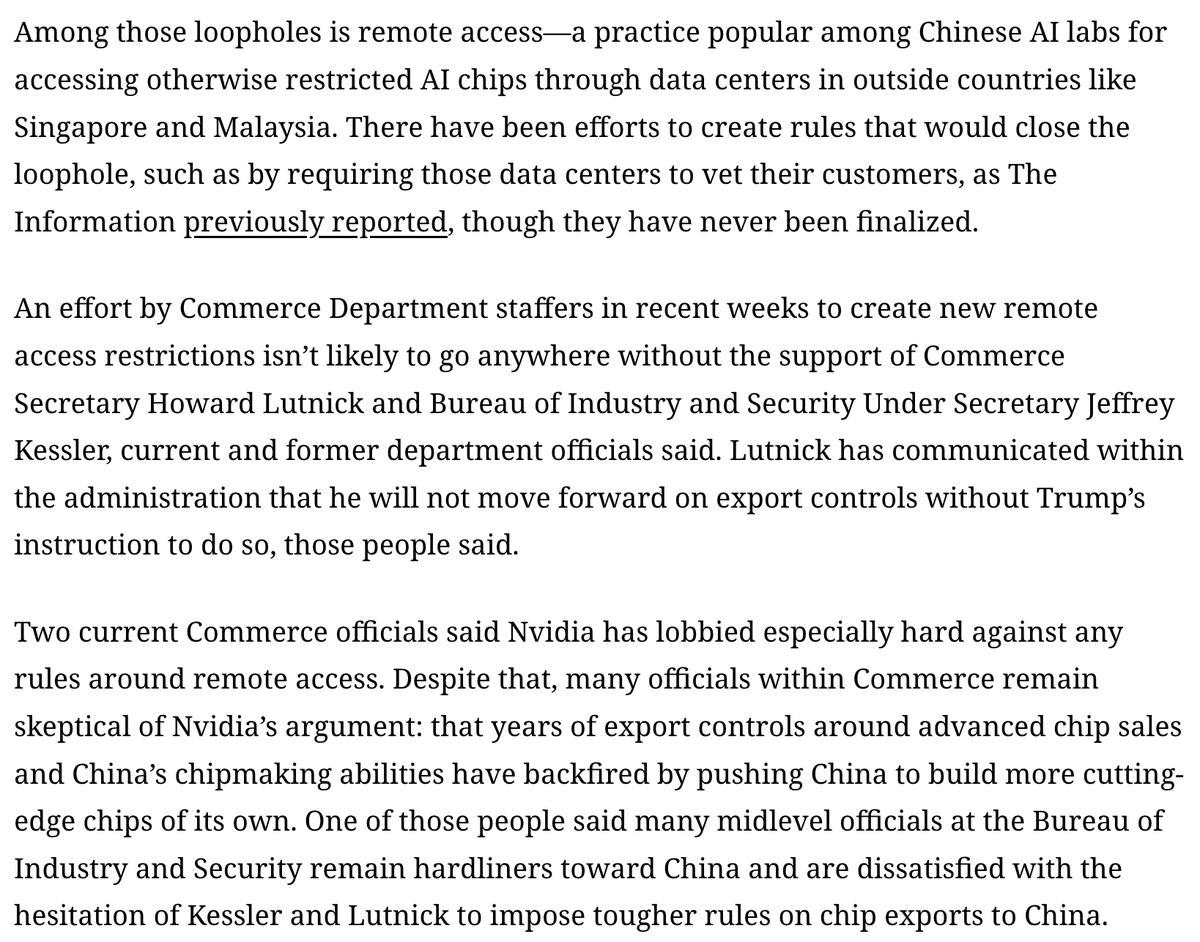
Since the summer of 2025, it has increasingly been *China*, not just DC, blocking Nvidia GPUs in China. Within weeks of Secretary Lutnick saying the goal was to get Chinese developers "addicted" to the American technology stack, Beijing began pressuring its tech giants to stop buying the H20. Then it ordered them to stop buying the RTX Pro 6000D, sent customs teams to the ports to crack down on Nvidia chip imports, and barred foreign AI chips from new state-funded data centers. And as of last week, Reuters reports that roughly 600,000 H200s are sitting in Hong Kong because Beijing won't approve large-scale imports of a chip that is still better than anything China's own industry makes at scale.
If allowing the export of these less powerful GPUs was a policy mistake that *advantaged* China, then why is *China* the one blocking them?
From my perspective, China understands that if they are dependent on American AI hardware - either on the ground in China or accessed remotely via the wide range of southeast Asian clouds (which include SE Asian availability zones from the largest American hyperscalers) - then we have immense leverage over them in any future conflict. Being able to turn off the clouds instantly is actually the greatest leverage.
Yes, Chinese AI labs still want Nvidia chips. Gray market prices for H200 servers have roughly tripled over the past year. But that is exactly the point. Beijing is willing to impose real costs on its own AI labs to avoid dependence on American GPUs, which tells you how Beijing views GPU imports: not as a gift, but as a threat to its own ambitions.
Maybe, just maybe, selling China GPUs that trail our own state of the art, so that Chinese developers stay “addicted” to American GPUs and China doesn't build an alternative AI hardware ecosystem that we have no control or influence over *and* that China could share over time with our adversaries, was actually a smart, pro-American national defense policy. And letting them access southeast Asian clouds might be an even smarter policy as so easy to turn clouds off.
I believed and still believed it was smart policy. And I say this as someone whose posts here are hawkish enough on China that I won't travel there anymore.
And note that both the Biden and Trump administration allowed the export of less powerful GPUs to China for all of these reasons. It was only under the Trump administration that China woke up to the risk of what was actually a pretty smart, pro-national defense policy and then China began restricting GPUs.
The lesson of the H20 is that a deliberately crippled chip doesn't keep China on our stack. Beijing moved against the H20 and RTX Pro 6000D as it concluded that domestic Chinese chips had caught up to them. So if China develops an alternative AI hardware ecosystem that it shares with Russia, Iran and North Korea, we will look back and think it would have been even smarter to offer China the B30A in 2025 instead of the H200s we eventually approved case-by-case. Especially given the H200 is not the frontier: with Vera Rubin now in full production, it is two generations behind what American labs are buying.
All of this is to say that Jensen has been consistently lobbying for a position that was adapted by both the Biden *and* Trump admins *and* looks smarter every month that goes by as Chinese labs increasingly adapt their MoE architectures to domestic Chinese hardware. DeepSeek reportedly gave Huawei and Cambricon early access to V4 instead of Nvidia and AMD, and a Huawei-led team has since post-trained V4-Pro on Ascend chips.
And if America *ever* falls behind China in AI, the China hawks here in America who helped accelerate the creation of this alternative Chinese AI hardware ecosystem will deserve a significant share of the blame.
Anthropic is targeting Thursday or Friday next week, Nov. 19-20, to begin trading on the Nasdaq under ticker $ANT
The company plans to unveil its IPO valuation range early this week, with some major investors pushing for a valuation below the previously expected $1.5T.
- WSJ
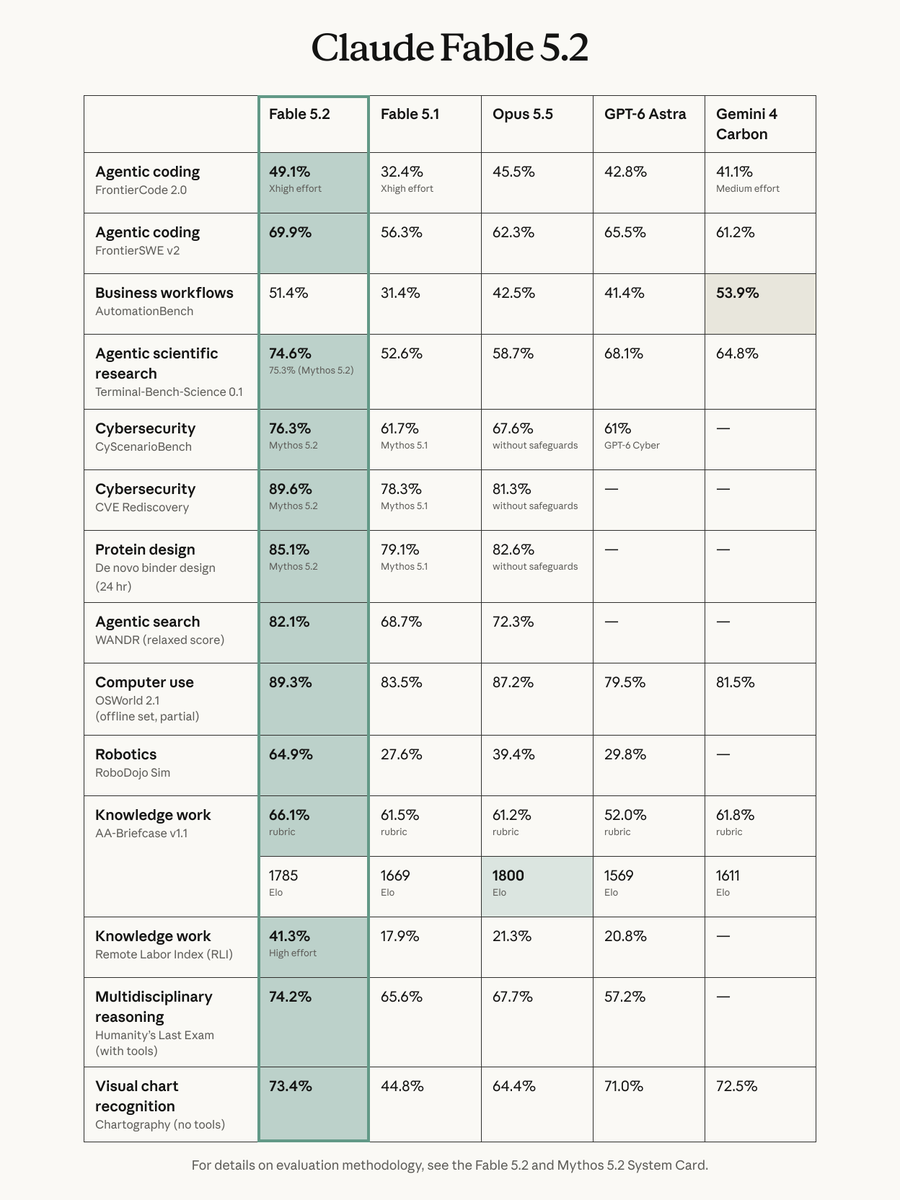
FABLE 5.2 AND MYTHOS 5.2 SPOTTED IN AMAZON AWS BEDROCK - LESS PRICE;
No announcement from Anthropic yet.
Both are priced 20% below 5.1, per 1M tokens:
input $10 → $8
output $50 → $40
Fable 5.2 and Mythos 5.2 are a step above Opus 5.5 in almost all the capabilities we evaluated.
Testers have found that they communicate more clearly than past Fable and Mythos models. They generate outputs up to 30% faster than Fable 5.1 and Mythos 5.1.
Introducing Claude Fable 5.2 and Claude Mythos 5.2, designed to tackle the most daunting technical challenges.
They’re capable collaborators on ambitious projects in many fields, and show improvements in areas like coding, reasoning, and vision.
GOOGLE EXPANDS ITS TPU CHIP LINEUP
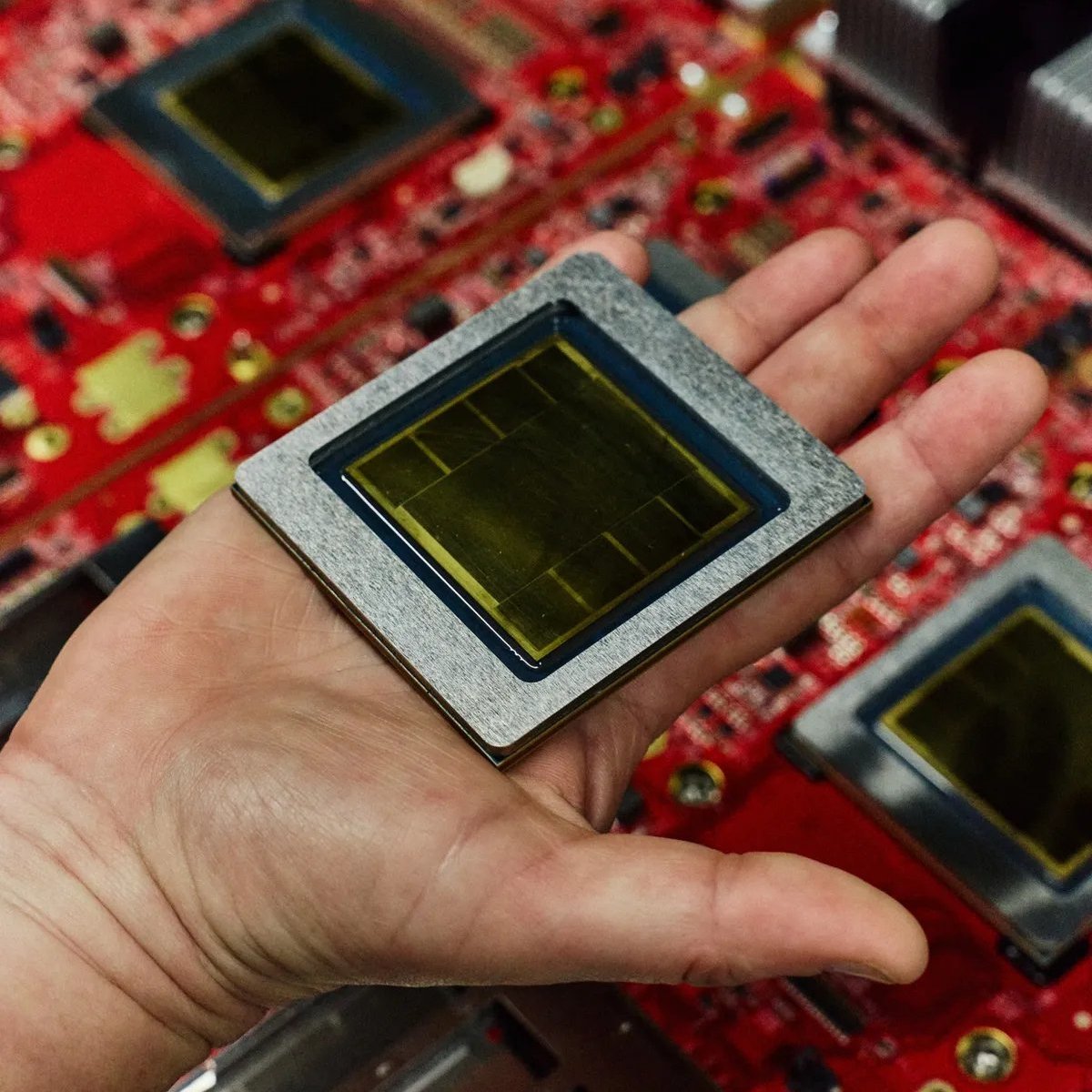
$GOOGL is introducing two new specialized versions of its eighth-generation TPU systems, bringing its lineup to four configurations, Bloomberg reports.
The new systems target two increasingly important AI workloads:
1) TPU 8tx: Designed for secure, confidential computing. It pairs with $AMD CPUs to enable chip-level data encryption, targeting government agencies and companies in regulated industries.
2) TPU 8i Max: Combines two TPU chips in a single package for greater computing power and memory capacity. It's designed for AI workloads requiring long context windows, including coding, drug discovery and complex mathematics.
Both are reconfigured versions of Google's existing TPU designs, rather than entirely new chips, and are expected to become available in 2027.
Google is increasingly focusing on specialized AI hardware as customer requirements evolve.
The company also said its entire available TPU supply is already contracted.
Guessing from a common-sense perspective, the three decisive stages mentioned in below by @Frenchie_ will probably play out like this:
- 17th (earnings): NVIDIA prints another record quarter, well above guidance. Demand remains absurdly strong, and the numbers remind everyone why the stock is where it is.
- 18th (closed-door briefing): It largely confirms what the board already said — this was a personal matter. No evidence of classified or sensitive NVIDIA information being compromised. The national-security angle stays thin.
- Board investigation conclusion: They acknowledge the personal conduct issue (which Jensen already admitted), but reaffirm him as CEO with full support. No credible successor exists, the business is too dependent on him, and there’s no smoking gun on secrets or export-control violations serious enough to force a change.
The whole thing is messy and embarrassing, but the core business doesn’t look broken. Markets will treat it as a governance overhang rather than an existential threat.
Bon, j'ai essayé de résumer ce qu'on sait sur l'histoire entre Jensen et Alice Huang
L'histoire a continué cette nuit et c'est compliqué de tout suivre
Voici ce qui a été rapporté jusqu'ici :
1. Jensen Huang a reconnu une infidélité dans un mémo aux salariés : « I was unfaithful to my wife »
2.D'après le renseignement américain, Alice Huang (dirigeante ou ex-dirigeante de Megaspeed, client de Nvidia basé à Singapour) aurait été recrutée par le ministère chinois de la Sécurité d'État
3. Selon ces enquêtes, Washington estimait qu'ils avaient une relation amoureuse, ce que Jensen a depuis reconnu
4. Une note classifiée rédigée plus tôt cette année a été transmise à quelques hauts responsables américains
5. Megaspeed fait déjà l'objet d'enquêtes aux États-Unis et à Singapour pour un possible contournement des contrôles à l'export vers la Chine. Megaspeed nie, et Nvidia dit n'avoir trouvé aucune preuve de détournement. Le parralèle avec SMCI est frappant
6. Le conseil d'administration de Nvidia ouvre une enquête indépendante. Il dit n'avoir « aucune raison de croire » que la sécurité nationale ou les secrets de Nvidia aient été compromis, et garde Jensen comme PDG
7. Trump l'a qualifié de « fine person » et dit qu'il devrait rester PDG, mais trump n'est pas l'ensemble de l'appareil réglementaire US. Trump a cependant un pardon présidentiel jusqu'en 2028. (NBC)
8. Depuis des mois, Jensen milite publiquement pour assouplir les contrôles à l'export et pour vendre à la Chine des GPU moins puissants que ceux des États-Unis. Cela pourrait être vu comme allant dans le sens de la Chine et comme une preuve.
9. Trois présidents républicains de commissions de la Chambre lui ont demandé un briefing à huis clos le 18 novembre. Nvidia publie ses résultats le 17. Deux journées qui s'annoncent parmi les plus tendues de l'histoire de $NVDA
10. Côté Street, deux lectures coexistent. Les clients ont toujours besoin de GPU la demande ne changera pas , mais le marché peut payer les bénéfices de Nvidia moins cher s'il voit plus de risque de gouvernance ou de réglementation. Personne ne crois à un remplacement de Jensen, aucun successeur crédible énoncé.
11. La question de la succession est légitime mais très difficile, car tout passe par Jensen : la stratégie, les clients, les fournisseurs. Il a créé la boîte, c'est son bébé. Aucun départ n'est annoncé, mais les marchés de prédiction s'y mettent : sur Polymarket, un départ annoncé avant fin 2026 est coté autour de 15 % (avec peu de volume lol)
12. L'autre crainte, c'est un éventuel divorce. Jensen et Lori sont mariés depuis 1985, avant la création de Nvidia, et la Californie partage en principe à 50/50 les biens acquis pendant le mariage. Sur le papier, sa part pourrait dépasser 60 Md$ d'actions $NVDA. Le précédent qui fait peur, c'est MacKenzie Scott, qui a vendu et donné une partie de ses actions Amazon après son divorce
Ce qu'on ne sait pas encore et c'est important : aucune enquête n'a conclu à un transfert de secrets, et il n'y a ni divorce annoncé ni ventes forcées d'actions
Alors, qui reçoit vraiment les puces les plus avancées, et à quelles conditions ? Pourquoi Megaspeed reste-t-elle partenaire de Nvidia pendant les enquêtes (lol) ?
Bon, pas besoin d'être un génie pour voir les trois étapes cruciales : les résultats du 17, le briefing du 18, puis les conclusions de l'enquête du conseil
C'est un moment très dur pour $NVDA mais je pense qu'ils passeront cela