Full portfolio breakdown. May 2026.
YTD performance : +44.79%
13 positions. Every one has a reason.
From biggest to smallest, here's what I own and why 🧵
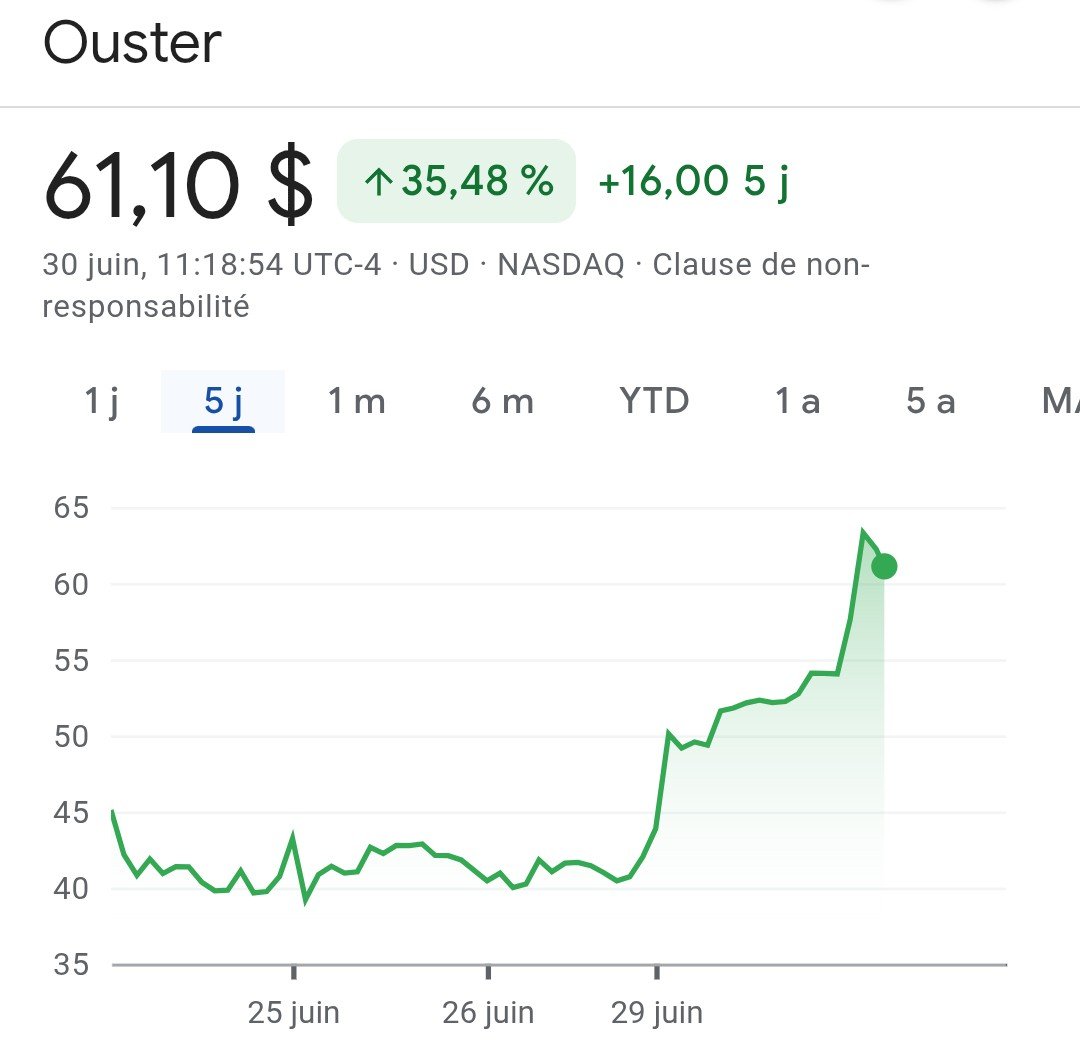
Bought $OUST in May. Still June. Already +100%+.
I don't think I've had a position move this fast in this portfolio. The catalysts are real (Benchmark, AIM, FieldAI, today ARGUS) but the speed itself is the story right now.
Holding. NFA.
$OUST up +21% today 🔥
Today's catalyst : a strategic agreement with ARGUS Interception GmbH to supply digital lidar for net-based counter-drone interceptor systems. Defense. Physical AI. A completely different market from where the last surge came from.
Same technology. New vertical pulling on it.
This is what a hardware moat starts to look like. Most LiDAR companies sell into one vertical and hope for adoption. Rev8 is getting qualified across automotive, defense, robotics, and smart infrastructure simultaneously. One platform, multiple markets.
The bear case was always "LiDAR is commoditized." The qualification cycle of the last two weeks is making that argument harder to defend.
I'm not going to pretend I called both catalysts.
I bought $OUST around $32 because the digital LiDAR thesis made structural sense in a Physical AI world. The defense partnership today is confirming what the hardware already promised.
Small position. Clear thesis. Still holding.
NFA. Personal positions disclosed.
The market gave me prices today. I bought.
Two very different bets. Same logic.
🟢 $ASTS — added more at $74.57 (–29.5% over the past month)
The selloff is driven by SpaceX IPO pricing below $2T expectations. Not by anything AST SpaceMobile did wrong.
The operational thesis is intact.
$1.2B contracted backlog. $3.5B liquidity runway through FY28. 45 satellites on track for November 2026. BlueBird Block 2 nearly doubles peak data speeds vs previous generation.
SpaceX identifying ASTS as a direct competitor in their IPO filing is not a threat. It's validation.
The DCF puts fair value at $138. The market is offering $74.
I'm not selling that discount.
🟢 $PNG (Kraken Robotics) — initiated at CAD $7.21
This one is off most radars.
Kraken builds underwater sonar systems, AUVs, and high-pressure subsea batteries for NATO navies and offshore energy.
The catalyst : acquisition of Covelya Group closes July 2nd. On a combined basis → $350-380M revenue, 24% EBITDA margin, 24% CAGR since 2023.
National Bank just upgraded to Outperform with a CAD $13 target → +80% from here.
10 days to the catalyst. Position initiated.
→ Two themes. Two corrections. Two entry points.
The best trades are the ones the market hands you on a bad day.
Next gates : $ASTS earnings Aug 10 · $PNG Covelya close + guidance July 2.
NFA skin in the game above.
Aujourd'hui $2CRSi s'est effondré de -43% sur un rapport short de Grizzly Research.
La contagion a été immédiate. $ALSEM, $ALRIB, Soitec, Kalray... tout le secteur semi FR a plongé dans la journée, sans discrimination.
C'est exactement ce genre de panique que j'attends.
🟢 J'ai vendu $BESI ×3 à €313 au-dessus du bull case consensus (objectif Morgan Stanley : €300). L'Investor Day du jour était le timing parfait pour sortir dans la hausse.
🟢 J'ai vendu $XFAB ×82 à €9,45 fondamentaux dégradés (EBIT -89% séquentiel Q1 2026), JPMorgan short déclaré à 0,99%, fair value DCF analystes à €5,53. La narrative photonique est réelle mais représente encore ~17% du CA. Le reste est du cyclique auto qui pèse.
→ Capital libéré → recyclé dans la panique sectorielle du jour.
$ALSEM (Semco Technologies) × 22 titres — PRU ~€54,14
Marge EBIT 40,7% en 2025. CA +29,5% YoY. Objectifs 2028 confirmés : CA >€55M, marges >40%. 16 clients en phase de qualification ou prototypage. Intégration Euronext Tech Leaders le 15 juin.
La chute de -9% aujourd'hui ? Contagion mécanique pure. Zéro lien avec 2CRSi.
$ALRIB (Riber) × 42 titres — PRU €12,58
Notes d'AG publiées hier : 2ème système ROSIE livré prochainement à un acteur quantum computing US. Intensification BD sur BTO/STO photonique. Carnet de commandes +24% fin 2025.
La contagion retail a créé le point d'entrée.
La conviction :
Le PEA permet d'arbitrer sans aucune friction fiscale. Pas de flat tax 30%. Pas de frottement.
Quand la panique sectorielle frappe des valeurs sans lien fondamental avec l'événement déclencheur, c'est une opportunité d'arbitrage pure.
BESI et XFAB étaient soit au-dessus de leur fair value, soit en dégradation fondamentale.
ALSEM et Riber ont subi une correction injustifiée le même jour.
Le swap s'imposait.
Gate suivante : résultats H1 ALSEM le 28 juillet 2026.
Convaincu par la thèse de @Frenchie_ et @aleabitoreddit Je renforce et j'élargis mon exposition européenne.
Trois mouvements sur les 7derniers jours sur le PEA.
$XFAB renforcé à €10. La thèse PhotonixFAB reste intacte, première foundry européenne dédiée à la photonique silicium pour CPO. Le calendrier est long (H2 2027-H1 2028) mais la position se construit à ce prix, pas à la veille du catalyst.
$SOI initié à €150 puis renforcé à €138. Soitec, leader mondial des substrats SOI qui alimentent les semi-conducteurs basse consommation, RF et automotive. Chaque génération de nœud avancé dépend de leurs plaquettes. C'est de l'infrastructure silicium discrète, pas glamour, mais structurellement indispensable.
$STMPA initié à €64.60. STMicroelectronics, pure play semi EU avec exposition automotive, IoT et industrial. La correction récente a créé une zone d'entrée que je ne pouvais pas ignorer.
Ces trois noms ont un point commun : ils alimentent les mêmes mégatendances que mes positions US, mais depuis l'Europe, dans un PEA exonéré d'impôt.
The Strait of Hormuz is reopening.
Trump just confirmed a deal with Iran. Toll-free shipping. Hostilities ending.
3.5 months of geopolitical risk premium built into every tech position on the market.
That premium is now unwinding fast.
$NBIS. $COHR. $LITE. $RKLB. $TSM.
None of these theses changed during the conflict. The macro overhang did.
Geopolitical risk was the discount. Resolution is the re-rating.
Jensen Huang just drew the line at Computex.
"Use copper as much as we can, for as long as we can. But copper has its limits."
That single sentence sent $COHR +17% to an all-time high yesterday.
Here's what it actually means.
Every AI data center today runs on copper interconnects. They're cheaper, simpler, and they work up to a certain bandwidth threshold.
That threshold is now being crossed.
In the Rubin Ultra generation, the physical scale of NVL576 exceeds the limits of copper interconnects. (https://t.co/RXWG1FQeNp) Co-packaged optics isn't a future technology anymore. It's the only path through.
And $COHR builds the actual hardware. The optical transceivers. The indium phosphide components. The interconnects that carry the light between chips when copper can't keep up.
NVDA didn't just endorse the category. They hold a disclosed strategic equity stake in $COHR directly — validating the indium phosphide optics technology as critical to next-generation AI infrastructure. (Electro IQ)
That's not a market signal. That's a structural commitment.
The demand side confirms it. $COHR management reported orders now reaching into calendar 2028 with customer LTAs extending to end of decade. (Ainvest) Record bookings last quarter.
8 analysts lifted price targets simultaneously yesterday. Jefferies, Raymond James, Rosenblatt, Stifel, TD Cowen, CFRA, Morgan Stanley, Rothschild.
When 8 firms move on the same day, the thesis isn't contrarian anymore. It's becoming consensus.
I've held $COHR since $270. It hit $425 yesterday.
I'm not selling. The Rubin Ultra generation hasn't even ramped yet.
May 2026 : +30.27% vs S&P +5.12%.
Not because I got lucky. Because I made three deliberate decisions and stayed concentrated.
Here's what happened.
The moves
Sold $GOOGL at $387. +130% from my $167 entry. The thesis played out completely — AI optionality was no longer optionality, it was in the multiple. The easy money was made.
Redeployed into $TSM at $409. Same AI infrastructure thesis, different position in the supply chain. $GOOGL is one hyperscaler customer. $TSM manufactures chips for all of them. The opportunity cost was clear.
Slightly reduced $NBIS around $220-229. Not a thesis change — a risk management decision after a significant run. Still my highest conviction position.
Added $XFAB in the PEA. European foundry play, different risk profile, different account.
Why the gap vs the index
Concentration.
The S&P gives you 500 companies. You get the winners diluted by everything else.
I run 10 positions. When the thesis is right, there's nowhere for the performance to hide.
$NBIS, $SIVE, $RKLB, $COHR, $LITE every core position compounded in May. Not because of luck. Because the AI infrastructure and photonics thesis kept getting validated by earnings, contracts, and new ETF filings packaging my watchlist.
What I'm watching in June
$SIVE just hit 100 SEK today. The squeeze isn't done.
$RKLB Neutron is the next gate. First flight late 2026.
$NBIS remains the highest conviction. The ARR trajectory doesn't lie.
$SIVE just hit 100 SEK. Up +65% today.
A few months ago the local Swedish hedge funds were shorting this at 17%+ of free float.
Today they're covering into a squeeze that isn't done yet.
MSCI inclusion. NASDAQ dual listing incoming. Jabil partnership on 1.6T optical transceivers for AI data centers. Pipeline up 77% to $799M.
The thesis didn't change. The price caught up.
Still holding. What a day.
$XFAB just entered my portfolio.
Spotted via @aleabitoreddit. Took the time to dig into it myself before pulling the trigger.
The thesis is real: X-FAB is one of the only European specialty foundries with SiC + GaN + Silicon Photonics under the same roof. The CPO supercycle needs manufacturing. X-FAB makes the parts.
Yes, margins are weak today (21% gross margin). That's the point.
When SiC demand for AI data centers and photonics volume ramp in 2027, utilization goes from 70% to 90%+. Fixed costs don't move. Margins do.
The automotive drag (62% of revenue) is real risk. But the pivot is already happening: SiC +152% YoY, photonics +42% YoY, industrial +32% YoY in Q1 2026.
The market is pricing the decline. I'm pricing the transition.
Entered at €11.03. Next earnings July 30.
$COHR $LITE are my CPO plays on the demand side. $XFAB is the manufacturing layer underneath.
NFA
$OUST up +21% today 🔥
Today's catalyst : a strategic agreement with ARGUS Interception GmbH to supply digital lidar for net-based counter-drone interceptor systems. Defense. Physical AI. A completely different market from where the last surge came from.
Same technology. New vertical pulling on it.
This is what a hardware moat starts to look like. Most LiDAR companies sell into one vertical and hope for adoption. Rev8 is getting qualified across automotive, defense, robotics, and smart infrastructure simultaneously. One platform, multiple markets.
The bear case was always "LiDAR is commoditized." The qualification cycle of the last two weeks is making that argument harder to defend.
I'm not going to pretend I called both catalysts.
I bought $OUST around $32 because the digital LiDAR thesis made structural sense in a Physical AI world. The defense partnership today is confirming what the hardware already promised.
Small position. Clear thesis. Still holding.
NFA. Personal positions disclosed.
Roundhill just filed for a Photonics & Optics ETF. Ticker : $LYTE.
I had to read the prospectus twice.
Optical transceivers. Laser sources. Silicon photonics. Optical interconnects. Photonic foundry services. Industrial and defense lasers. Optical computing.
It's not an ETF prospectus. It's my watchlist with a Bloomberg terminal.
For context : Roundhill crossed $10B AUM last November. They don't launch ETFs on speculative themes. They launch when retail and institutional demand has already arrived but lacks a clean vehicle.
CHAT was their first-to-market generative AI ETF in 2023. MAGS captured Mag7. Both became reference vehicles for thematic capital.
Photonics is next on that list.
That means one thing : the thesis I've been building this portfolio on for the past two years just became consensus enough to need its own ticker.
What the prospectus actually targets.
The fund will invest in companies where at least 50% of revenue comes from optical and photonic technologies. The categories named in the filing :
🟢 Optical transceivers and modules
🟢 Laser sources and photonic components
🟢 Silicon photonics integrated circuits
🟢 Optical interconnect systems
🟢 Photonic substrates and wafer materials
🟢 Photonic foundry services
🟢 Industrial and defense lasers
🟢 Fiber optic infrastructure
🟢 Optical computing and photonic AI acceleration
This isn't a "AI-adjacent" basket. This is the picks-and-shovels layer of the entire AI infrastructure buildout, packaged in one ticker.
The names that are going to absorb the inflows.
$COHR — transceivers, lasers, components. Full-stack photonics player. One of the largest pure-play exposures Roundhill can take.
$LITE — optical transceivers for data center and telecom. Direct hit on the thematic mandate.
$AAOI — datacom optical transceivers. Hyperscaler exposure. Smaller cap, more leverage to flows.
$SIVE — silicon photonics components for CPO. Pure play on the next-generation architecture. The float is tight.
$POET — silicon photonics platform. Smaller cap, high beta to thematic inflows.
$ANET — adjacent through optical networking integration.
Every passive dollar that flows into $LYTE has to buy these names. Mechanical pressure on a thin float.
---
Here's what most retail investors will miss.
ETFs validate themes after the early movers have already positioned. The story isn't "buy the ETF when it launches." The story is "the underlying names that the ETF will be forced to buy are still mispriced relative to the thematic flows coming."
I'm not a buyer of $LYTE. I'm a holder of half its likely top 10 positions.
That distinction matters.
My position perso.
I've been building photonics conviction since long before Roundhill filed this paperwork. $NBIS, $COHR, $LITE, $SIVE, $AAOI — all in portfolio, all part of the same thesis.
Watching Wall Street package my watchlist into an ETF is the strangest form of validation I've experienced as a retail investor.
Photonics was the contrarian bet of 2024. It's becoming the consensus theme of 2026.
The early conviction is starting to pay.
I just sold my entire $GOOGL position at +130%. And bought $TSM.
Not because Google is broken. Because the upside is already priced in.
I bought $GOOGL at $167 PRU. The thesis was simple : best-in-class search moat, cloud catching up, AI integration undervalued by the market.
That thesis played out. +130% later, $GOOGL is trading at ~27x forward earnings. The AI optionality is no longer optionality — it's in the multiple.
The easy money on $GOOGL was made between $150 and $250. What's left from $387 is execution risk at fair value.
---
So where does that capital do more work over the next 5 years ?
Every major AI infrastructure commitment routes through the same company.
$NVDA designs chips. $AAPL designs chips. $AMD designs chips. $GOOGL designs chips for its own data centers.
They all manufacture at $TSM.
$GOOGL is one customer. $TSM is the foundry every customer depends on.
---
The valuation argument is not about multiples.
$TSM trades at ~25x forward, $GOOGL at ~27x. The gap is almost irrelevant.
The argument is asymmetry.
$GOOGL at $387 needs to execute perfectly across Search, Cloud, and AI to justify its current multiple and grow from here. Any stumble — regulatory pressure, AI search disruption, cloud market share loss — reprices the stock.
$TSM at $409 benefits from every dollar of AI capex regardless of who wins the hyperscaler race. They don't need to pick the right AI model. They just need the world to keep building AI infrastructure.
One company needs to be right. The other needs everyone else to keep competing.
---
The derisking thesis adds a second layer.
The geopolitical discount priced into $TSM today, the "Taiwan risk" premium is mechanically shrinking. Arizona Fab 1 is in production. Fab 2 construction complete, 2nm production targeted 2027. Kumamoto in production. Dresden under construction.
$GOOGL has no equivalent re-rating catalyst built into the stock.
This trade could be wrong.
$GOOGL could re-accelerate growth in ways I'm not pricing. Gemini could outcompete. Cloud could gain share faster than expected.
But on a 5-year horizon, my bet is simple : the company that manufactures all AI chips, with a compressing geopolitical discount and accelerating revenue, compounds better than a search/cloud compounder already at fair value.
Sold $GOOGL at $387. Bought $TSM at $409.
Opportunity cost is the only metric that matters.
@RocketLab@synspective 88 Electron missions. 9 down, 18 to go on the Synspective constellation alone.
This is what "boring execution" actually looks like in space. Same customer keeps coming back because nobody else can deliver this combination of cadence and orbital precision at small-lift scale.
Three things compound here.
First GEO bus production for $RKLB. Optical Systems payload built in-house. Space Force as anchor customer.
Each contract like this embeds Rocket Lab deeper into the architecture of US space infrastructure. That's not a launch company anymore. That's a prime.
Rocket Lab has been awarded a $90 million contract by the @USSpaceForce’s Space Systems Command @USSF_SSC to design, manufacture, integrate, and operate two geostationary satellites hosting the Heimdall space domain awareness payload produced by Rocket Lab Optical Systems.
Rocket Lab components have long played an essential role in many GEO programs, but this is our first satellite production program for geostationary orbit. The two satellites will be built on our Lightning bus, adapted for the thermal, radiation, propulsion, and station-keeping demands of GEO.
Told myself I'd stop checking the portfolio every day
That was before everything went green simultaneously.
$NBIS $LITE $SIVE $OUST $AAOI $ASTS $COHR...
All up. Same day. Same thesis.
Concentration is supposed to be the risky strategy.