I spent 5+ years mastering technology…
Only to realize my biggest edge in trading wasn’t technical at all.
The signs were there since I was 15.
Back in 10th standard, I was obsessed with the stock market.
I read every finance book I could find, followed the markets daily, and tried to analyze companies using fundamentals.
Then life took me somewhere else.
For the next 5 years I went all in on tech:
Web design -> Web development -> iOS apps -> Blockchain -> Cybersecurity -> Digital Forensics -> Crypto Forensics.
I got good. Built projects. Got recognition. But something always felt… off.
What I was actually naturally good at wasn’t code.
It was strategy.
Competitor analysis.
And understanding how people think and behave.
With my teammates’ help, I finally started listening to that voice.
That realization pulled me back to finance.
But this time I wasn’t the same person who left.
My communication, presentation, strategic thinking, and persuasion skills had all leveled up.
I had also discovered something I never expected: social psychology.
Years ago I used to quietly observe people at family functions and public places, how they acted, what triggered them, how emotions spread.
I didn’t know there was an entire field dedicated to this.
Five years ago, price charts looked like random lines to me.
Today I don’t see candles.
I see human emotions playing out in real time:
Fear.
Greed.
Hope.
Panic.
Hesitation.
Euphoria.
Every single candle is a reflection of collective psychology.
Learning social psychology didn’t just improve my trading.
It completely changed how I see the markets.
Most people chase better strategies.
The real edge?
Understanding the humans behind the price.
@SolanaPlays What do you think, bro? Is money a human or something that knows what you're thinking? Anyway, it's a brilliant presentation of a foolish thought.
Stop building in public.
Here's why.
I started building in public a while ago.
My first 1-3 ventures failed, and I shut them down. That's supposed to be part of the "build in public" journey, right?
But here's what no one talks about.
Some people lost trust in me because I failed.
Now I've started something new, and I'm committed to seeing it through. But progress is slow, and people who watched my previous journey may already assume this one will fail too.
It gets worse.
Imagine pitching to an investor. They check your social media and see a timeline full of projects you started and later abandoned.
Some investors will appreciate the lessons.
I don't think the people who appreciate that would bet their hard-earned money on potential alone, would they?
There's a psychological reason for this.
It's called negativity bias and belief perseverance.
People naturally give more weight to negative information than positive information. A history of failed public projects can overshadow your skills, discipline, and growth.
Once people start believing you're someone who stops things halfway, they tend to keep believing it.
After you succeed, your failures become an inspiring story.
Before you succeed, they're just failures in the eyes of many.
Build in public if you want.
Just understand that you're not only documenting your journey.
You're also shaping your reputation.
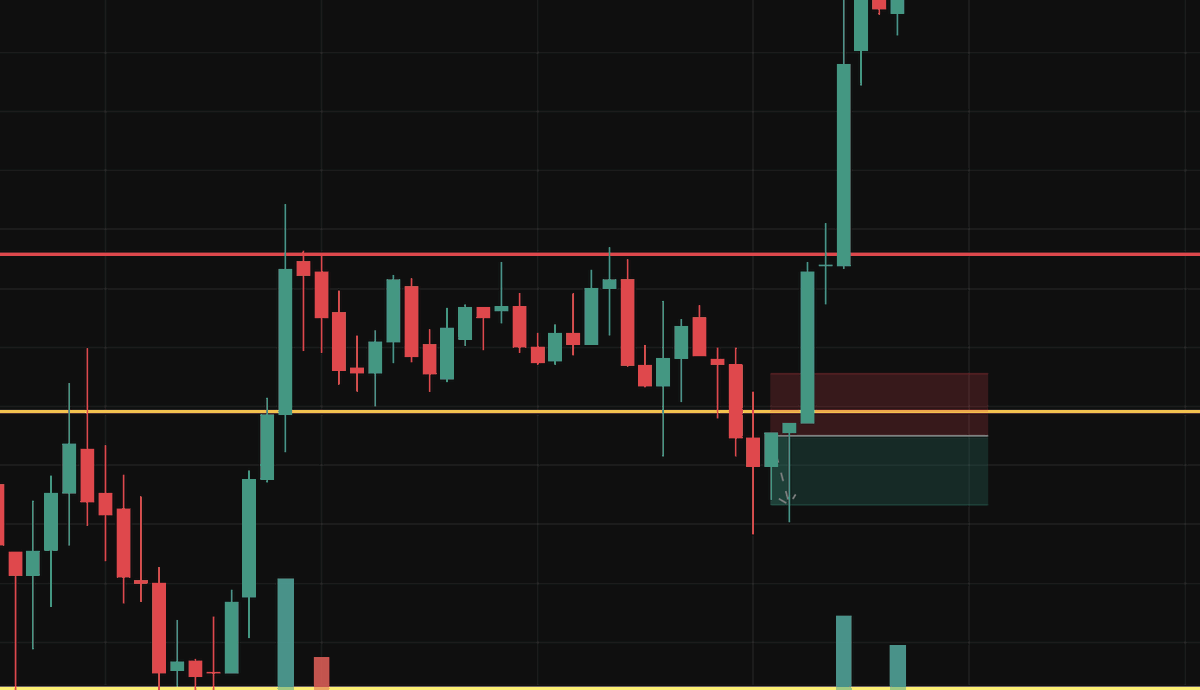
Classic ORB Lesson with Volume & Psychology
The price respected the Opening Range perfectly until the 4:45 AM candle. It broke below the range and looked like a clean breakdown.
But it quickly reversed back inside.
Another breakdown attempt came at 6:45 (and a few earlier ones). Low volume. Weak participation. Not an ideal short entry.
Then came the 7:15 candle.
It broke above the upper boundary with strong volume, much higher than the previous attempts. This triggered a powerful bullish rally.
Key takeaway: Both the upper and lower boundaries of the ORB acted as strong resistance and support.
Volume confirmed the real move. So, I'm telling you guys, never trade the ORB or OHL strategy based only on the classic rules. Instead, focus on the ORB/OHL + Volume Strategy, which is what I followed here.
Strict ORB followers could have profited from the second breakdown (63,088 to ~62,880), but it was risky without proper targets and stop losses.
The high volume bullish breakout was the higher probability trade.
Psychology:
Many traders jump in on the first signal because of FOMO.
After the first breakdown failed, they convinced themselves, "This time it's real," and ignored the weak volume.
The result? Low probability trades and unnecessary losses.
Have you ever entered a fake ORB breakdown?
Drop your experience below.
#DayOfTrading #100DaysOFTrading
FOMO is quietly destroying your trading account.
Most traders know FOMO is dangerous, but few understand exactly how it tricks them into bad entries.
Here's how to spot it and use it wisely instead.
if you follow a strategy or indicator and everything aligns with your plan, but the price breaks as you predicted, do not jump in quickly.
That feeling of missing the opportunity is what triggers fear of missing out.
Psychologically, you compare yourself to others already in the trade.
You assume they are printing money while you will lose the move. This is the comparison trap.
Then comes loss aversion, The pain of missing profit feels twice as strong as any gain you already have.
Finally, many traders pile in at the end of momentum due to FOMO.
They see others profiting and think, "It went up this far, it will continue." They buy anyway.
This is exactly when smart long holders square off for profits. Stop losses trigger and trigger a chain of selling.
Rule: Do not trust FOMO every time, Recognize this pattern and think clearly.
What is your biggest FOMO mistake? Drop it below 👇
#TradingPsychology #FOMO #DayTrading #IntradayTrading #PriceAction #TradingTips #StockMarket #UnusualTrader #LumirSVinod
“I don’t want to be the king in the world of chess. Everyone believes the king is the one who moves and controls everyone. But I want to be the invisible hand of the game, the one who even controls the king.”
Buddha once said that desires are the cause of suffering, but in my point of view, it’s completely wrong. What I believe is that not striving to fulfill your true desires becomes the cause of suffering.
I argued with my parents about the failure of the system, but they are not understanding it.
They are following the same path they have been following since the dawn of the Great Indian Education System.
That doesn’t matter.
There is no hope of making them understand it.
They will not understand.
The Indian Education System is an utter failure.
The Indian education system needs to change.
And I say this as someone who's into trading, not education policy. But I can't stay quiet about this anymore.
We're living in a dark era where our brightest, most capable students are trapped inside an outdated system and an exam culture that has become almost violent in its intensity.
Only a small fraction get access to real opportunities.
The rest, with equal or greater potential, are left behind simply because they couldn't crack one exam on one day.
A nation's greatest asset is its people.
When you filter talent by exam performance instead of potential, creativity, or critical thinking, everyone loses.
The country loses.
If this continues, there will be consequences.
Let me tell you a real story.
A close friend of mine works at an overseas education loan agency.
Through him I heard about a student whose mother works in the UK.
After finishing 10th standard, this girl went to the USA with the help of her parents' connections and started getting hands-on experience and education in a psychology related field.
After two years she came back to India.
Later she got admission for a bachelor's degree abroad. She needed an education loan.
No Indian bank would give her one.
Why?
Because she hadn't completed Plus One and Plus Two the conventional way.
Sit with that for a second.
A foreign institution looked at her skills, her experience, her potential and said yes.
Her own country looked at her missing certificates and said no.
Certificates measure academic performance.
They don't measure ability.
Some people score well through unfair means.
Others build real skills through real experience and still get rejected because they don't fit a rigid box.
This is one of the biggest flaws in how we define merit in this country.
We are not short on talent. We are short on systems that recognize it.
#IndianEducationSystem #EducationReform #NEETUGC #ExamCulture #Merit #IndianEducation #StudyAbroad #FutureOfIndia #EdTech #WakeUpIndia
@theslowtell Yes, that's true too.
Even if we document our judgment, most people still judge us by whether we were right or wrong.
Sharing our judgment helps justify our decisions in public, but it doesn't make people believe in us.
I once believed my goal was to create history, starting from my +2 days.
To build something so big that it leaves a mark forever.
But now I see it differently.
Creating history is powerful, but living comes first.
Because at the end of everything, when I face my final moment, only one question will matter.
Did I truly live my life?
And I want my answer to be simple and honest.
Yes.
So now, it is not just about building history.
It is about living fully and letting history be the byproduct.
My teammate started sounding less like a human and more like ChatGPT.
When we discuss ideas, his replies feel generated. Polished. Safe. Just like ChatGPT.
I asked him, "Why are your answers like this? Do you use AI models for everything?"
He said he uses ChatGPT for almost everything, even uploading CAPTCHA images instead of solving them himself.
This is becoming the new common.
ChatGPT doesn't have opinions.
It tells you what you want to hear.
You pitch an idea -> "This is fantastic. You could become a millionaire."
You ask for risks in a new chat -> "This approach is inefficient and not worth building."
Same idea. Completely opposite answers.
I pushed it further.
I said, "Assume there are no food delivery services in India. Explain why building one would fail."
It gave me a long, confident list of reasons why it would flop.
I almost convinced myself it was a bad idea.
Now, you have to understand this: if AI is your judge, you're not seeking truth. You're seeking agreement.
The better way to build: Don't ask AI to find problems or validate your ideas. Go to platforms like X, Reddit, and others.
Talk to people directly.
Use AI tools like ChatGPT, Gemini, and Grok to summarize your research, analyze competitors, and process information.
But the final decision? Always yours.
Never outsource your thinking.
Understand. Think. Solve.