If there were zero consequences, this is the DM I’d send to Satoshi Nakamoto:
“Quick question.
Was Bitcoin your plan… or did you accidentally invent it while trying to fix your printer?
Because the amount of confidence people have when explaining your intentions is honestly impressive for someone who’s been offline longer than some countries have existed.
Also, blink twice if you’re secretly reading crypto Twitter and laughing every time someone says, ‘This is exactly what Satoshi wanted.’
Anyway, no rush replying. You’ve already ghosted the internet for over a decade.”
Somehow I feel like @RallyOnChain would appreciate this level of chaos.
The Best Crypto Products Usually Solve a Problem You Didn't Realize You Had.
A few years ago, we accepted that crypto meant juggling multiple apps.
One wallet to store assets.
Another to swap.
Another to earn.
Another to track your portfolio.
Another to spend, if spending was even possible.
Somewhere along the way, that became "normal."
But maybe it shouldn't be.
The projects I'm paying attention to today aren't just adding another feature.
They're asking a better question:
"Why should users have to do all this in the first place?"
That's one reason @xora_finance stands out to me.
Its vision isn't simply to offer yield.
It's working toward bringing earning, managing, payments, and future governance into one ecosystem built around XRP holders.
Will every part of that vision be easy to execute?
Probably not.
But I think that's the kind of thinking crypto needs more of.
Not more apps.
Not more tokens.
Just better experiences.
What's one thing you wish every crypto platform did better?
Share with us... 🔻
Meanwhile, get on Xora and start earning yield: https://t.co/FXQp2TfFQN
I have a note on my phone full of messages I’ll never send because I enjoy having a functioning life.
This one keeps trying to escape.
DM to Satoshi Nakamoto:
“I don’t need your identity anymore. I need you to explain why every time I finally buy Bitcoin it suddenly remembers gravity.
If this is some long-running social experiment, congratulations. My portfolio has developed trust issues.
Reply with literally anything. A period. A typo. An accidental emoji. I just need proof you’ve been watching us panic for fun.”
Some thoughts should stay in drafts.
@RallyOnChain
@KbGold77 Money and compute got decentralized because they're ultimately mechanical, you can verify them. Judgment resists that because it's contextual by nature, and I think that's the actual wall this piece is pointing at.
@KbGold77 The idea that AI agents will need something like a judiciary, not just a settlement rail, is a bigger claim than it first sounds like. Curious how far GenLayer takes that.
A few months ago, I caught myself asking AI the same question in three different ways just to compare the answers. Not because I doubted its intelligence, but because I realized I was really testing its judgment.
That made me think about a bigger problem.
As AI agents become part of everyday decisions, the real challenge is no longer generating answers. It’s deciding which answer should be trusted when information conflicts, contexts change, or multiple agents disagree. Intelligence alone doesn’t solve that.
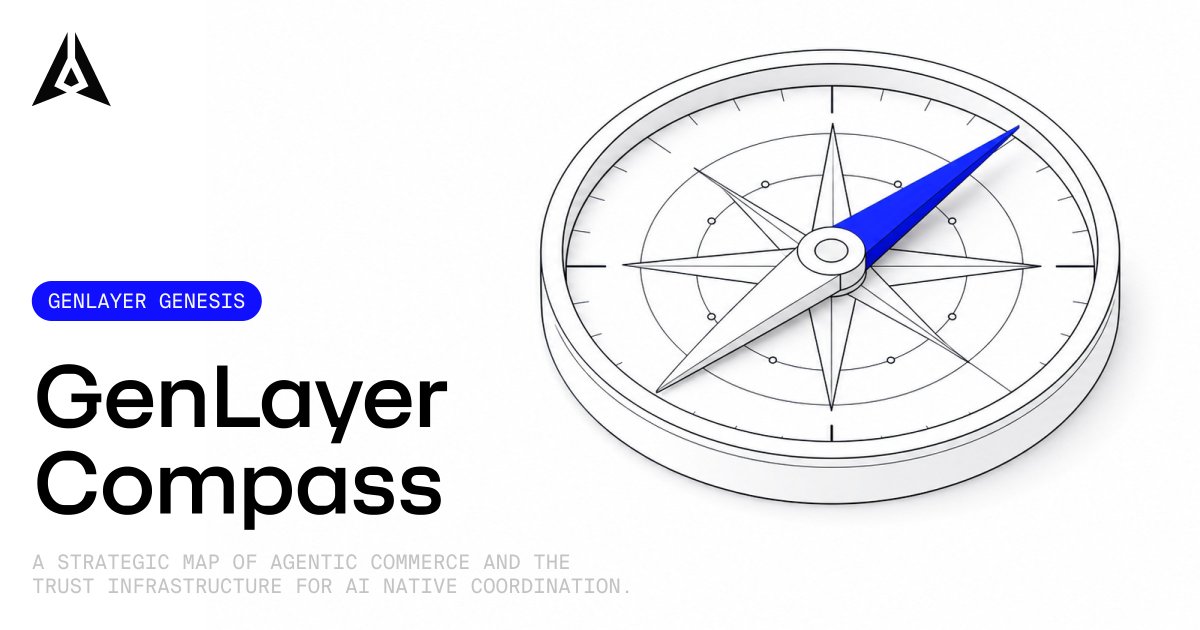
That’s why I found @GenLayer’s Compass interesting. It doesn’t just describe another blockchain. It lays out a different way of thinking about the next layer of the internet. Bitcoin gave us trustless money. Ethereum gave us trustless computation. The Compass argues that adjudication is the missing piece if autonomous agents are going to interact at scale without handing final authority to a single company or model.
The idea that stuck with me is simple: every technological leap has reduced the need to trust individuals. The next leap may be reducing the need to trust a single source of judgment.
Worth reading if you’re thinking about where AI infrastructure is actually heading.
What kind of system do you think can make judgment both scalable and accountable?
The entire agent economy is being built for the moment things go right.
Payments, identity, negotiation.
Almost no one is building for the moment two agents disagree.
And they will. By 2030 ARK projects the agentic economy at $9 trillion, and no court was built to settle deals between software.
The average civil dispute in the US already takes 344 days.
That missing piece is adjudication, and it is the layer GenLayer exists to be.
We wrote the whole thinking behind it in The Compass, one of GenLayer's founding texts alongside the Manifesto and the whitepaper.
It lays out the worldview, the concept, and the mission in one place.
Read The Compass → https://t.co/EaIu3i8cz9
The first time I stood on a suspension bridge, I learned something engineers never stop repeating.
If the cables fail, nothing else matters.
I didn't understand why that stayed with me until I read The Compass.
We spend most of our time talking about payments, identity, and negotiation because they're the road everyone can see.
Then I found one number I couldn't stop thinking about.
344 days.
That's the average time it takes to resolve a complex civil dispute in the US.
Now imagine an economy where AI agents identify each other, negotiate agreements, and move value in seconds.
The transaction isn't the bottleneck anymore.
It's deciding what happens when two intelligent systems genuinely disagree about what the agreement meant.
That's when I stopped thinking of The Compass from @GenLayer as just a technical document.
It's a worldview for the missing layer that helps trust survive the full journey: agreement, execution, disagreement, and resolution.
Whether you agree with every conclusion or not, it's one of the clearest places to understand the problem before judging the solution.
If you're curious, read it here:
https://t.co/DIS5w7Svmj
When you're done, tell me which idea stayed with you the longest. I'm genuinely curious whether it was the same one for both of us.
My signature move is waiting five more minutes before making almost any decision.
Not because I’m indecisive. Because I’ve learned that my first reaction is usually emotional, while the second one is informed.
I’ve avoided bad trades because of those five minutes. I’ve also avoided sending messages I’d regret and saying yes to opportunities that only looked exciting at first glance.
A friend once joked that if I ever disappear after asking a question, everyone knows I’m in my “five-minute mode.”
It sounds like a tiny habit, but it’s probably saved me more money and stress than any strategy I’ve ever tried.
That’s why I like conversations around @RallyOnChain. Everyone has a signature move, and the interesting part isn’t whether it’s flashy. It’s whether it quietly makes you better over time.
So now I’m curious: what’s the small habit people instantly recognize as uniquely yours?
If you didn’t get an airdrop,
Then don’t fret.
This is just the beginning of AGNT rewards.
The message is clear.
Be a real user.
I don’t want to hand out money to Sybils.
If you don’t link your x or deposit any funds, then I can’t verify you’re not a Sybil.
Rewards will go to those I. The leaderboard
Trade, launch, use the feed etc