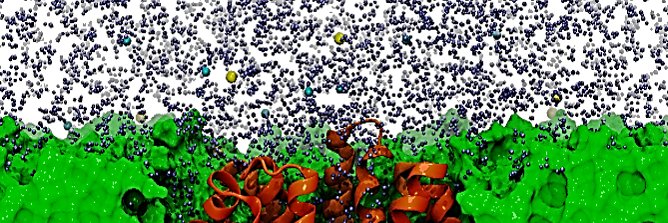
Explored how the membrane environment and protein dynamics shape lactose binding and transport, and used targeted MD to steer the sugar into its binding pocket.
Really rewarding to see how lipids, water, and ions all come together to drive function at the molecular level. 🧬
With David and the Baker Lab in the spotlight today, I wanted to share some insights into the @UWproteindesign and how it operates, a glimpse behind the curtain. I had planned to write this post-graduation, but now seems as good a time as any. (Got twitter blue free trial so this could all fit in less tweets!)
First, the lab is enormous. ~60 grad students, ~60 postdocs, a handful of visitors, undergrads, and a surrounding institution of another 150 or so. Collaboration is strongly encouraged (even mandated) by David, who sets up pro-collaboration incentives. Notably, he's fine with grad students graduating without a sole first-author paper—it's acceptable to "only" have worked as a co-first author. This is a key ingredient in the secret sauce: the tight collaboration between wet lab and dry lab. It ensures that all our work is ultimately grounded in strong wet-lab validation—our "oracle" is the real world, not another computational model.
While we have regular meetings for different subgroups and the entire group, much information travels through the lab via informal one-on-one interactions. In some ways, it reminds me of a classic "tribe of humans in the state of nature"—100-200 people with no clear hierarchy, passing information via "gossip". It’s maybe not the most complete way of ensuring everyone is on the same page, but saves time as we aren’t drowning in endless meetings.
Does David stay in touch with all these grad students and post-docs? Remarkably, yes. Unlike some very large labs known for being run entirely by post-docs, he knows exactly what everyone is working on and the stage of their projects. Each member has monthly one-on-ones with him, and monthly subgroup meetings that David attends. If he suggests you try something at your previous one-on-one, you'd better have it done by the next.
Does he actually contribute research ideas, or is he more of a detached big-picture project manager? Definitely the former. He understands the intricacies of a shocking range of topics. I'll be discussing some arcane deep learning concept with him, and then he'll turn around and talk to someone about the details of a catalytic mechanism. He's actually the most hands-on PI I've ever had—if anything, he verges on over-managing rather than being too detached.
How does he keep track of everything? Partly, he's just a brilliant person with exceptional recall. But he has also built infrastructure above and below him in the lab to handle many of the details, bureaucracy, big picture, and management tasks. This allows him to spend most of his day doing what he's most passionate about and skilled at: walking around talking to people about science. He also lives very much in the moment and in his own words, “never thinks very far ahead". To keep up with tools, methods, and wet lab techniques, he does the occasional project and design campaign himself on the side when time allows.
It's still a tremendous cognitive load to keep all this in his head, but as much as possible, he has offloaded non-scientific cognitive burdens. It helps that he’s in the lab in person most days of the year, rarely traveling for conferences or talks, instead doing them over Zoom or not attending. (1/2).
“Guidelines for Reporting Molecular Dynamics Simulations in JCIM Publications”
Interesting (and somewhat controversial) because it both gives guidelines for reporting, but also on how simulations should be setup, performed, and analysed.
https://t.co/E8ODdaQQ9H
We are organizing a free symposium on "Computational methods in drug and materials design" with @eriklindahl@BioExcelCoE and Tom Cheatham as our plenary speakers. In-person and online details below. #compchem
Glad to share that we are organizing our second workshop on DeepModeling for molecular simulation. Free and fully virtual. Dates: July 7-8. More info https://t.co/HzFMOeSep0 and registration link https://t.co/tKNlNNn0WI. Please share!
Coursera had started with my machine learning class. I’m delighted to announce that I’ll soon be teaching a new Machine Learning Specialization, created by @StanfordOnline & @DeepLearningAI_. Please help me spread the word! You can sign up here: https://t.co/8WJOnNGz7W