Ex-Google engineer just dropped 1-hour course: loops, self-improving AI, memory systems - from scratch:
00:00 - the self-building agent
03:01 - soul.md runs everything
30:16 - RAG memory: pull 20 messages, not 2,000
31:48 - the loop that knows when to stop
35:14 - find the bug, fix the prompt
50:22 - how Claude compresses your memory
1 hour of his guide beats any paid agent course
watch & bookmark - then read Karpathy's loop method below
Anthropic just dropped 5 workshops on building self-improving agentic systems from scratch:
00:00 - Ship your first Claude agent
36:44 - Build memory for Claude agents
1:05:06 - Make your agent autonomous
1:26:46 - Set up a proactive agent
2:03:35 - self-improving agents (tools,skills)
These 3-hours of free Claude workshops will replace 10 paid agentic courses.
Watch today, then read article below on how to build a self-improving agentic system with Fable 5.
Watched this and it’s incredible. Crazy amount of info compressed into a dense 20 minutes.
This is exactly how you enjoy Twitter Premium without actually paying for it.
My friend applied to 200 tech jobs in two years. No PhD. No Stanford.
Last month Anthropic offered him $750,000.
I asked him how he broke in from zero.
He sent me a course that was never supposed to get out. A 3-hour video to build a full LLM from scratch.
A developer teaches you exactly how LLMs like ChatGPT and Claude are actually built.
I watched it last night.
Halfway through, I realized it's embarrassingly simple to break into an AI lab.
Bookmark this and read the article below.
• 00:00 - intro to LLMs
• 05:43 - LLM transformer architecture
• 40:24 - training the LLM
• 1:30:27 - modernizing the LLM
• 2:33:53 - scaling the LLM
Karpathy's Agentic Engineering finally has proper tooling!
(built by Google)
Karpathy defined agentic engineering as the discipline that separates production agent work from vibe coding. The core skills he listed were spec design, eval loops, and security oversight.
The problem is that production agents don't run on the agent code alone. They need a model provider, a retrieval layer, an eval system, a deployment target, and observability.
And normally, these are scattered across different dashboards, config files, and tools, each with its own setup and learning curve.
The solution to production-grade Agentic Engineering is now actually implemented in Google’s Agents CLI.
It covers the entire lifecycle in a single interface, covering scaffolding, evaluating, and deploying ADK agents.
The setup command injects 7 ADK-specific skills into a coding agent's context, which lets it handle scaffolding, evals, deployment, and enterprise registration through natural language.
I mapped the whole thing end-to-end in the diagram below. Here is what each layer is doing:
> Agent Orchestration defines the agent using the ADK, and the A2A protocol handles coordination when one agent needs to invoke another. ADK is model-agnostic, so the models cover Gemini, Gemma, and third-party models like Claude, via Model Garden.
> The data layer handles retrieval. Vector Store stores the embeddings for RAG, and the ingestion pipeline loads and chunks docs into it. Monitoring and storage happen alongside it.
> The evaluation layer runs the agent against test scenarios with LLM-as judge scoring. It runs before deployment.
> For deployment, you can choose between Agent Runtime, Cloud Run, etc., depending on how much control you need. Agents CLI configures across all targets.
> Finally, teams that need staging and production environments, the IaC and CI/CD layer handles infrastructure as code and deployment pipelines.
Every one of these layers is a service that a dev would otherwise configure manually.
But Google's Agents CLI ties them together to make the full agentic engineering lifecycle practical.
The diagram below makes this clear, and I worked with the Google Cloud team to put this together.
Agents CLI GitHub repo → https://t.co/ho8fGyd8GF
(don't forget to star it ⭐ )
Akshay wrote a hands-on article covering all six steps from install to enterprise registration.
It includes the eval scorecard, the instruction loophole the eval caught before deployment, and what the deployment process actually looks like end-to-end.
Read it below.
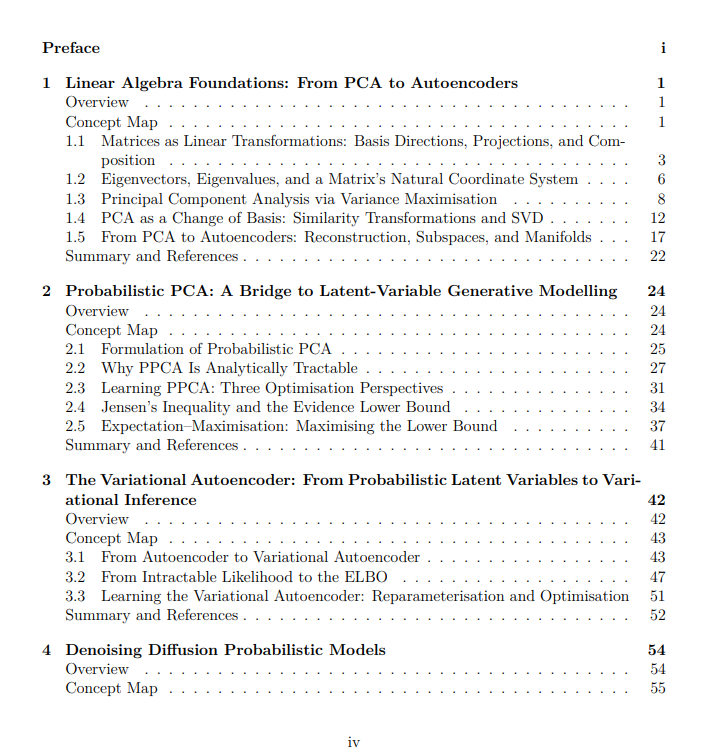
A 178 page survey study for refreshing math and generative AI foundations from University of Huddersfield.
The Little Book of Generative AI Foundations.
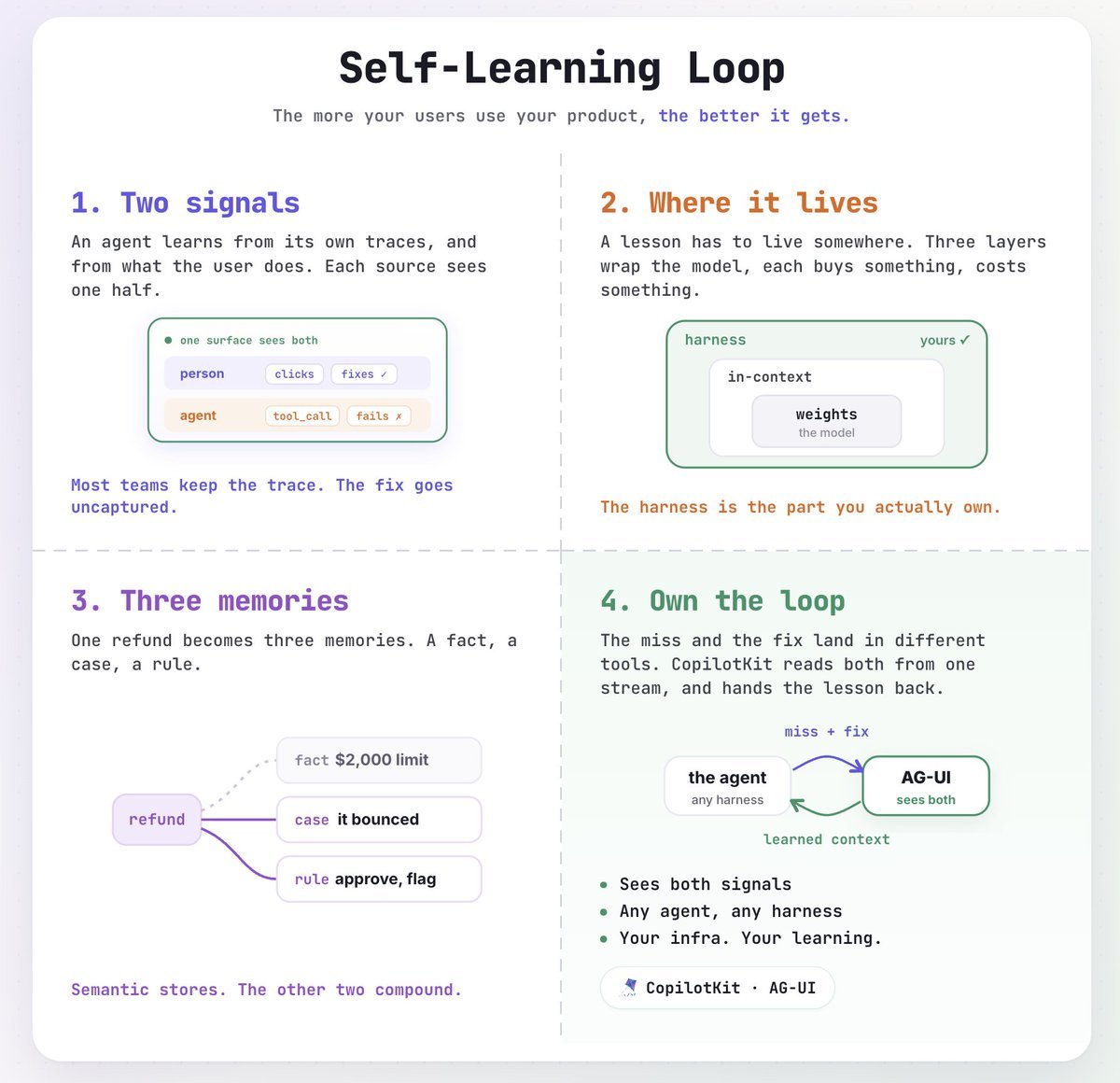
Static agents won't survive 2026.
Self-learning agents are WHAT you need, and the best ones get better every time someone uses them.
Let's understand this.
Your AI Agents actually learn in 3 places:
1. Model (the weights): owned by the AI labs, the hardest layer to improve.
2. Harness (the loop, tools, prompts): medium difficulty. You can improve it, but it takes some real work.
3. Context (memory + skills): plain text you can read and edit, the easiest place to start.
You already use all three in Claude Code and Codex.
But here's what almost everyone skips:
Your agent should learn from your users, not just its own runs.
Every time a person fixes the agent's call, that's a labeled example no benchmark can give you. Worth more than a hundred synthetic tests.
Capture it. Feed it back. That's the loop that compounds.
Andrej Karpathy explained the 5 shifts that turned LLMs from chatbots into agentic systems:
00:00 - Memory turns chat into personal AI
6:41- Multimodal AI can read the world
16:58 - Thinking models solve harder tasks
24:51 - Search makes LLMs live
30:58 - Tools turn LLMs into workers
This is not another video about “prompt engineering.”
It is a 40-minute roadmap for the next AI workflow: memory / vision / reasoning / search / tools.
Watch today, then read the article below on how to turn LLMs into self-improving agent loops.
Anthropic engineer:
"You're not supposed to prompt Claude. You're supposed to build a system that prompts itself."
In 45 minutes she breaks down how Anthropic builds agents that remember, learn from their mistakes, and get smarter with every run.
Worth more than any paid course you'll find on building agents.
Watch the session, then read the guide on building loops below.
Google just dropped a 1-hour course on agentic engineering from scratch:
00:00 – How to build your first AI agent
08:24 – Build agent memory (short, persistent, long)
28:34 – Agentic loops, long-running AI agents
40:04 – How to build MCP (MCP vs API)
1:00:22 – Multi-agentic systems
This 1-hour watch will replace 10 paid agentic courses on the internet.
Watch it today, then read how to build a self-improving agentic system in the article below.
Claude Code team just dropped a free course on loop engineering with Fable 5:
00:00 - how Claude Code works under the hood
05:01 - the agentic loop explained
16:21 - the feature 99% of devs miss: auto mode
19:01 - why voice beats typing
32:34 - auto code review with draft PRs
58:39 - Fable 5 for non-code work
this free course replaces every paid Claude Code tutorial
watch today, then read the article below on loop engineering by Karpathy
Andrej Karpathy quietly published 9 rules for building AI agents.
Rule 1: stop writing prompts.
"If you find yourself iterating on a single message at 3 in the morning, you are still in the prompting era."
A friend who runs agent infra at a trading firm read it once and deleted half the harness his team built last quarter.
The whole paper argues most agents die from a weak harness, not a weak model. Everything you added to compensate for the model becomes dead weight the moment the model improves.
The rule near the middle, about letting the loop delete its own work and start over, is the part he screenshotted. It contradicts how almost everyone builds right now.
The closing section on where the bottleneck goes next is the whole paper in one line.
He said he read it twice, second time with his own repo open beside it.
Everyone is still tuning prompts. Karpathy already moved on.