New paper out! 🚨 We show that vampire bats use amino acids from a recent blood meal to fuel RUNNING - a rare mode of locomotion in bats ideal for stalking prey. I’d worry less about your neck and more about your ankles! 🧛🏻♂️ @WelchLab_UTSC@RSocPublishing
https://t.co/4H5dg7TsNK
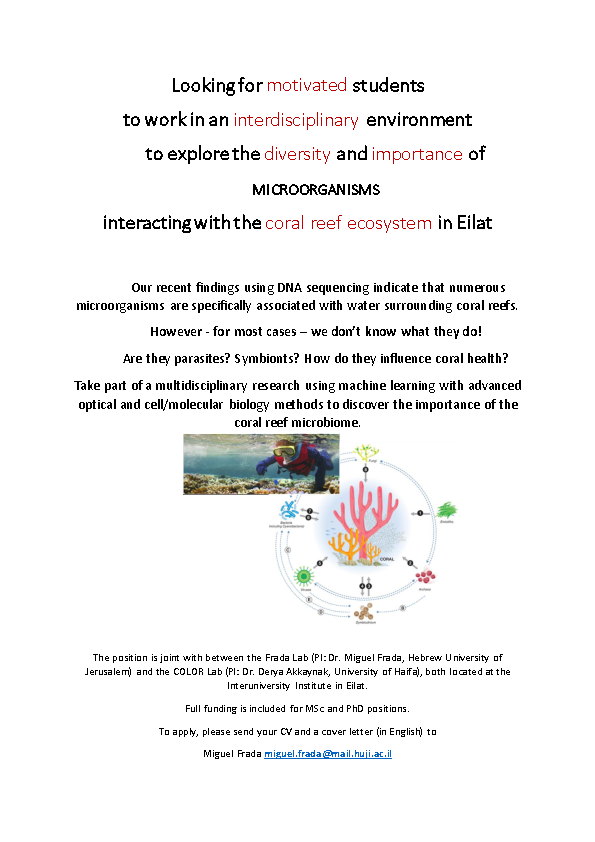
The coral reef outside our lab is a playground. Who are the main microbial inhabitants and how microorganisms function in this ecosystem? Join @dakkaynak and us to find out
Very exciting! In this study, published in the @ISMEJournal, together with Michel Flores, the Koren lab, and the @vardilab, we studied marine bloom infection by airborne algicidal bacterium🦠🌊🫧
We are happy to share our new study by Dr. Naama Lang-Yona (@ly_naama) and Dr. Michel Flores on the impact of airborne algicidal bacteria on marine phytoplankton blooms 🌊☁️🦠
https://t.co/l4xXOPdImK
Opening the new year with exciting research milestones!
1- Our Atmospheric Microbiology Lab proudly presents our debut paper led by Ariel Tastassa, on the world of Aeromicrobiology (https://t.co/rUtzZt078u).
2- Additionally, in collaboration with Adi Radian, and Ji-Dong Gu we have performed a fascinating exploration of the dust microbiome and their potential contribution to global processes and health, led by Pengfei Hu and (https://t.co/CdVcojJCq2).
There probably isn’t a square mile on this planet that hasn’t been contested in tribal warfare, isn’t „occupied“ in one way or another, hasn’t seen violence or forced migration. History is an endless series of injustices. So where does this focus on Israel stem from? /1
@elife
Dear Tara, dear editors:
We wish to withdraw our manuscript from editorial consideration at eLife. We are shocked by the recent posts of eLife‘s Editor-in-Chief on X, in which he disparaged the victims of the Hamas terrorist attacks and
/1
Excited to share the upcoming 51st Annual Conference for Science and the Environment.
This year, we will have for the first time a dedicated track on carbon sequestration!
Join us for sessions exploring carbon fixation studies in diverse environments and…https://t.co/Rm9ydT4GO6
שמחה לעדכן שהשנה בכנס השנתי של האגודה לאקו��וגיה וסביבה יתקיים מסלול קיבוע פחמן ובו מושבים על מחקרים לקיבוע בסביבות שונות וחידושים טכנולוגיים מרתקים.
והרשמה ב https://t.co/yR3FoLslTl. אל תחמיצו! 🌍🌱
התערערות האקלים הגיעה השנה לשיאים חדשים. האוקיינוסים רותחים, הנהרות מתייבשים והיערות בוערים. וזו רק ההתחלה. אנחנו היחידים שיכולים לבלום את זה לפני שיהיה מאוחר מדי. הנה עשר פעולות שעלינו לעשות⬇️
השביתה באוניברסיטאות: זה דרמטי.
בעייני הסיפור החשוב הוא הקביעות - האוצר רוצה לבטל אותה. כלומר - יהיה אפשר לפטר מרצה לאחר קביעות אם לא עמד ביעדים. זה נשמע לכם פעוט אבל זה לא.
��ה כל הסיפור. זה הופך את האקדמיה לחסרת שיניים, פחדנית, עם סכין על הצוואר. זה רע למחקר ורע לדמוקרטיה ⬇️
This study represents the first documentation of this genus in Israel, and provides important insights into the changing nature of lake ecosystems.
Exciting times for lake ecology research! #lakeecology#cyanobacteria#environmentalresearch
Exciting news from Lake Kinneret, Israel!
We have discovered a massive abundance of Gloeotrichia Pisum, a type of benthic epiphytic colonial cyanobacterium, in the lake.
In our recently published paper, you can read all about how G. Pisum colonies host…https://t.co/ylEmwG0A6n