in order to become a better person, you must first realize how horrible you really are. not in the dramatic sense, but in the quiet ways you sabotage yourself, repeat unhealthy patterns, hurt people who care about you, or tolerate what wounds you. you cannot grow if you keep pretending you’re innocent in the story you’ve created.
المقطع الاكثر حذفًا في تويتر من امبارح
المقطع ده الفيفا بتطارده بحقوق النشر من امبارح وكل اللي بينشره بيتقفله حسابه او المقطع ينحذف
ده باختصار ملخص الاخطاء التحكيمية امبارح وملخص المدعرة اللي عملها الحكم القذر ضد مصر
اتفرجوا بعينكم … ظلم بيّن وسرقة
@marcelcarrillog Lo mismo quieren hacer en Guerrero con la Esthela Damián, hasta la pusieron a bailar la iguana para ganar simpat��a.
Da asco la 4t, che partido de porquería.
Les dejo este video de una extraordinaria oftalmóloga y retinóloga, donde les explica con claridad por qué es una estupidez lo que hizo @ClaraBrugadaM de pintar de morado todo.
This always gets me:
“The most valuable of all education is the ability to make yourself do the thing you have to do, when it has to be done, whether you like it or not.”
- Aldous Huxley
🚨 CENSURA 🚨
🤫 NO le digan #NarcoRégimen al #NarcoRégimen 🤫
El INE censura a la oposición. Acaba de ordenar que se elimine este Spot en radio y TV.
La Comisión de Quejas y Denuncias ordenó a @AccionNacional suspender este promocional, porque se expone cómo han destruido a México.
Les ofende que se les llame criminales a los criminales. Les ofende que se exhiba cómo entregaron a México.
Una democracia real necesita de un debate libre. ¡La libertad de expresión NO debe ser coartada!
Aquí les dejo el video CENSURADO 🚫. 👇
#CensuraINE #NarcoPartido #INE #Electoral
Una respuesta muy simple al actual problema de falta de comprensión lectora, a la nula capacidad de enfocarse más de 2 minutos, y que ahora hasta se burlan diciendo "demasiado texto".
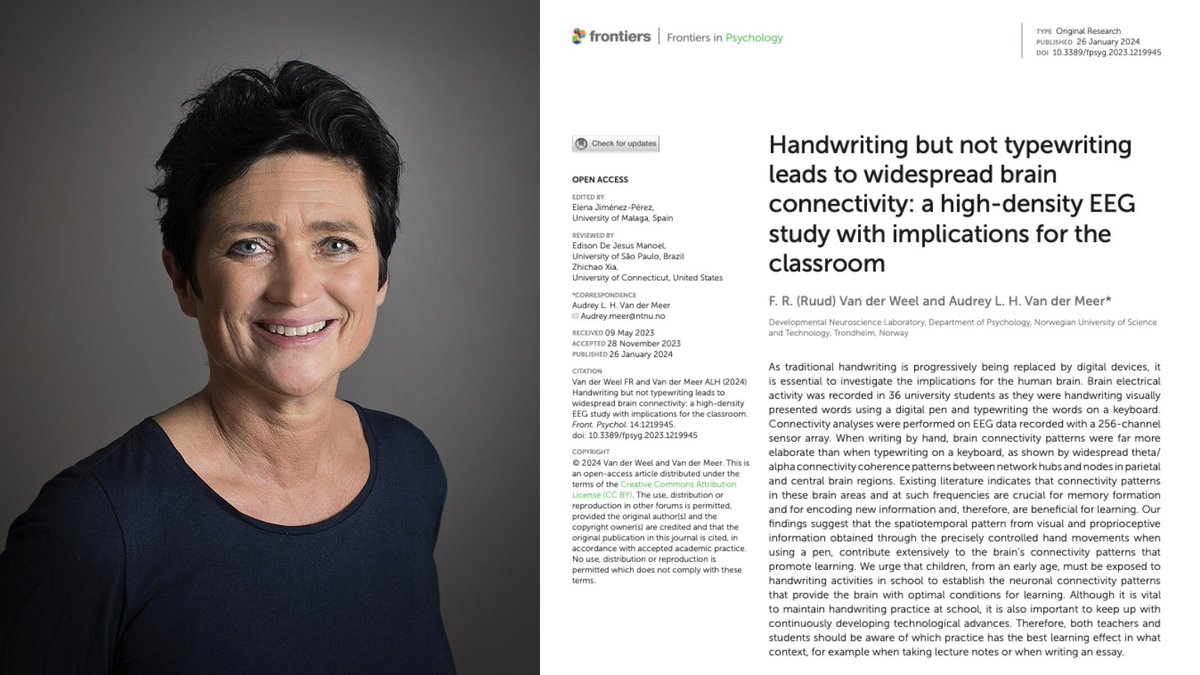
A Norwegian neuroscientist spent 20 years proving that the act of writing by hand changes the human brain in ways typing physically cannot, and almost nobody outside her field has read the paper.
Her name is Audrey van der Meer.
She runs a brain research lab in Trondheim, and the paper that closed the argument was published in 2024 in a journal called Frontiers in Psychology. The finding is brutal enough that it should have changed every classroom on Earth.
The experiment was simple. She recruited 36 university students and put each one in a cap with 256 sensors pressed against their scalp to record brain activity. Words flashed on a screen one at a time.
Sometimes the students wrote the word by hand on a touchscreen using a digital pen, and sometimes they typed the same word on a keyboard. Every neural response was recorded for the full five seconds the word stayed on screen.
Then her team looked at the part of the data most researchers had ignored for years, which is how different parts of the brain were communicating with each other during the task.
When the students wrote by hand, the brain lit up everywhere at once.
The regions responsible for memory, sensory integration, and the encoding of new information were all firing together in a coordinated pattern that spread across the entire cortex. The whole network was awake and connected.
When the same students typed the same word, that pattern collapsed almost completely.
Most of the brain went quiet, and the connections between regions that had been alive seconds earlier were nowhere to be found on the EEG.
Same word, same brain, same person, and two completely different neurological events.
The reason turned out to be something nobody had really paid attention to before her work. Writing by hand is not one motion but a sequence of thousands of tiny micro-movements coordinated with your eyes in real time, where each letter is a different shape that requires the brain to solve a slightly different spatial problem.
Your fingers, wrist, vision, and the parts of your brain that track position in space are all working together to produce one letter, then the next, then the next.
Typing throws all of that away. Every key on a keyboard requires the exact same finger motion regardless of which letter you are pressing, which means the brain has almost nothing to integrate and almost no problem to solve.
Van der Meer said it plainly in her interviews.
Pressing the same key with the same finger over and over does not stimulate the brain in any meaningful way, and she pointed out something that should scare every parent who handed their kid an iPad.
Children who learn to read and write on tablets often cannot tell letters like b and d apart, because they have never physically felt with their bodies what it takes to actually produce those letters on a page.
A decade before her, two researchers at Princeton ran the same fight using a completely different method and ended up at the same answer. Pam Mueller and Daniel Oppenheimer tested 327 students across three experiments, where half took notes on laptops with the internet disabled and half took notes by hand, before testing everyone on what they actually understood from the lectures they had watched.
The handwriting group won by a wide margin on every question that required real understanding rather than surface recall.
The reason was hiding in the transcripts of what the two groups had actually written down.
The laptop students typed almost word for word, capturing more total content but processing almost none of it as they went, while the handwriting students physically could not write fast enough to transcribe a lecture in real time, which forced them to listen carefully, decide what actually mattered, and put it in their own words on the page.
That single act of choosing what to keep was the learning itself, and the keyboard had quietly skipped the choosing and skipped the learning along with it.
Two studies. Two countries. Same answer.
Handwriting makes the brain work. Typing lets it coast.
Every note you have ever typed instead of written went into your brain through a thinner pipe. Every meeting, every book highlight, every idea you captured on your phone instead of on paper was processed at half depth.
You did not forget those things because your memory is bad. You forgot them because typing never woke the part of the brain that would have made them stick.
The fix is the thing your grandmother already knew.
Pick up a pen. Write the thing down. The slower road is the faster one.
A tiny bee just did what chemotherapy couldn't.
Scientists in Australia discovered that honeybee venom can wipe out 100% of aggressive breast cancer cells in under 60 minutes.
And the healthy cells around them? Barely touched.
The breakthrough came from Dr. Ciara Duffy and her team at the Harry Perkins Institute of Medical Research, working alongside the University of Western Australia.
They tested venom drawn from 312 honeybees and bumblebees across Australia, Ireland, and England.
The target: triple-negative breast cancer and HER2-enriched breast cancer. Two of the deadliest, most stubborn forms of the disease.
The weapon: melittin. The same tiny peptide that makes a bee sting burn.
At one specific dose, melittin tore through cancer cell membranes completely within an hour. Within just 20 minutes, it shut down the chemical signals cancer cells need to grow and multiply.
Bumblebee venom, which lacks melittin, did nothing. Zero effect, even at high concentrations.
Scientists then recreated melittin synthetically in the lab and got almost identical results, meaning no bees need to be harmed to develop the therapy.
Published in the peer-reviewed journal npj Precision Oncology, the findings are still early-stage. Human trials haven't happened yet.
But one thing is clear. Nature has been hiding answers in plain sight all along, sometimes inside the smallest creatures on Earth.
Source: Harry Perkins Institute of Medical Research / npj Precision Oncology (Dr. Ciara Duffy et al.)
8000 BC: "Plants are what we eat when the hunt fails."
3000 BC: "Grain and vegetables are what we feed the slaves."
500 BC: "Lentils and barley are the diet of the poor."
100 AD: "Bread and circuses for the mob. The legions get meat."
1200s: "Pottage and roots are what the serf gets. The lord eats venison."
1700s: "Vegetables and porridge are what the starving eat."
1800s: "The Irish are surviving on potatoes. The landlords are exporting the beef."
1900s: "Plants and grain are wartime filler. We're rationing the real food."
1950s: "Plants are cheap. Feed them to the poor."
1970s: "Plants should be the BASE of the pyramid. This is science."
1990s: "Plant-based is emerging as extremely healthy, actually."
2010s: "Plant-based is optimal. Meat is the problem."
2020s: "Plant-based is saving the planet!"
2025: "Plant-based is the healthiest diet on earth. The science is settled."
You: noticing that the diet currently being sold as enlightened and optimal is the same one every ruling class in recorded history fed to the people it was trying to keep weak, compliant, and grateful.
¿Sabías que durante el sexenio de Peña Nieto fueron encarcelados ocho exgobernadores? La mayoría de ellos del PRI:
1. Roberto Borge (PRI) - Quintana Roo.
2. Javier Duarte (PRI) - Veracruz.
3. Tomás Yarrington (PRI) - Tamaulipas.
4. Guillermo Padrés (PAN) - Sonora.
5. Luis Armando Reynoso Femat (PAN) - Aguascalientes.
6. Jesús Reyna García (PRI) - Michoacán.
7. Andrés Granier Melo (PRI) - Tabasco.
8. Flavino Ríos (PRI) - Veracruz.
En ese sexenio también se detuvo al "Chapo" Guzmán, a los Beltrán Leyva ("Los Mochomos"), a Dámaso López "El Licenciado", a Vicente Carrillo "El Viceroy", a Nazario Moreno "El Chayo" y a "La Tuta"; además, casi se desarticuló a Los Zetas y a Los Caballeros Templarios. De los 122 objetivos prioritarios establecidos al inicio de su mandato, se logró aprehender a 110, según su último informe.
Es decir, un presidente de la República que supuestamente ha sido uno de los más corruptos, encarceló a seis gobernadores de su propio partido, destituyó a un titular de CONAGUA por utilizar un helicóptero como taxi personal y a un titular de PROFECO luego de que su hija amenazara con clausurar un restaurante. ¿Lo recuerdas?
¿Cómo le explicamos a la gente que los últimos presidentes, que presumen ser honestos y tener autoridad moral, en lugar de encarcelar se han aliado con el narcotráfico, crearon "la barredora", dejaron en libertad al hijo del "Chapo" y a la hija del "Mayo", protegen el huachicol fiscal, defienden a narcogobernadores y utilizan las embajadas y el Palacio Nacional como casa de huéspedes para sus familiares?
¿Qué les decimos cuando después de tantos escándalos en lugar de cesarlos o encarcelarlos los protegen y los defienden?
Los que decían "no ser iguales" mantienen en libertad y en altos puestos a personajes como Adán Augusto López, Andy López Beltrán, Rutilio Escandón y Rubén Rocha Moya, entre otros.
Al parecer, se les cayó la narrativa. Por ahora, los hechos contradicen el discurso de que México estaba peor con los "prianistas". ¿O dígame pues cómo le hacemos para justificar lo que estamos viendo y viviendo en la actualidad?
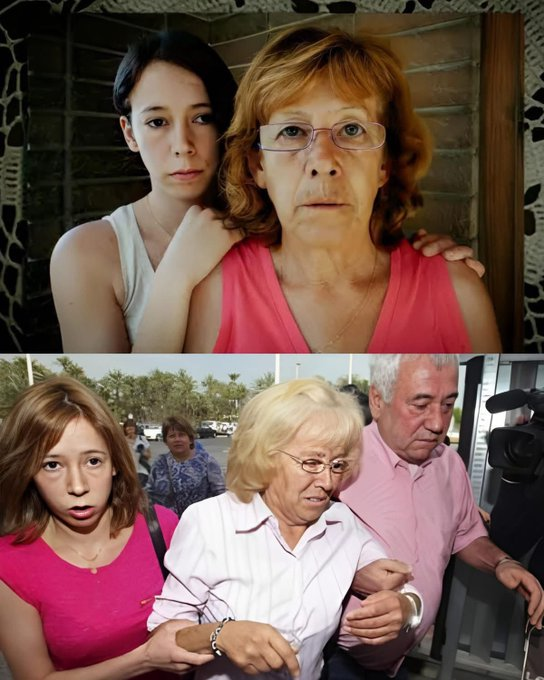
En 1998, una niña de 13 años fue secuestrada y violada bajo amenaza de cuchillo en Alicante, España. El violador, Antonio Cosme, de 63 años, fue condenado a 9 años de cárcel.
Siete años después, en 2005, la madre de la víctima, María del Carmen García, esperaba en una parada de autobús cuando vio a un hombre acercándose.
"¿Cómo está tu hija?", preguntó el hombre con una sonrisa burlona en el rostro.
Era el violador de su hija.
Antonio estaba fuera en un permiso diurno.
Enfurecida por lo que acababa de ocurrir, María corrió a la tienda más cercana, compró 1,5 litros de gasolina y entró en el bar al que Antonio acababa de acceder.
Lo roció de pies a cabeza con gasolina, le prendió fuego y se apartó para observar con calma cómo el violador de su hija ardía vivo ante sus ojos.
María fue condenada a 9,5 años de cárcel por su acto de venganza, pero fue liberada en 2018 tras cumplir 5,5 años.
Hoy, vive libremente en España tras reunirse con su hija.
In 2020, a Stockholm University lab mixed sperm and egg fluid from 16 couples in a dish. Some men's sperm got pulled toward the fluid much harder than others. And in half the cases, the egg picked a stranger's sperm over the partner's.
The egg releases a chemical bait. Sperm carry tiny smell sensors on their heads that pick up that bait. When the smell matches, the sperm speeds up and swims straight at the egg. When it doesn't, the sperm slows down or loses its line. The lead researcher, John Fitzpatrick, called it a chemical breadcrumb trail.
The sperm race is mostly a myth. A man releases around 100 million sperm at a time. Only about 250 ever reach the egg. The rest die along the way. The vagina is acidic and kills most of them. The cervix makes thick mucus that traps them like flypaper. The womb's immune system attacks them as foreign invaders. And half of the survivors pick the wrong fallopian tube, because only one of the two tubes has the egg in it.
By the time anyone even gets close, the race is already over. Then the egg picks.
The egg is selecting for immune-system genes. The more different the father's immune genes are from the mother's, the wider the range of diseases their child can fight off later. So the egg favors sperm that bring more genetic diversity.
Fitzpatrick thinks this could explain some of the 30% of infertility cases doctors label "unexplained." For some couples, their bodies just don't chemically match, even when everything else does.
Out of 100 million sperm, your father's chemistry was the one the egg agreed to let in. Which means all of us are, in some way, the quiet outcome of a chemistry test no one studied for.
Your eyes can only see the moon in gray. It's actually covered in color, blues and oranges and pinks, all from different metals sitting in the rock. You just need a camera and some patience to pull them out.
These photos are called "mineral moons." A photographer points a telescope at the moon, takes hundreds or thousands of pictures, stacks them on top of each other to clean up the image, then slowly turns up the color intensity in editing software. The colors that show up were always there. Too faint for your eyes to catch on their own.
Each color is a different metal. The blue areas have a lot of titanium in them. The orange and brown zones have more iron. The pinkish-red patches around the edges are the oldest parts of the moon's crust, full of aluminum and calcium.
That deep blue region on the left side is called the Sea of Tranquility. Apollo 11 landed right there in July 1969. When Armstrong and Aldrin brought back 47 pounds of rock from that blue titanium zone, scientists cracked the samples open and found three minerals that had never been seen on Earth before. They named one "armalcolite" after the three astronauts (Arm-Al-Col: Armstrong, Aldrin, Collins). They named another "tranquillityite" after the landing site itself. For 40 years, tranquillityite was known as "the moon's own mineral" because nobody could find it here. Then in 2011, a geologist in Western Australia spotted a speck of it inside a billion-year-old rock.
Andrew McCarthy, a photographer in Sacramento, once stacked 150,000 separate pictures of the moon to build one color map. Each splash of blue or orange in these images is a real metal deposit on a surface that's been getting hit by space rocks for 3.5 billion years. The moon was never gray. We just couldn't see it.
300 years before Christianity was invented by paul and co, 1000 years before Islam was invented by prophet Mohamed, An ancient Chinese philosopher said,
" pray all you want, heaven can't hear you... It's not going to stop the winter because you are cold, and it's not going to make the earth smaller because you don't want to walk so far
you pray for rain and it rains, but your prayer has nothing to do with it...sometimes you dont pray for rain and it rains anyways. What do you say then?
educate yourself , and think carefully about the consequences of your actions"
- xun zi
A both funny and educational meme. Let me explain:
In the first panel, Joey is excited because the hotel’s “free Wi-Fi” is extremely fast. Anyone who has stayed in hotels knows their Wi-Fi is usually slow, overloaded, and frustrating. So when a connection suddenly feels blazing fast, it feels like you got lucky.
In the second panel, Joey checks his device and notices his IP address starts with 172.16.42.x. His expression instantly changes to shock — because that number means something very specific in cybersecurity.
That IP range is the well-known default network configuration used by a device called a WiFi Pineapple.
A WiFi Pineapple is a portable penetration-testing tool that attackers can use to create rogue Wi-Fi access points. It can imitate legitimate networks … like a hotel’s Wi-Fi and trick nearby devices into connecting to it instead of the real network.
Once your device connects, the attacker effectively becomes the network in the middle, allowing them to observe or manipulate traffic passing through it. This is a classic Man in the Middle (MitM) attack.
The reason the connection feels “fast” is simple: you’re probably one of the few people connected to it, and the attacker is letting your traffic pass through so they can monitor it.
So if you ever connect to public Wi-Fi and notice an IP address like 172.16.42.x, there’s a good chance you’re not actually on the hotel’s network…. you might be connected to a rogue hotspot controlled by someone else.