Pi App Studio has released two updates to help creators build more engaging and useful app experiences.
1. Backend support enables persistent user experiences for newly created App Studio apps: Apps can save and retrieve user-specific data across sessions, enabling experiences that continue even after users leave and return.
2. AI-assisted App Planning Phase: Creators can develop their ideas with the help of AI before App Studio generates the app. This helps guide creators from an initial idea toward a more complete app concept in a more interactive and dynamic way.
Go to the Pi mining app to learn more, and create new apps with these features today!
Take on the Pi2Day Ecosystem Quest to celebrate new feature releases and receive a special in-app badge!
The Ecosystem Quest guides Pioneers to complete activities to discover new apps, test ecosystem features, and understand how Pi’s infrastructure supports utility creation across compute, AI, and identity.
Certain steps in the Quest require completing a quiz, so remember to pay attention to the updates! You can show-off your in-app badge in Pi Chats, Fireside Forum, and Pi Social Profiles.
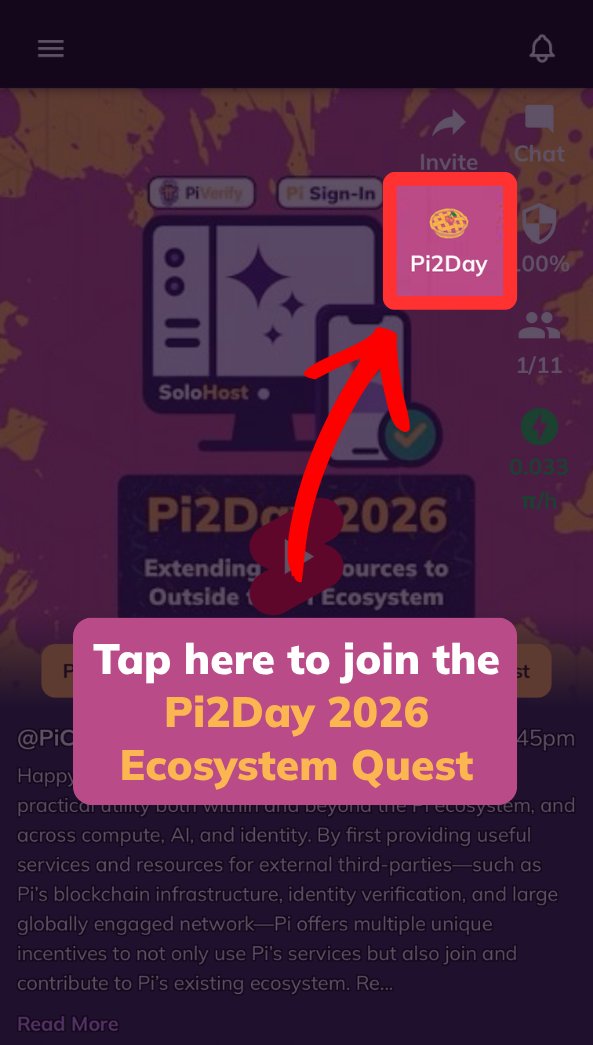
Participate in the Ecosystem Quest by tapping the “Pi2Day” icon on the top right of the Pi mining app home screen. The event will end on July 13.
New to Pi? Download the Pi mining app and get started here https://t.co/sHTvwa8Vt7
Pi2Day 2026 reflects how Pi’s utility continues to grow through infrastructure and participation.
- Through SoloHost, Pi Desktop and Nodes can support new local AI app and compute use cases
- Pi Sign-in can help connect those experiences across users, devices, and services
- PiVerify can extend Pi’s real-human verification capabilities to third-party clients.
Together, these releases point to a broader direction for the ecosystem: Pi products are built both for the Pi ecosystem and to extend Pi services and resources to the external world. This, in turn, enriches and strengthens the Pi ecosystem.
Pi’s practical utility is built not only by product releases but by the Pioneers, Node operators, developers, KYC validators, app teams, merchants, and third-party services that use them, test them, and build on them.
Read the Pi2Day 2026 blog to learn more
https://t.co/5hkl8TAxxQ
SoloHost expands the utility of Pi Nodes beyond just blockchain validation.
Released in Beta on Pi2Day 2026, SoloHost on Pi Desktop gives Pioneers new ways to use their computers to run local apps, AI utilities, distributed computing, and other compute-based use cases.
Pioneers can also remotely engage with the corresponding app through mobile devices on Pi Browser.
SoloHost also lets developers build and list these local apps through an open, permissionless framework to reach the over 420,000 Pi Node operators who are already running Pi Desktop.
Local is key. With SoloHost streamlining access to local applications through Pi Desktop, people can benefit from AI while keeping their data on their own devices, not third-party remote servers.
This means:
- More privacy.
- More control.
- Less reliance on cloud services
Learn more at https://t.co/lMgJBEMbYj
Pi Sign-in allows supported third-party websites and apps to offer Pi accounts as a sign-in or sign-up option.
It helps provide the infrastructure that allows applications and services to recognize, connect, and serve users across and outside the ecosystem.
This means Pioneers can access supported services with their Pi account instead of creating a new account or password for every app.
Why would third-party services or websites want to integrate Pi Sign-in? Pi Sign-in creates a simpler way to connect them with Pi’s large user base and bring Pi users into their own product experiences. It also gives Pi more presence in third-party contexts while offering a way to tap into the additional benefits and resources of Pi Network, besides user traffic.
Learn more about the Pi2Day 2026 release at https://t.co/lMgJBEMbYj
PiVerify is a KYC identity verification service available to third-party companies, making Pi’s real-human verification capabilities available outside the Pi ecosystem.
With PiVerify, external platforms can verify their users, reduce fake or duplicate accounts, and support compliance-related identity workflows.
For businesses and platforms, the need is straightforward: many digital services need to know whether users are real people. Verified identities are needed for any meaningful transactions, especially in real-world economies.
PiVerify services are also paid for in Pi, which increases Pi utility.
By making this infrastructure available to third parties, the Pi2Day 2026 PiVerify release extends the utility of Pi’s verified identity technology and resources beyond Pi’s own apps and services.
Learn more at https://t.co/azUeoeGENF
The three key Pi2Day 2026 releases extend Pi’s services to businesses and developers outside the Pi ecosystem, while inviting them to join Pi Network and take advantage of Pi’s unique benefits and resources.
Read the full Pi2Day blog to learn more about the SoloHost, Pi Sign-in, and PiVerify releases.
https://t.co/lMgJBEMbYj
Happy Pi2Day 2026 Pioneers!
Pi Network is celebrating Pi2Day with new releases advancing Pi’s practical utility both within and beyond the Pi ecosystem, and across compute, AI, and identity.
By first providing useful services and resources for external third-parties—such as Pi’s blockchain infrastructure, identity verification, and large globally engaged network—Pi offers multiple unique incentives to not only use Pi’s services but also join and contribute to Pi’s existing ecosystem.
Head to the Pi mining app and read the Pi2Day announcement to learn more about the new SoloHost, Pi Sign-in, and PiVerify releases today!
Also, take part in the Pi2Day Ecosystem Quest to learn more about the new releases, test features, and earn a special in-app badge to commemorate Pi2Day 2026—and show it off!
Pi2Day celebrates double Pi Day — June 28th — because one day a year isn't enough to celebrate the Pi community.
Watch the video below and head to the Pi mining app to learn more about Pi2Day 2026’s key releases: SoloHost, Pi Sign-In, and PiVerify!
Pi2Day (tomorrow, June 28) is a moment to engage with new product releases and gain insight into the direction and priorities of the network.
Reminder: This year, Pioneers also have a timely opportunity to take part in app utilities expansion, community growth, and ecosystem development feedback before the events end tomorrow on June 28.
Participate in the two initiatives, the vibe coder campaign and Pi Launchpad Testnet token, now and stay tuned tomorrow for Pi2Day!
https://t.co/CCff3IuRQv
Does anyone else feel that running AI models and agents locally, on your own computer, should be much easier?
The privacy benefits are clear: your data stays with you. But while there are many open-source models and projects out there, turning them into a usable local AI agent is still far too hard for non-engineers.
Join Pi’s vibe coder campaign ahead of Pi2Day (June 28)!
Pioneers can participate by joining relevant creator or developer communities and sharing why Pi may be useful for builders who already have prototypes or working apps built through AI platforms. Then submit your public post link in the Pi app for a chance to win Pi Network merchandise!
Wondering how to introduce Pi to vibe coder communities?
Posts introducing Pi can point vibe coders to Pi App Studio, explain how externally created apps can connect with Pi, and highlight the users, payments, ads platform, and broader infrastructure available through the Pi ecosystem.
Pi’s value proposition should be clear:
In the Pi ecosystem, vibe coders building web apps with AI can make their app accessible to 60M+ engaged users, and run their app on built-in payments, identity and ads infrastructure, by simply plugging their service or product into Pi Network.
You can also:
- Introduce Pi opportunities to creator communities;
- Describe how Pi App Studio makes it simple for vibe coders to integrate with Pi;
- Share statistics of organic traction Pi apps have received from the Pi ecosystem;
- Explain why developers and creators should explore Pi.
Learn more https://t.co/euwz9BMwll