Hundreds of girls report facing sexual harassment online but have no one to turn to for help.
This is what they want to change.
NEW story for @CNN As Equals from me and the brilliant @cnni team & exclusive research in collaboration with @PlanGlobal
https://t.co/1MNrpyQFQx
Nearly a year after this platform’s AI chatbot sputtered out more than 3 million deepfakes of women in bikinis, bruises and worse: I found survivors forced to take matters into their own hands.
Inside the Grok Deepfake Scandal Police Couldn’t Stop from @TBIJ is out now
The women taking on the tech giants over deepfakes and digital abuse
Under new legal rules companies like TikTok could face hefty fines for failing to tackle illegal intimate images. Yet victims say police are still finding it difficult to act, reports @lydmorrish
https://t.co/0yizBMPuw3
Exclusive: A rare bookseller suspected his books were being bought by AI companies. He stuck an AirTag in a book and we tracked it to a secretive Amazon facility in Las Vegas where they scan and destroy books called VGT3:
https://t.co/WXSo0zB6JF
I find it utterly disappointing and frankly disturbing how much my colleagues in the media have dropped the ball on covering this.
It isn't insightful to dismiss people with eating disorders, which have the highest mortality of any psychiatric illness. It isn't a Smart Take to mock people's concern for a woman who has, very publicly, and very obviously, been struggling with a deadly illness for a long time.
I understand talking about women's bodies is difficult and this is a hot-button issue that a lot of people don't know how to discuss sensitively. But this is a celebrity with millions of young fans whose lives are at stake. And her illness is being celebrated as not just normal, but aspirational.
I also understand she personally has no obligation to publicly discuss this. And I agree with that, but only to an extent. Because by virtue of her fame, WE have to publicly discuss this and de-normalize it. This is a woman with 360 million followers on Instagram, whose face is plastered over Swarovski and Givenchy ads, who performs to sold-out venues worldwide. EVERYTHING about her is sold to her fans as aspirational, and it's willfully ignorant to pretend otherwise.
Ariana Grande's art may be in "acrimonious conversation with its spectators." But anyone familiar with the psychology of eating disorders knows that this acrimony is not coming from a rational place. She may be angry about the public scrutiny, but that's because she has a disease that is telling her she is beautiful and thriving and everyone who disagrees is just jealous, even as she withers away in real time. It's completely disingenuous to pretend she has the moral high ground here. It just lends credence to her (patently wrong) claim that she is healthy and happy and look away, everyone, everything is fine.
None of this is Ariana's fault. But it's our responsibility to call this illness out for what it is, rather than continuing to look the other way and write off the discourse as misogynistic body-shaming. And failing to do so is nothing short of a moral failure. Not just for Ariana, but for the millions of young girls who need to be told, in no uncertain terms, that this is NOT normal.
The Kremlin’s cognitive warfare is evolving. Leaked documents from Russia’s Social Design Agency reveal efforts to move beyond planting fabricated stories on social media. Now Russian influence operators are trying to create Wikipedia clones and fake think tanks to shape the information powering search engines and AI chatbots. https://t.co/R1NqMxyJjr
My colleague @neilmhta takes you through our @WSJ analysis and how to spot the deceptive Polymarket videos here
Come for the journalism, stay for Neil saying "Bro, what?" (Or vice versa)
https://t.co/iF9TkpwqcT
New: Hackers have been stealing high-profile Instagram accounts by simply asking Meta's AI support chatbot to change the email associated with the account they want to steal.
Shockingly easy, terrible flaw associated with offloading support to AI:
https://t.co/PvRm8u0MV7
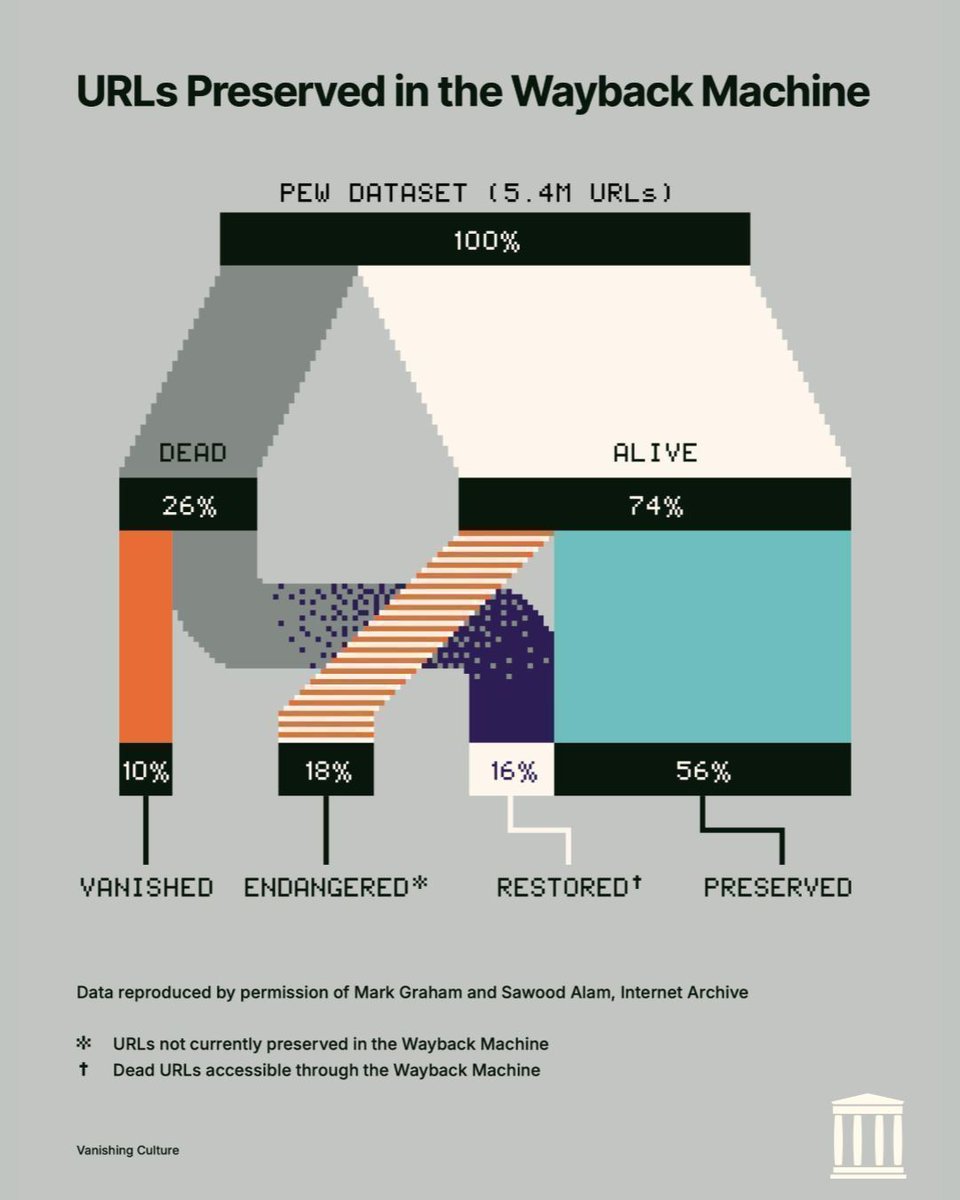
The web is disappearing 🕳️
According to a Pew Research Center report, 26% of pages from 2013-2023 are no longer accessible.
But that’s not the whole story.
In a new study published in Internet Archive's book, VANISHING CULTURE, data scientists working with the Wayback Machine have found:
16% have been restored through the Wayback Machine.
56% are preserved before they disappear.
Preservation is the remedy for cultural loss.
📚 Read VANISHING CULTURE free from the Internet Archive
📖 Download & read: https://t.co/BrawXOwMBr
🛒 Purchase in print: https://t.co/EB58IliqDm
#VanishingCulture #DigitalMemory #InternetArchive #BookTwitter