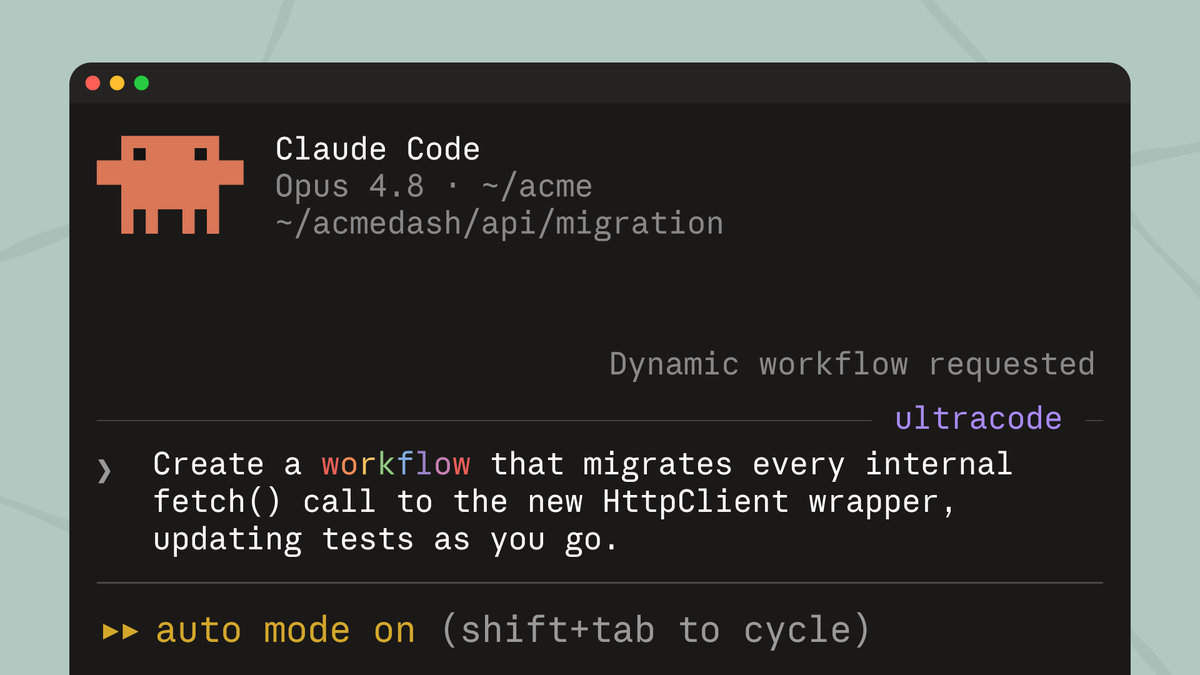
New in Claude Code (research preview): dynamic workflows.
Claude writes an orchestration script on the fly, then spins up a large fleet of coordinated subagents in parallel to take on your most complex tasks.
Use the word "workflow" in a prompt to get started.
Actually in the last week I've not yet given grok build a problem it couldn't solve.
I'm cautious with giving it too much, but for basic tasks that would otherwise just be laborious.... It's pretty good
Bug fixes shipping to Grok Build 0.2.3 (release notes will be available in the TUI)
- add “Yes, and don't ask again for anything (always-approve mode)"
- add alpha/stable to welcome screen
- JetBrains/JediTerm terminal detection so TUI does not get confused and detect it as some other terminal
- persist model ID instead of display name for default_model
- clamp Q&A height to prevent ratatui buffer overflow
- better UX for tmux inside ssh copy-paste issues
- store vim mode persistently in the config.toml to prevent restart loss
- memory usage improvements for managing chat history on the hot path
Shopify CEO Tobi Lutke explains Goodhart’s law and why he doesn’t like KPIs or OKRs
“Goodhart’s law is real. The moment a metric becomes a goal, it’s no longer a useful metric… No metric by itself is a complete heuristic for a complex business. There’s a million different tensions in a company, and you can’t keep all of them in harmony by optimizing for one thing.”
For this reason, Shopify doesn’t use KPIs or OKRs. But as Tobi explains, this doesn’t mean they don’t value data and metrics.
“We are extremely data informed. We have invested enormous amounts of money and time into systems that give us basically everything at our fingertips… But what Shopify attempts to do is just not over-fit for what’s quantifiable.”
People love optimizing for highly-quantifiable things because there’s immediate gratification that comes from seeing a number go up. But Tobi thinks that the most important aspects of a product are rarely quantifiable:
“The overlap of the most valuable things you can do with a product and the things that happen to be fully quantifiable are like maybe 20%. Which leaves 80% of a value space unaddressable by the people who only look at quantifiable things.”
He continues:
“Shopify is comfortable with unquantifiable things like taste, quality, passion, love, hate… The sort of deep satisfaction that a craftsperson feels when they’ve done a job well is actually a better proxy if you allow it to be.”
They then have robust analytics systems that tell the company if something’s wrong or a new rollout breaks something.
“We think about it as a cockpit for a pilot. The decisions are still made by pilots, and we think this leads to better results… I think there needs to be more acceptance in business of unquantifiable things… And then metrics take a support function.”
Source: @lennysan (Feb 2025)
AMP founder @AnjneyMidha says that today's levels of compute underutilization would be like if factories during the late Industrial Revolution only operated half the time.
What he said:
"We think we're roughly in like 1885 Industrial England, where the steam engine's been invented, everybody knows that you can make cool new products like steel, notebooks, pens, and cars. And there's this very scarce input called coal that everybody's hoarding."
"[But] in this case it's compute. And if you fly over industrial-era England, you'll see all these factories getting set up, and everyone's running a generator at half capacity."
"This makes no sense. If I'm looking at all my portfolio companies, these clusters are running at half utilization."
"In fact, Elon's got 500,000 GB300s running in Memphis at 11% MFU and less than 60% node allocation. This is $12 billion of compute being wasted."
I don't like when tests require changes to production code to test things. Test observable behaviors reachable from the real, intended, semantical public API, not fake semantics that exist only to make the test writer's life easier at the expense of system semantics.
NEW: Elon Musk took $500 million in loans out at SpaceX, a move that would have been illegal at a public company. It's just one example of the years of financial engineering at the helm of his companies. Latest investigation with @susannecraig https://t.co/w0RPNHS1WI
🚨 Bitwarden CLI 2026.4.0 was compromised as part of the ongoing Checkmarx supply chain campaign after attackers abused a GitHub Action in Bitwarden’s CI/CD pipeline.
We’ll continue updating our coverage as more details are confirmed.
https://t.co/G0aakn8swq
Anthropic bros I don't know how to tell you but these pricing games (even if it's a/b testing) is spectacularly bad idea both in taste and growth. Who ever internally is pushing for this is screwing you over and handing sama win
Update on rsETH incident:
@LlamaRisk has published a report outlining the rsETH incident, the immediate actions taken, its impact on Aave, and potential paths forward.
All service providers have been working to assess the two potential bad debt scenarios on the Aave protocol.
Aave DAO service providers are also leading an effort with ecosystem participants to address any bad debt. This effort already has several indicative commitments from various parties and we are grateful for the strong support we have received so far.
We will share further updates as we have them.
In the meantime, the full report can be read here: https://t.co/jy3BHZCa7b