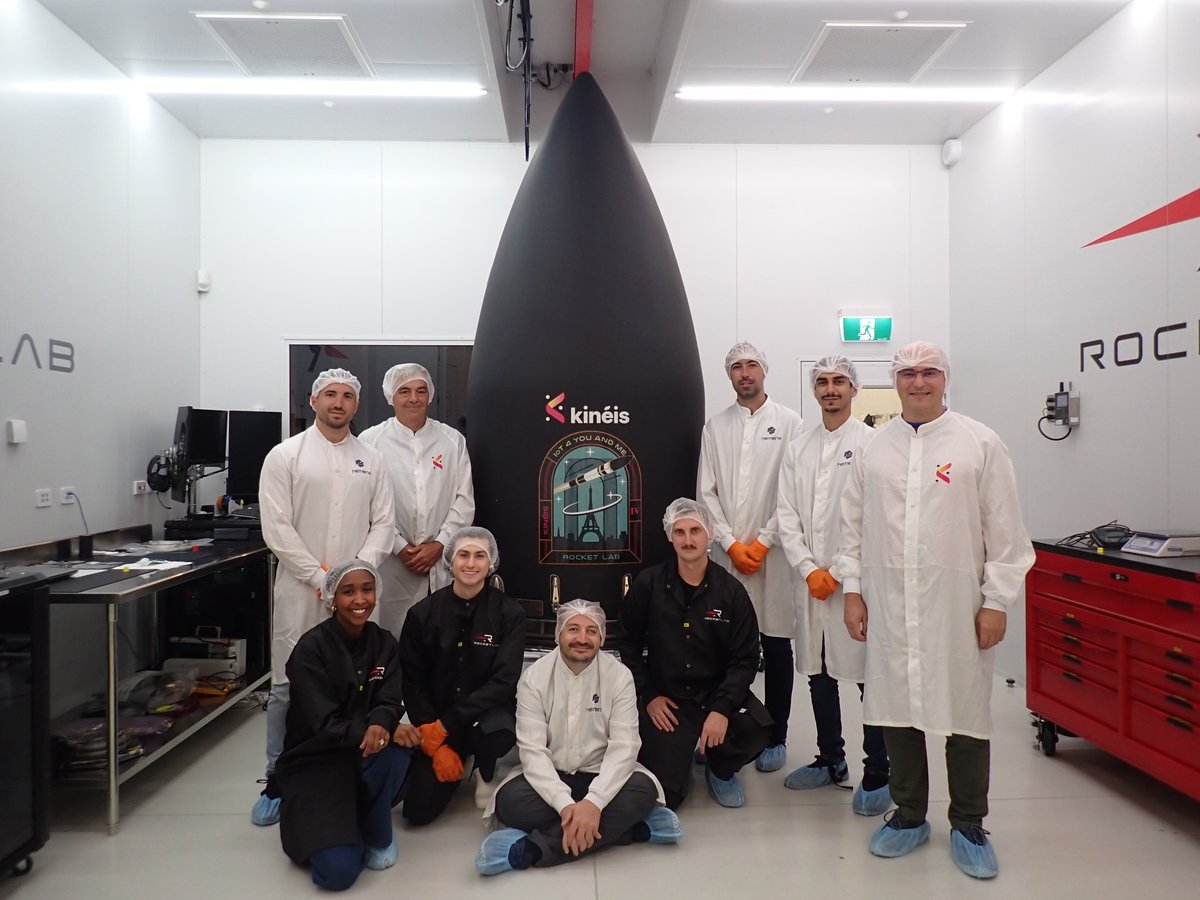
Launch is date set - let's go to space for @KineisIoT 🚀
⏰Target lift-off: 9:43 am, Feb 9th NZT (20:43 Feb 8th UTC)
🛰️Mission name: IoT 4 You and Me
🤝 Customer: @KineisIoT
🌏 Launch site: LC-1
💻Mission info: https://t.co/KaXeISJ1Ov
We've made a historic space video call from an area of no coverage using a standard mobile phone and commercial satellites built to offer a full mobile broadband experience 🛰️
Watch @astro_timpeake join us in unveiling our space to land gateway ⤵️ https://t.co/d9NWVLCQIL
$RDW
The combination of Redwire and Edge Autonomy creates a uniquely positioned space and defense company.
"Redwire is poised to provide end-to-end solutions for multi-domain operations from the surface of the earth to the surface of the moon and beyond."
-Peter Cannito, CEO
Here's Edge Autonomy CTO Allen Gardner talking about their Stalker UAS.
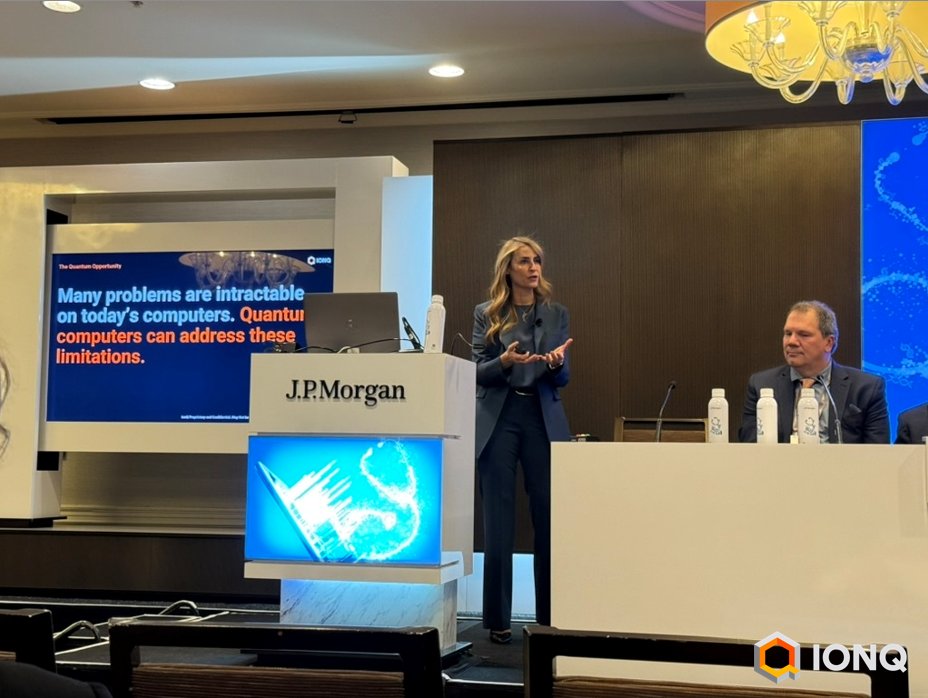
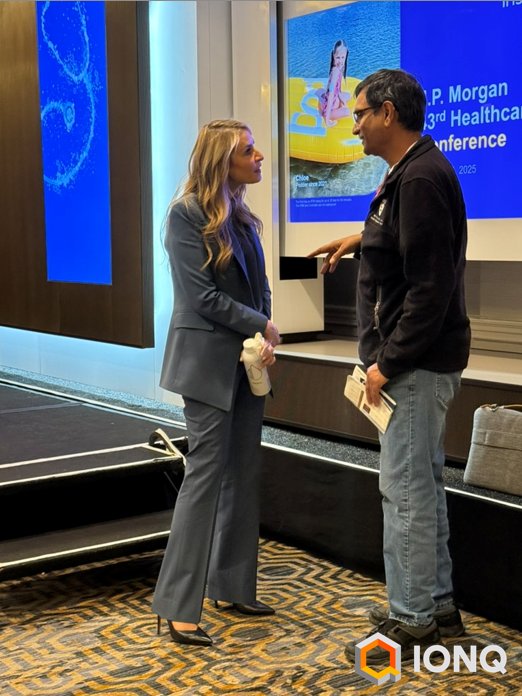
Yesterday, IonQ’s Rima Alameddine presented at the #JPM2025 Healthcare Conference to share how it’s using quantum computing to unlock new breakthroughs and solve the world’s most complex challenges in healthcare, chemistry, drug discovery, biopharmaceuticals, and more.
$IONQ Thoughts on the Jensen Huang Quantum Computing "Reality Check": Promise, Progress, and Puzzling Timelines
As a long-term follower and investor in the quantum computing space, I've always aimed to be direct about both the potential and challenges in this field. While I maintain a core position in IonQ shares, I believe we've reached a critical inflection point where words and projections are no longer sufficient - we need concrete evidence. Jensen Huang's recent comments about quantum computing's timeline, suggesting "if you picked 20 [years], I think a whole bunch of us would believe it," have brought the stark disconnect between commercial claims and academic perspectives into sharp focus. As someone deeply immersed in this sector, I want to unpack this divergence and examine what it means for the industry's future.
The quantum computing sector faced a sobering reality check when NVIDIA CEO Jensen Huang offered a notably measured timeline for the technology's development. Speaking at NVIDIA's analyst day event, Huang elaborated, "If you kind of said 15 years for very useful quantum computers, that would probably be on the early side. If you said 30, it's probably on the late side. If you picked 20, I think a whole bunch of us would believe it." This stark assessment from one of tech's most influential leaders sent quantum computing stocks tumbling, particularly impacting companies like IonQ.
What makes Huang's assessment particularly significant is NVIDIA's deep involvement in the space. As he noted, "We are the perfect company to be the classical part of classical-quantum... we're working with just about every quantum computing company in the world." Through their CUDA-Q quantum computing toolkit, NVIDIA is actively engaged in developing the classical computing infrastructure that quantum systems will require, giving them unique insight into the field's practical challenges.
This conservative timeline aligns closely with the perspective of John Preskill, the physicist who coined the term "Quantum Supremacy" in 2012. Preskill's recent assessment suggesting quantum computing applications are "decades" away carries particular weight given his foundational role in the field. As the originator of many key quantum computing concepts, his timeline estimates reflect deep understanding of the fundamental challenges facing the technology.
These views must be understood in the context of what Preskill himself termed the NISQ (Noisy Intermediate-Scale Quantum) era. Current quantum systems face significant challenges from environmental interference, including thermal fluctuations, electromagnetic interference, and photon loss. While researchers have developed various error mitigation techniques, including quantum error correction codes and dynamical decoupling methods, scaling these solutions remains a formidable challenge. The NISQ designation acknowledges both the potential and limitations of current systems.
Yet amid these conservative assessments, quantum computing theorist Scott Aaronson presents a more optimistic perspective. In his recent blog post "Quantum Computing: Between Hope and Hype," Aaronson states he's "now more optimistic than I've ever been that, if things continue at the current rate, either there are useful fault-tolerant QCs in the next decade, or else something surprising happens to stop that." His optimism stems from concrete technical achievements, particularly in two-qubit gate fidelities, which have progressed from 50% in the late 1990s to multiple groups now reporting 99.9% fidelity.
Aaronson's perspective is particularly interesting given his personal history with the field. Having started 25 years ago, he initially "reconciled myself to the prospect that I'm going to study what fundamental physics implies about the limits of computation, and maybe I'll never live to see any of it experimentally tested." Now, at age 43, his shift to stating "once you tell me that there is a serious prospect of testing it soon, then I become kind of impatient" suggests a significant change in outlook from someone who once accepted they might never see practical quantum computers in their lifetime.
These measured academic perspectives stand in striking contrast to commercial timelines across the industry. Quantinuum has outlined an ambitious path to universal, fully fault-tolerant quantum computing by 2030, recently unveiling their roadmap for their fifth-generation quantum computer, Apollo, which they claim will be capable of executing circuits with millions of gates. QuEra is targeting nearer-term milestones, claiming they will demonstrate "practical quantum advantage" with 100 qubits by 2026.
Perhaps the most ambitious timeline comes from IonQ, whose technical roadmap claims extend well beyond current capabilities, projecting not just incremental improvements but transformative leaps in performance. IonQ has already demonstrated achievement of several technical milestones ahead of schedule, including reaching 36 algorithmic qubits on their Forte system a full 12 months early. Most notably, IonQ projects achieving 99.9999% fidelity by 2026+, a dramatic improvement from their current 99.9% fidelity levels. This six-nines fidelity target would represent "quantum" leap in precision that would fundamentally transform the capabilities of their systems. The company couples this with their bold claim of achieving "broad commercial advantage" in the same timeframe, suggesting their systems will be capable of solving real-world problems across multiple industries with practical value.
Their technical roadmap outlines several stepping stones toward these ambitious goals:
- 64 qubits by 2025 with their "Tempo" system, promising "commercial advantage capable" performance
- 256 qubits with 16:1 error correction by 2026
- 384 qubits with 32:1 error correction by 2027
- 1024 qubits with 32:1 error correction by 2028
The company's product timeline shows a clear progression through different generations, each with increasing capabilities but ending with commercial advantages THIS YEAR
- Tempo (2025): Commercial advantage capable
- Future Systems (2025+): Broad commercial advantage
IonQ's roadmap is particularly notable for its modular scaling approach, outlined in three stages:
- Stage 1: Achieving 200 qubits through multi-core technology
- Stage 2: Expanding to 400 qubits by adding photonic interconnect capabilities
- Stage 3: Reaching 1000+ qubits through the integration of quantum networking
The company has already demonstrated progress on this front, recently announcing achievements in remote ion-ion entanglement, marking a crucial step toward their scaled architecture. Their recent partnership with NKT Photonics for optical subsystems and with IMEC for photonic integrated circuits and chip-scale ion trap technology further supports their scaling timeline.
This stark disparity between academic timelines and commercial roadmaps raises crucial questions, particularly about IonQ's ambitious positioning. The company has demonstrated consistent technical progress, meeting or exceeding their roadmap milestones ahead of schedule. They've also secured significant government support, including a $54.5 million contract from the Air Force Research Lab, and established partnerships with major players like Accenture, Hyundai, Goldman Sachs, and others. They've also made notable progress in quantum networking through the acquisition of Qubitekk's assets, including 118 quantum networking patents.
However, while IonQ has demonstrated technical achievements and secured government contracts, evidence of significant commercial system sales remains limited. Over the last two years, IonQ executives have repeatedly cited strong demand for system sales during conference calls and generated considerable excitement around partnerships with prominent companies including Airbus, Accenture, Hyundai, Goldman Sachs, Dow, Thompson Machinery, AstraZeneca, Ansys, Dell, and others. This narrative peaked during the Quantum World Congress in 2023 with the Tempo/Forte announcements, which some critics dismissed as "vapor ware." The company projects a total addressable market of $65 billion by 2030 (according to Prescient & Strategic Intelligence), but despite the consistent messaging about robust commercial interest, private sector adoption that would validate their aggressive timeline hasn't materialized as expected. While government contracts appear promising, shareholders have been left waiting for the many commercial sales that were suggested throughout 2023 and into 2024. Furthermore, Peter Chapman's suggestions about quantum-AI integration and becoming an "AI company," coupled with the departure of their Chief AI team lead Dominic Widdows to AMD (who cited wanting to "help more sooner," implying quantum-AI integration is slow going), raise questions about the company's near-term strategic focus.
The return of IonQ founders Jungsang Kim and Chris Monroe to academic research at Duke, where they're working on 256 qubit interconnect systems, adds another layer of complexity to this narrative. Their focus on fundamental research rather than commercial deployment might be seen as either a strategic division of labor or a telling shift in priorities.
The quantum computing industry thus stands at a critical juncture, with perhaps its starkest divergence yet between academic and commercial timelines. While Huang suggests "if you picked 20 [years], I think a whole bunch of us would believe it" and Preskill points to a multi-decade timeline, IonQ (and other companies similarly) claims they will achieve "broad commercial advantage" with 99.9999% fidelity by 2026+ - a mere two years away. This is not just a difference in degree but in kind - the gap between these visions of quantum computing's future has never been wider.
The resolution of these competing narratives will likely come soon, given the specificity and nearness of IonQ's claims. Their projection of achieving "broad commercial advantage" by 2026+ represents a testable claim on a concrete timeline. If achieved, it would fundamentally invalidate the more conservative academic timelines. If missed, it would raise serious questions about the industry's aggressive commercialization projections.
The quantum computing sector now faces a moment of truth. Either we are on the verge of a quantum computing revolution that will arrive far sooner than leading academics believe possible, or commercial timelines are dramatically optimistic. Resolution will come through demonstrable commercial applications and independent verification of performance claims, particularly around the ambitious fidelity targets. The gap between industry promises and academic caution has created significant market uncertainty, but unlike previous debates about quantum timeline, this one has set itself up for relatively near-term resolution.
Unlike quantum states themselves, the competing narratives about quantum computing's timeline cannot remain in superposition indefinitely - the wavefunction of quantum computing projections must collapse into reality. Peter Chapman and IonQ's leadership have the power to force this collapse through a straightforward demonstration: show us the system sales and concrete use cases that translate into revenue. The time for such a demonstration is now, or as soon as possible. While quantum computers may be able to exist in multiple states simultaneously, balance sheets cannot. Long-term shareholders deserve to see definitive proof of commercial viability, not just promising technical achievements. The gap between academic timelines measuring in decades and commercial projections promising transformative capabilities within years must be resolved through tangible evidence. The quantum computing industry has reached its measurement moment - it's time to open the box and see if Schrödinger's quantum advantage is alive or dead.
As a long-term investor, I'm seeking validation through performance, not market enthusiasm or speculation. While I remain invested in IonQ's potential, my conviction needs to be supported by concrete results rather than market momentum. IonQ has a clear opportunity to prove skeptics like Jensen Huang wrong - not through words, but through demonstrable commercial success. The quantum computing story deserves to be written through revenue and customer wins, not just technical achievements and promises. What a moment!
$NVDA CEO suggests that quantum computers won’t see widespread use for general applications for at least another 15 years. While this may hold true for universal adoption -- it overlooks the reality that quantum computers are already making an impact today in specific, high-value use cases.
$IONQ, for example, is actively deploying its quantum systems through platforms like $AMZN AWS and $MSFT Azure, providing businesses with accessible pathways to harness quantum computing. With the introduction of its AQ64 quantum computers, IonQ is set to further expand the practicality and utility of quantum solutions.
This progress directly challenges the idea that practical quantum applications are decades away. IonQ’s real-world results prove the quantum revolution has already begun. I believe quantum computing will accelerate rapidly over the next 5 years -- transitioning from niche use cases to widespread adoption faster than most anticipate.
These are the levels where I think IonQ can bounce 👇
• $29 -- 21-Week EMA
• $19 -- Average VWAP from May 2023 breakout
• $16 -- Massive Volume Shelf
#SPX is about to start a massive 8 year rally as based on this '100 year blue-print', it has entered the final (and most aggressive) phase of the 23-year Bull Cycle that started after the 2008 Housing Crisis.
This is a quite detailed chart analysis and shows the cyclical nature of the market over the decades with systemic Bull and Bear Cycles that share striking similarities, giving long-term investors a powerful tool to time the markets with patience.
Based on that, we are currently on the 'A.I. Bubble' wave and we can see the S&P at 20000 by 2032.
It is worth taking the time to read the full analysis.
Full description on our Telegram channel:
👉 https://t.co/9vLjuzwnAV
LIKE 👍, FOLLOW ✅, SHARE 🙌 and COMMENT ✍ if you enjoy this analysis!
#US500 #SPX500 #standardandpoors #stockindex #StockMarket #TradingTips #trading #Signals #tradingsignals #spxsignals
We want to get Mars rocks into the hands of scientists sooner and cost-effectively 🤝
We’ve been selected by @NASA to complete a study into retrieving samples from the Martian surface and bringing them to Earth for the first time as part of the Mars Sample Return Program.
Learn more: https://t.co/LjIbIAdFto
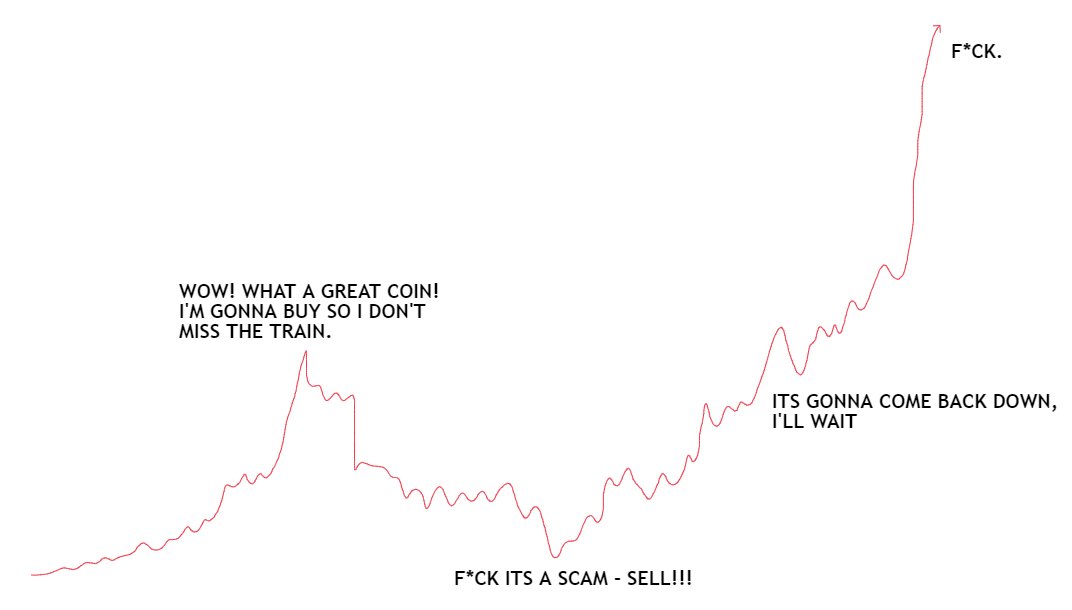
On-chain lowcaps pumped hard, even before majors did.
Right now, we're seeing a slow bleed and cleanse from the market before things start to take off again.
Some coins have dropped 70%, which is a normal drop in a Bull-Run.
We've seen this playbook play out every bull cycle.
Pump 20x, dump 60%+ and then pump into the Billions.
If you truly want generational wealth, you need to have the MOST patience ever.
good morning bros
the bird dog flies and conquers in all areas
stay tuned for the madness of the coming weeks bros, you're all making this the best community there's ever been and we couldn't be more proud
let's f*cking $BIRDDOG
Today is #BitcoinPizzaDay.
On this day in 2010, a programmer named Laszlo Hanyecz purchased two Papa John's pizza pies for 10,000 $BTC.
At the time, they were worth only around $30.
Today? That value has skyrocketed to roughly $700 million.
Poor Laszlo.
#Bitcoin
Further Expansion & Innovation! 🚀
We're thrilled to announce major upgrades to our #mining operations:
⛏ More Rigs: We’re ramping up to 50 high-performance mining rigs!
💪 More Power: Increasing our #GPU count to 400!
And there’s more...
Get ready for the launch of our new #dApp, designed to enhance your $HashAI experience with seamless functionality and cutting-edge features.
Stay tuned for more updates and thank you for being part of journey!
At $HASHAI, we are committed to both delivering against our strategic and operational goals as well as providing transparency to enable trust for new and existing investors alike.
We are delighted to show you a short video that demonstrates and verifies our new infrastructure, which is part of our $3 million international expansion.
In this video, you will see one of our international sites, which has the benefits of gas and water cooling jackets.
Our S19-XP’s are installed and running, currently being stress tested with our #AI algorithms, and a "go-live" date will be communicated within the next week.
The whole team will be visiting this site very soon, and further videos will be posted for our community every step of the way.



![JKeynesAlpha's tweet photo. $IONQ Thoughts on the Jensen Huang Quantum Computing "Reality Check": Promise, Progress, and Puzzling Timelines
As a long-term follower and investor in the quantum computing space, I've always aimed to be direct about both the potential and challenges in this field. While I maintain a core position in IonQ shares, I believe we've reached a critical inflection point where words and projections are no longer sufficient - we need concrete evidence. Jensen Huang's recent comments about quantum computing's timeline, suggesting "if you picked 20 [years], I think a whole bunch of us would believe it," have brought the stark disconnect between commercial claims and academic perspectives into sharp focus. As someone deeply immersed in this sector, I want to unpack this divergence and examine what it means for the industry's future.
The quantum computing sector faced a sobering reality check when NVIDIA CEO Jensen Huang offered a notably measured timeline for the technology's development. Speaking at NVIDIA's analyst day event, Huang elaborated, "If you kind of said 15 years for very useful quantum computers, that would probably be on the early side. If you said 30, it's probably on the late side. If you picked 20, I think a whole bunch of us would believe it." This stark assessment from one of tech's most influential leaders sent quantum computing stocks tumbling, particularly impacting companies like IonQ.
What makes Huang's assessment particularly significant is NVIDIA's deep involvement in the space. As he noted, "We are the perfect company to be the classical part of classical-quantum... we're working with just about every quantum computing company in the world." Through their CUDA-Q quantum computing toolkit, NVIDIA is actively engaged in developing the classical computing infrastructure that quantum systems will require, giving them unique insight into the field's practical challenges.
This conservative timeline aligns closely with the perspective of John Preskill, the physicist who coined the term "Quantum Supremacy" in 2012. Preskill's recent assessment suggesting quantum computing applications are "decades" away carries particular weight given his foundational role in the field. As the originator of many key quantum computing concepts, his timeline estimates reflect deep understanding of the fundamental challenges facing the technology.
These views must be understood in the context of what Preskill himself termed the NISQ (Noisy Intermediate-Scale Quantum) era. Current quantum systems face significant challenges from environmental interference, including thermal fluctuations, electromagnetic interference, and photon loss. While researchers have developed various error mitigation techniques, including quantum error correction codes and dynamical decoupling methods, scaling these solutions remains a formidable challenge. The NISQ designation acknowledges both the potential and limitations of current systems.
Yet amid these conservative assessments, quantum computing theorist Scott Aaronson presents a more optimistic perspective. In his recent blog post "Quantum Computing: Between Hope and Hype," Aaronson states he's "now more optimistic than I've ever been that, if things continue at the current rate, either there are useful fault-tolerant QCs in the next decade, or else something surprising happens to stop that." His optimism stems from concrete technical achievements, particularly in two-qubit gate fidelities, which have progressed from 50% in the late 1990s to multiple groups now reporting 99.9% fidelity.
Aaronson's perspective is particularly interesting given his personal history with the field. Having started 25 years ago, he initially "reconciled myself to the prospect that I'm going to study what fundamental physics implies about the limits of computation, and maybe I'll never live to see any of it experimentally tested." Now, at age 43, his shift to stating "once you tell me that there is a serious prospect of testing it soon, then I become kind of impatient" suggests a significant change in outlook from someone who once accepted they might never see practical quantum computers in their lifetime.
These measured academic perspectives stand in striking contrast to commercial timelines across the industry. Quantinuum has outlined an ambitious path to universal, fully fault-tolerant quantum computing by 2030, recently unveiling their roadmap for their fifth-generation quantum computer, Apollo, which they claim will be capable of executing circuits with millions of gates. QuEra is targeting nearer-term milestones, claiming they will demonstrate "practical quantum advantage" with 100 qubits by 2026.
Perhaps the most ambitious timeline comes from IonQ, whose technical roadmap claims extend well beyond current capabilities, projecting not just incremental improvements but transformative leaps in performance. IonQ has already demonstrated achievement of several technical milestones ahead of schedule, including reaching 36 algorithmic qubits on their Forte system a full 12 months early. Most notably, IonQ projects achieving 99.9999% fidelity by 2026+, a dramatic improvement from their current 99.9% fidelity levels. This six-nines fidelity target would represent "quantum" leap in precision that would fundamentally transform the capabilities of their systems. The company couples this with their bold claim of achieving "broad commercial advantage" in the same timeframe, suggesting their systems will be capable of solving real-world problems across multiple industries with practical value.
Their technical roadmap outlines several stepping stones toward these ambitious goals:
- 64 qubits by 2025 with their "Tempo" system, promising "commercial advantage capable" performance
- 256 qubits with 16:1 error correction by 2026
- 384 qubits with 32:1 error correction by 2027
- 1024 qubits with 32:1 error correction by 2028
The company's product timeline shows a clear progression through different generations, each with increasing capabilities but ending with commercial advantages THIS YEAR
- Tempo (2025): Commercial advantage capable
- Future Systems (2025+): Broad commercial advantage
IonQ's roadmap is particularly notable for its modular scaling approach, outlined in three stages:
- Stage 1: Achieving 200 qubits through multi-core technology
- Stage 2: Expanding to 400 qubits by adding photonic interconnect capabilities
- Stage 3: Reaching 1000+ qubits through the integration of quantum networking
The company has already demonstrated progress on this front, recently announcing achievements in remote ion-ion entanglement, marking a crucial step toward their scaled architecture. Their recent partnership with NKT Photonics for optical subsystems and with IMEC for photonic integrated circuits and chip-scale ion trap technology further supports their scaling timeline.
This stark disparity between academic timelines and commercial roadmaps raises crucial questions, particularly about IonQ's ambitious positioning. The company has demonstrated consistent technical progress, meeting or exceeding their roadmap milestones ahead of schedule. They've also secured significant government support, including a $54.5 million contract from the Air Force Research Lab, and established partnerships with major players like Accenture, Hyundai, Goldman Sachs, and others. They've also made notable progress in quantum networking through the acquisition of Qubitekk's assets, including 118 quantum networking patents.
However, while IonQ has demonstrated technical achievements and secured government contracts, evidence of significant commercial system sales remains limited. Over the last two years, IonQ executives have repeatedly cited strong demand for system sales during conference calls and generated considerable excitement around partnerships with prominent companies including Airbus, Accenture, Hyundai, Goldman Sachs, Dow, Thompson Machinery, AstraZeneca, Ansys, Dell, and others. This narrative peaked during the Quantum World Congress in 2023 with the Tempo/Forte announcements, which some critics dismissed as "vapor ware." The company projects a total addressable market of $65 billion by 2030 (according to Prescient & Strategic Intelligence), but despite the consistent messaging about robust commercial interest, private sector adoption that would validate their aggressive timeline hasn't materialized as expected. While government contracts appear promising, shareholders have been left waiting for the many commercial sales that were suggested throughout 2023 and into 2024. Furthermore, Peter Chapman's suggestions about quantum-AI integration and becoming an "AI company," coupled with the departure of their Chief AI team lead Dominic Widdows to AMD (who cited wanting to "help more sooner," implying quantum-AI integration is slow going), raise questions about the company's near-term strategic focus.
The return of IonQ founders Jungsang Kim and Chris Monroe to academic research at Duke, where they're working on 256 qubit interconnect systems, adds another layer of complexity to this narrative. Their focus on fundamental research rather than commercial deployment might be seen as either a strategic division of labor or a telling shift in priorities.
The quantum computing industry thus stands at a critical juncture, with perhaps its starkest divergence yet between academic and commercial timelines. While Huang suggests "if you picked 20 [years], I think a whole bunch of us would believe it" and Preskill points to a multi-decade timeline, IonQ (and other companies similarly) claims they will achieve "broad commercial advantage" with 99.9999% fidelity by 2026+ - a mere two years away. This is not just a difference in degree but in kind - the gap between these visions of quantum computing's future has never been wider.
The resolution of these competing narratives will likely come soon, given the specificity and nearness of IonQ's claims. Their projection of achieving "broad commercial advantage" by 2026+ represents a testable claim on a concrete timeline. If achieved, it would fundamentally invalidate the more conservative academic timelines. If missed, it would raise serious questions about the industry's aggressive commercialization projections.
The quantum computing sector now faces a moment of truth. Either we are on the verge of a quantum computing revolution that will arrive far sooner than leading academics believe possible, or commercial timelines are dramatically optimistic. Resolution will come through demonstrable commercial applications and independent verification of performance claims, particularly around the ambitious fidelity targets. The gap between industry promises and academic caution has created significant market uncertainty, but unlike previous debates about quantum timeline, this one has set itself up for relatively near-term resolution.
Unlike quantum states themselves, the competing narratives about quantum computing's timeline cannot remain in superposition indefinitely - the wavefunction of quantum computing projections must collapse into reality. Peter Chapman and IonQ's leadership have the power to force this collapse through a straightforward demonstration: show us the system sales and concrete use cases that translate into revenue. The time for such a demonstration is now, or as soon as possible. While quantum computers may be able to exist in multiple states simultaneously, balance sheets cannot. Long-term shareholders deserve to see definitive proof of commercial viability, not just promising technical achievements. The gap between academic timelines measuring in decades and commercial projections promising transformative capabilities within years must be resolved through tangible evidence. The quantum computing industry has reached its measurement moment - it's time to open the box and see if Schrödinger's quantum advantage is alive or dead.
As a long-term investor, I'm seeking validation through performance, not market enthusiasm or speculation. While I remain invested in IonQ's potential, my conviction needs to be supported by concrete results rather than market momentum. IonQ has a clear opportunity to prove skeptics like Jensen Huang wrong - not through words, but through demonstrable commercial success. The quantum computing story deserves to be written through revenue and customer wins, not just technical achievements and promises. What a moment!](https://pbs.twimg.com/media/GgzdNjkWAAAr5d2.jpg)





![JKeynesAlpha's tweet photo. $IONQ Thoughts on the Jensen Huang Quantum Computing "Reality Check": Promise, Progress, and Puzzling Timelines
As a long-term follower and investor in the quantum computing space, I've always aimed to be direct about both the potential and challenges in this field. While I maintain a core position in IonQ shares, I believe we've reached a critical inflection point where words and projections are no longer sufficient - we need concrete evidence. Jensen Huang's recent comments about quantum computing's timeline, suggesting "if you picked 20 [years], I think a whole bunch of us would believe it," have brought the stark disconnect between commercial claims and academic perspectives into sharp focus. As someone deeply immersed in this sector, I want to unpack this divergence and examine what it means for the industry's future.
The quantum computing sector faced a sobering reality check when NVIDIA CEO Jensen Huang offered a notably measured timeline for the technology's development. Speaking at NVIDIA's analyst day event, Huang elaborated, "If you kind of said 15 years for very useful quantum computers, that would probably be on the early side. If you said 30, it's probably on the late side. If you picked 20, I think a whole bunch of us would believe it." This stark assessment from one of tech's most influential leaders sent quantum computing stocks tumbling, particularly impacting companies like IonQ.
What makes Huang's assessment particularly significant is NVIDIA's deep involvement in the space. As he noted, "We are the perfect company to be the classical part of classical-quantum... we're working with just about every quantum computing company in the world." Through their CUDA-Q quantum computing toolkit, NVIDIA is actively engaged in developing the classical computing infrastructure that quantum systems will require, giving them unique insight into the field's practical challenges.
This conservative timeline aligns closely with the perspective of John Preskill, the physicist who coined the term "Quantum Supremacy" in 2012. Preskill's recent assessment suggesting quantum computing applications are "decades" away carries particular weight given his foundational role in the field. As the originator of many key quantum computing concepts, his timeline estimates reflect deep understanding of the fundamental challenges facing the technology.
These views must be understood in the context of what Preskill himself termed the NISQ (Noisy Intermediate-Scale Quantum) era. Current quantum systems face significant challenges from environmental interference, including thermal fluctuations, electromagnetic interference, and photon loss. While researchers have developed various error mitigation techniques, including quantum error correction codes and dynamical decoupling methods, scaling these solutions remains a formidable challenge. The NISQ designation acknowledges both the potential and limitations of current systems.
Yet amid these conservative assessments, quantum computing theorist Scott Aaronson presents a more optimistic perspective. In his recent blog post "Quantum Computing: Between Hope and Hype," Aaronson states he's "now more optimistic than I've ever been that, if things continue at the current rate, either there are useful fault-tolerant QCs in the next decade, or else something surprising happens to stop that." His optimism stems from concrete technical achievements, particularly in two-qubit gate fidelities, which have progressed from 50% in the late 1990s to multiple groups now reporting 99.9% fidelity.
Aaronson's perspective is particularly interesting given his personal history with the field. Having started 25 years ago, he initially "reconciled myself to the prospect that I'm going to study what fundamental physics implies about the limits of computation, and maybe I'll never live to see any of it experimentally tested." Now, at age 43, his shift to stating "once you tell me that there is a serious prospect of testing it soon, then I become kind of impatient" suggests a significant change in outlook from someone who once accepted they might never see practical quantum computers in their lifetime.
These measured academic perspectives stand in striking contrast to commercial timelines across the industry. Quantinuum has outlined an ambitious path to universal, fully fault-tolerant quantum computing by 2030, recently unveiling their roadmap for their fifth-generation quantum computer, Apollo, which they claim will be capable of executing circuits with millions of gates. QuEra is targeting nearer-term milestones, claiming they will demonstrate "practical quantum advantage" with 100 qubits by 2026.
Perhaps the most ambitious timeline comes from IonQ, whose technical roadmap claims extend well beyond current capabilities, projecting not just incremental improvements but transformative leaps in performance. IonQ has already demonstrated achievement of several technical milestones ahead of schedule, including reaching 36 algorithmic qubits on their Forte system a full 12 months early. Most notably, IonQ projects achieving 99.9999% fidelity by 2026+, a dramatic improvement from their current 99.9% fidelity levels. This six-nines fidelity target would represent "quantum" leap in precision that would fundamentally transform the capabilities of their systems. The company couples this with their bold claim of achieving "broad commercial advantage" in the same timeframe, suggesting their systems will be capable of solving real-world problems across multiple industries with practical value.
Their technical roadmap outlines several stepping stones toward these ambitious goals:
- 64 qubits by 2025 with their "Tempo" system, promising "commercial advantage capable" performance
- 256 qubits with 16:1 error correction by 2026
- 384 qubits with 32:1 error correction by 2027
- 1024 qubits with 32:1 error correction by 2028
The company's product timeline shows a clear progression through different generations, each with increasing capabilities but ending with commercial advantages THIS YEAR
- Tempo (2025): Commercial advantage capable
- Future Systems (2025+): Broad commercial advantage
IonQ's roadmap is particularly notable for its modular scaling approach, outlined in three stages:
- Stage 1: Achieving 200 qubits through multi-core technology
- Stage 2: Expanding to 400 qubits by adding photonic interconnect capabilities
- Stage 3: Reaching 1000+ qubits through the integration of quantum networking
The company has already demonstrated progress on this front, recently announcing achievements in remote ion-ion entanglement, marking a crucial step toward their scaled architecture. Their recent partnership with NKT Photonics for optical subsystems and with IMEC for photonic integrated circuits and chip-scale ion trap technology further supports their scaling timeline.
This stark disparity between academic timelines and commercial roadmaps raises crucial questions, particularly about IonQ's ambitious positioning. The company has demonstrated consistent technical progress, meeting or exceeding their roadmap milestones ahead of schedule. They've also secured significant government support, including a $54.5 million contract from the Air Force Research Lab, and established partnerships with major players like Accenture, Hyundai, Goldman Sachs, and others. They've also made notable progress in quantum networking through the acquisition of Qubitekk's assets, including 118 quantum networking patents.
However, while IonQ has demonstrated technical achievements and secured government contracts, evidence of significant commercial system sales remains limited. Over the last two years, IonQ executives have repeatedly cited strong demand for system sales during conference calls and generated considerable excitement around partnerships with prominent companies including Airbus, Accenture, Hyundai, Goldman Sachs, Dow, Thompson Machinery, AstraZeneca, Ansys, Dell, and others. This narrative peaked during the Quantum World Congress in 2023 with the Tempo/Forte announcements, which some critics dismissed as "vapor ware." The company projects a total addressable market of $65 billion by 2030 (according to Prescient & Strategic Intelligence), but despite the consistent messaging about robust commercial interest, private sector adoption that would validate their aggressive timeline hasn't materialized as expected. While government contracts appear promising, shareholders have been left waiting for the many commercial sales that were suggested throughout 2023 and into 2024. Furthermore, Peter Chapman's suggestions about quantum-AI integration and becoming an "AI company," coupled with the departure of their Chief AI team lead Dominic Widdows to AMD (who cited wanting to "help more sooner," implying quantum-AI integration is slow going), raise questions about the company's near-term strategic focus.
The return of IonQ founders Jungsang Kim and Chris Monroe to academic research at Duke, where they're working on 256 qubit interconnect systems, adds another layer of complexity to this narrative. Their focus on fundamental research rather than commercial deployment might be seen as either a strategic division of labor or a telling shift in priorities.
The quantum computing industry thus stands at a critical juncture, with perhaps its starkest divergence yet between academic and commercial timelines. While Huang suggests "if you picked 20 [years], I think a whole bunch of us would believe it" and Preskill points to a multi-decade timeline, IonQ (and other companies similarly) claims they will achieve "broad commercial advantage" with 99.9999% fidelity by 2026+ - a mere two years away. This is not just a difference in degree but in kind - the gap between these visions of quantum computing's future has never been wider.
The resolution of these competing narratives will likely come soon, given the specificity and nearness of IonQ's claims. Their projection of achieving "broad commercial advantage" by 2026+ represents a testable claim on a concrete timeline. If achieved, it would fundamentally invalidate the more conservative academic timelines. If missed, it would raise serious questions about the industry's aggressive commercialization projections.
The quantum computing sector now faces a moment of truth. Either we are on the verge of a quantum computing revolution that will arrive far sooner than leading academics believe possible, or commercial timelines are dramatically optimistic. Resolution will come through demonstrable commercial applications and independent verification of performance claims, particularly around the ambitious fidelity targets. The gap between industry promises and academic caution has created significant market uncertainty, but unlike previous debates about quantum timeline, this one has set itself up for relatively near-term resolution.
Unlike quantum states themselves, the competing narratives about quantum computing's timeline cannot remain in superposition indefinitely - the wavefunction of quantum computing projections must collapse into reality. Peter Chapman and IonQ's leadership have the power to force this collapse through a straightforward demonstration: show us the system sales and concrete use cases that translate into revenue. The time for such a demonstration is now, or as soon as possible. While quantum computers may be able to exist in multiple states simultaneously, balance sheets cannot. Long-term shareholders deserve to see definitive proof of commercial viability, not just promising technical achievements. The gap between academic timelines measuring in decades and commercial projections promising transformative capabilities within years must be resolved through tangible evidence. The quantum computing industry has reached its measurement moment - it's time to open the box and see if Schrödinger's quantum advantage is alive or dead.
As a long-term investor, I'm seeking validation through performance, not market enthusiasm or speculation. While I remain invested in IonQ's potential, my conviction needs to be supported by concrete results rather than market momentum. IonQ has a clear opportunity to prove skeptics like Jensen Huang wrong - not through words, but through demonstrable commercial success. The quantum computing story deserves to be written through revenue and customer wins, not just technical achievements and promises. What a moment!](https://pbs.twimg.com/media/GgzdReRWcAE9RYL.jpg)