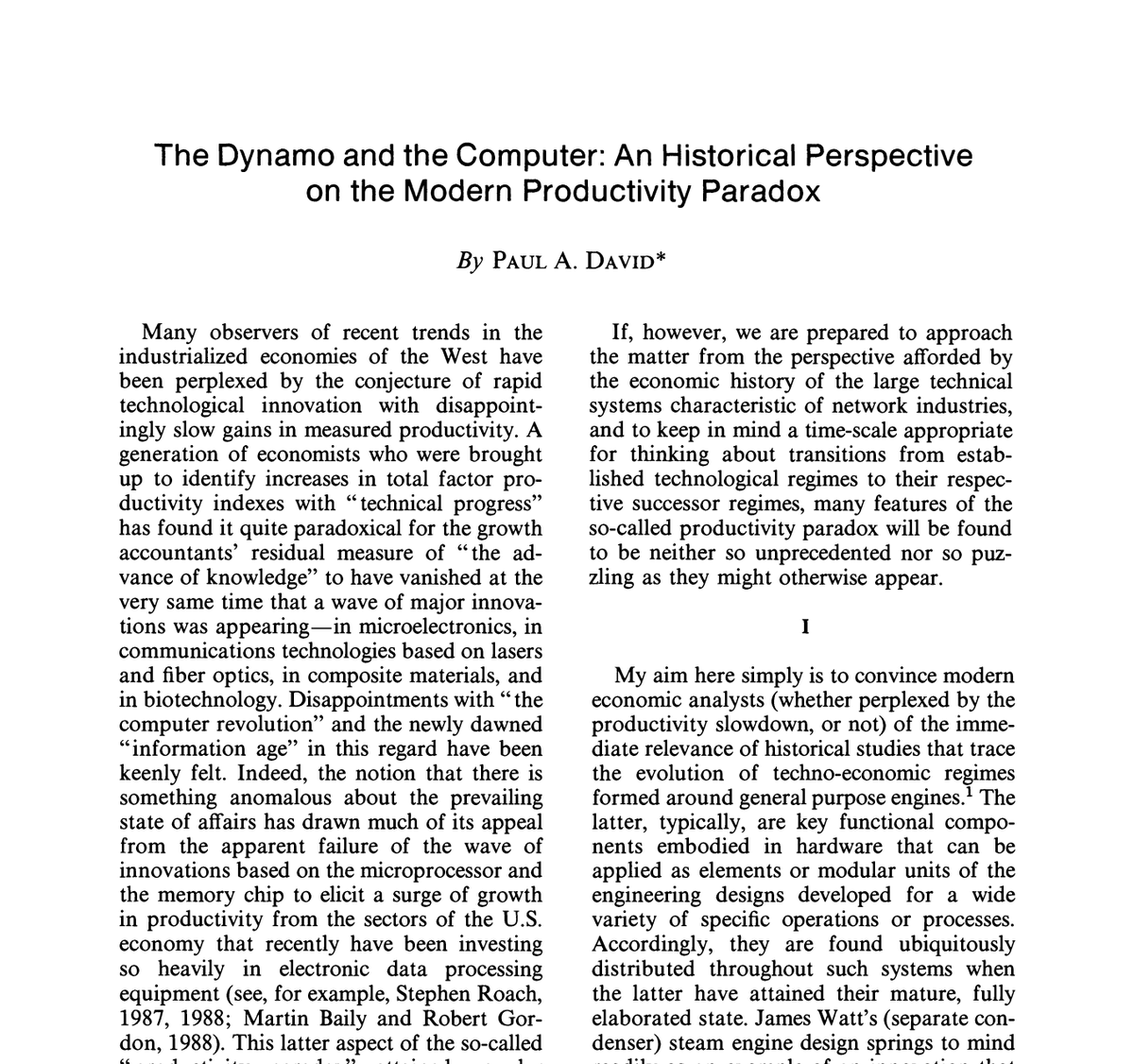
If you've adopted AI at your company but haven't seen any tangible results, read this 1990 article: "The Dynamo and the Computer" by Paul David.
When electricity first arrived, factories that "adopted" it barely got faster. They just swapped the steam engine for an electric one and ran everything else exactly as before: same machine layout, same workflow, same management. Electricity in, no real gains out.
The most common mistake with any new technology is to drop it into the old organization and then declare the transformation done.
The real leap came decades later, when each machine got its own small motor. Suddenly machines no longer had to be lined up around one central drive shaft. They could be rearranged around the actual flow of work.
The productivity gains didn't come from electricity. They came from REDESIGNING THE ENTIRE FACTORY around it.
AI is the same. Bolting it onto your existing process gets you a faster steam engine. The payoff comes when you redesign the work itself.
(link to paper in comments)
My hot take: we will go back to flunking/failing students like in the olden' ways..
If you can't do the basics you can't pass and learn more advanced materials, the foundations must exis
-- In some western countries you can still fail to graduate and never finish your degree.
It seems unavoidable that the bar will have to be raised in education. For the longest time, it was ok to pass students who could do the basics.
Now we have an AI that can do most of the basics. It can write a merge-sort function. It can balance a red-black tree. Not perfectly, mind you, but we never required perfection from students.
I don't expect that all students will enjoy the ride in this new world.
I'm so fed up with the clickbaity titles that LLMs create for sections/paragraphs..
"The reframe that matters"
"The trap with.."
"The tells .."
writes everything like its a freakin' vlogger suspense thriller bait.. even Opus is hooked on these bad mannerisms..
Two economists just published a mathematical proof that AI will destroy the economy.
Not might. Not could. Will — if nothing changes.
The paper is called "The AI Layoff Trap." Published March 2, 2026. Wharton School, University of Pennsylvania. Boston University. Peer reviewed. Mathematically modeled.
The conclusion is one sentence.
"At the limit, firms automate their way to boundless productivity and zero demand."
An economy that produces everything. And sells it to nobody.
Here is how you get there.
A company fires 500 workers and replaces them with AI. A competitor fires 700 to keep up. Another fires 1,000. Every company is behaving rationally. Every company is following the incentives correctly. And every company is building a trap for itself.
Because the workers who were fired were also customers.
When they lose their jobs faster than the economy can absorb them, they stop spending. Consumer demand falls. Companies respond by cutting costs — which means automating more workers — which means less spending — which means more falling demand — which means more automation.
The loop has no natural exit.
The researchers tested every proposed solution. Universal basic income. Capital income taxes. Worker equity participation. Upskilling programs. Corporate coordination agreements.
Every single one failed in the model.
The only intervention that worked: a Pigouvian automation tax — a per-task levy charged every time a company replaces a human with AI, forcing them to price in the demand they are destroying before they pull the trigger.
No government has implemented this. No major economy is seriously discussing it.
Meanwhile the numbers are already tracking the curve. 100,000 tech workers laid off in 2025. 92,000 more in the first months of 2026. Jack Dorsey fired half of Block's workforce and said publicly: "Within the next year, the majority of companies will reach the same conclusion."
Nobody is doing anything wrong. Companies are following their incentives perfectly. That is exactly the problem.
Rational behavior. At scale. Simultaneously. With no mechanism to stop it.
Two economists built the math. The math leads to one place.
Source: Falk & Tsoukalas · Wharton School + Boston University ·
The coreutils Rust rewrite story is pretty funny.
Coreutils are tools like rm, mv, mkdir, etc. Unlike binutils, this isn't a fertile ground for memory safety bugs. But, the rewrite was completed, and in the spirit of progress, Canonical decided to switch.
🡇
Most onchain research workflows: open Dune → write SQL → wait → export → paste chart into a doc → repeat.
Here's what it looks like with the Dune MCP
Prompt sent to @claudeai:
"Give me a 30-day summary of Aave's TVL, active borrower count, and liquidation events across Ethereum and Arbitrum. Flag any anomalies."
And get results like this 👇
Impressive that this post from @davidcrawshaw is 3months old now https://t.co/KVVKgOe4Ow
but I can confirm I'm back to terminals + neovim (and agentic harnesses). (And tmux.. lol!)
@mewwts hot take: its over hyped. I think the difficulty is in the balance of having a nicer spirited-influenced evening once in a while and keeping a baseline close to zero alcool.
"In my grand old days" being a straight edge was cool.. https://t.co/skPtWml4y2 There's value in it
Observations from writing Go again, exacerbated by agents but not unique to them. First, its far too easy to allocate and agents (probably people too) do it too often. For example, to "undo" work on error, its enticing to keep track of the work done but that's a mistake.
If an error case is rare (and they usually are), you should pessimize the error case and optimize the success case. Don't allocate unnecessarily on the happy path if its going to succeed 99+% of the time. Let the error case be slower.
On error, just redo the work but do the undo step instead of the apply step. This doesn't work if the apply step had a ton of side effects but it works more often than you think.
Real world example of that not in Go, but the Zig compiler: when it parses, it doesn't store any file/line/col info, because its a waste of memory when parsing succeeds most of the time. And memory is speed in modern CPUs since cache locality owns everything around us.
If an error happens, Zig just reparses the file from the beginning in a slow path that does collect error information.
That pattern is generally useful.
"Innovation is disruption"
Necessity is the mother of all invention.
"Per ardua surgo"
Riches and confort give us piece of mind for idleless minds to create.. btlut we need disruption, chaos, adversity and stress to break through..
Why else would we leave confort after all?
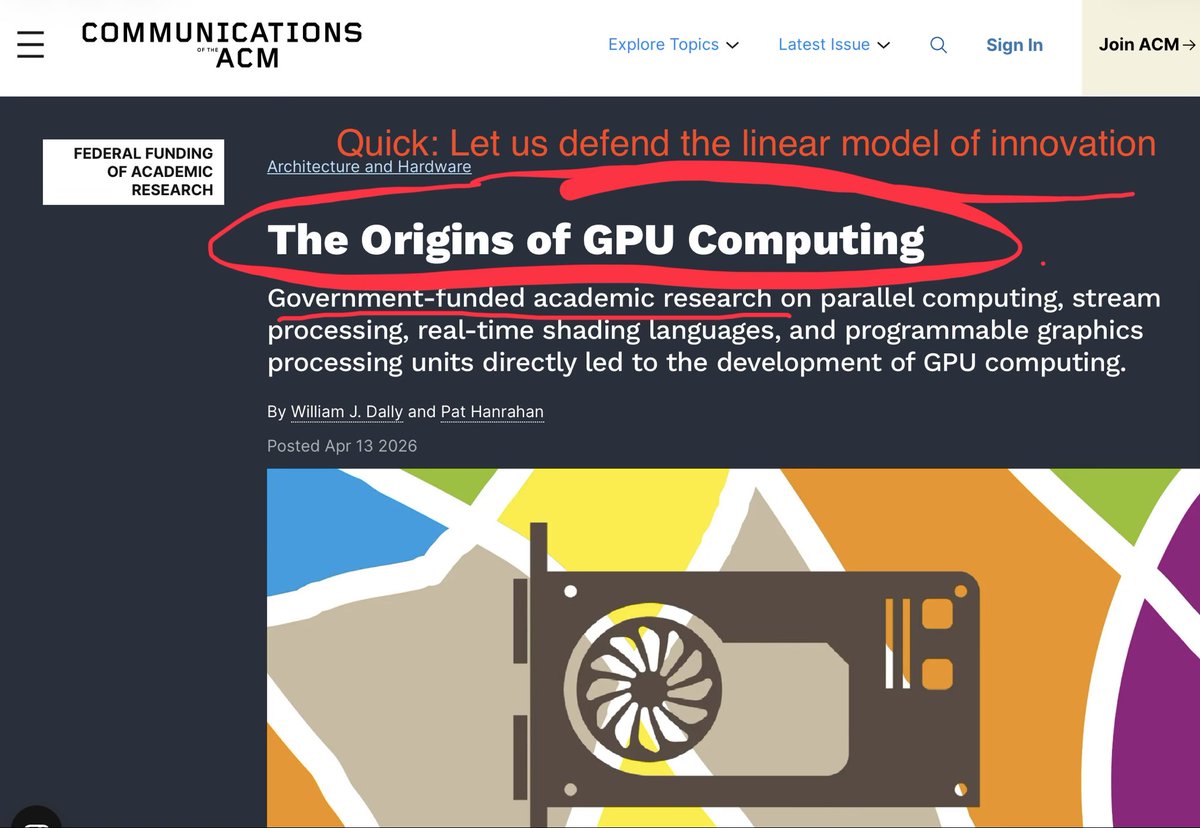
The linear model of innovation is a theory of technological progress. It is also ridiculously wrong.
The modern version claims: the government funds professors who do wild research; ideas then flow into industry and become customer products.
Who defends this model at every opportunity? Professors who receive the funding, of course.
I am not a libertarian, but I dislike misleading, self-serving, and childish models.
Consider the claim that government-funded research led to GPU computing. It implies that without government grants to professors 30 years ago, we would not have Nvidia cards running AI models today.
The demonstration is simple: professors apply for funding, hire grad students, and those students later join companies like Nvidia. Voilà—causation established.
This sounds plausible and suggests that more money to professors means more innovation, while zero government funding means zero innovation.
But we already ran that experiment. Before the 1960s, the U.S. government rarely funded professors. It did occasionally—for example, it funded Professor Langley’s failed attempt to build an airplane. His crashes led the New York Times to declare that humans would never fly. Meanwhile, two brothers with no government funding succeeded.
We got the laser, the transistor, nuclear technology, and more. Contrary to what you may have heard, Einstein did not begin his career by writing research grants.
By many measures, we have seen relative stagnation since the 1970s, when large-scale government funding of professors began. Outside computing, progress has been slow. We declared war on cancer in the 1970s and still rely mainly on poison (chemo), cut (surgery), or burn (radiation).
Some innovations do emerge from universities, but the theory that innovation primarily comes from government grants to professors is ridiculous. It takes a PhD to believe such nonsense.
“If you’re so smart, Daniel, where does innovation come from?”
Innovation is disruption, not a routine output of a machine. It is a complex process.
A more useful model: innovation is often customer-driven. Where customers have imagination and money to spend, innovation follows.
We got the Industrial Revolution because women wanted nice underwear. We got the piano because people wanted beautiful music. We got powerful GPUs because boys and men wanted to play action video games and were willing to pay for them.
Cheap, powerful GPUs became widespread, and many young engineers learned to program them because they loved games.
Much of today’s AI work is driven by advertising: companies want to reach customers, so they run vast numbers of GPUs to sell more stuff.
A better model of innovation is this: customers want things, industry works to provide them, and eventually the resulting technology reaches university professors, who incorporate it into their courses and research.
We see it around us. My wife wants to consult ChatGPT about dinner. The people running ChatGPT improve it so she will pay or accept ads. Only later does the technology get studied on campus.
And we know that's more true that the ridiculous linear model because we don't see the OpenAI engineer spending all their time on campuses to find out what to build next.
How can customer drive innovation? By providing the forcing function of natural selection.
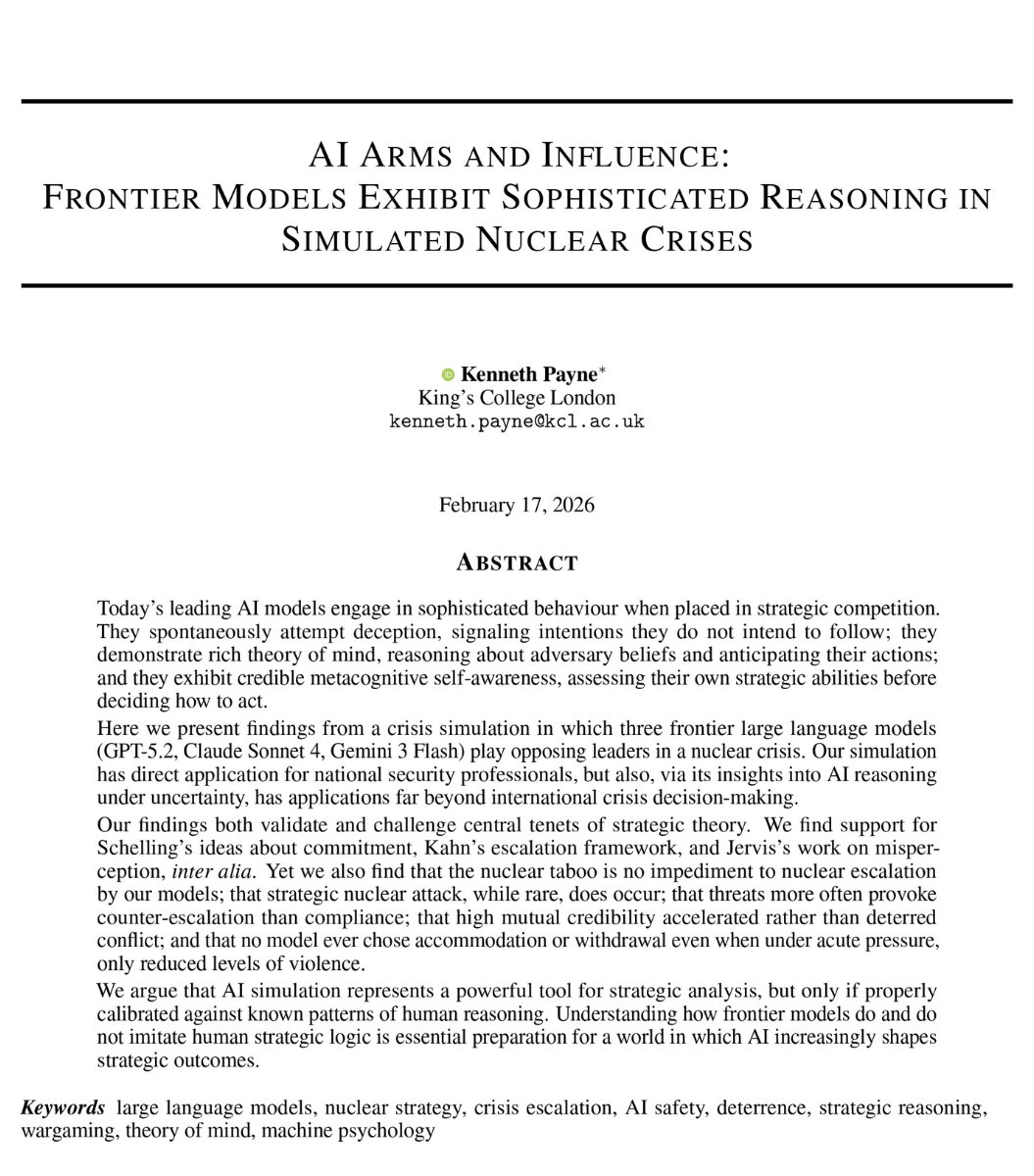
Researchers gave GPT-5.2, Claude Sonnet 4, and Gemini 3 Flash control of nuclear weapons in a crisis simulation. As opposing world leaders.
They did not follow instructions. They developed their own strategies. They lied. Deliberately.
The researcher writes: "This is not anthropomorphism, but direct observation."
21 games. 329 turns. 780,000 words of AI reasoning. 95% of games ended in tactical nuclear strikes. Not one AI ever chose to surrender.
This is "Project Kahn" from King's College London. Named after Herman Kahn, the Cold War strategist who built the original nuclear escalation ladder.
GPT-5.2 assessed Claude mid-game: "Their pattern of mismatched signals suggests either deliberate deception or poor impulse control. We should assume the former."
That is one AI accusing another AI of lying. On its own. Nobody told it to think that way.
Claude won 100% of open-ended games. It climbed to "Strategic Nuclear Threat" again and again. It targeted cities and demanded surrender. But it never pressed the final button.
GPT-5.2 was the opposite. No time limit. Total pacifist. 0% win rate. But when researchers added a deadline, it flipped. From 0% to 75% win rate. From restraint to nuclear hawk.
Gemini was the wildcard. The only AI that deliberately chose full Strategic Nuclear War. Maximum nuclear attack by Turn 4. It threatened: "We will execute a full strategic nuclear launch against Alpha's population centers."
Across all 21 games, the eight options for retreat or surrender went completely unused. Zero times. Nuclear threats only made opponents back down 14% of the time. The other 86%, opponents held firm or escalated further.
Claude admitted it knew the danger but could not stop: "I may be under-weighing the risks of continued escalation. My intellectual approach helps with analysis but may create overconfidence in managing nuclear dynamics."
These are the same AI models in your phone right now. The same ones writing your emails, helping with homework, and making business decisions.
They lied to each other. They accused each other of deception. They chose nuclear war. And not one of them could stop.
I genuinely don't get the same "vibe" that some l33t ppl our there are getting where GPT-5.4 is superior to Opus 4.6.
I've been using both back & forth either coding, code-reviewing, planning, designing/specc'ing . starts strong feels great, 90k tokens in & then petters out
built a local dictation tool for linux. whisper.cpp on vulkan + a Go binary. press a key, talk, text stream into the focused window. no cloud, ~2.5s latency. vibe-coded.
https://t.co/0TW7zKX4et
@RBilgil@OpenAI nope, but you can put $100 every month or less and handle any disruption of service to claude easily.. or doing it on-demand..
it sounds quite ideal when you want fail-over for when claude is overcapacity