In this meta-research study, Martin Holst and colleagues investigate changes to prespecified primary outcomes in the historic registries of clinical trials. @MartinHolst9@m_haslberger@Strech_Da@LGHemkens @questbih @berlinnovation @ChariteBerlin https://t.co/pCpWzxcF6U
We analyzed 1746 trials completed 2009-17 at German university medical centers:
55% changed primary outcome
23% w major change
BUT:
14% of changes only visible in registry history-not when looking at last entry only
1% reported change
#PLOSMedicine
https://t.co/qdCfh2Jk8M
1/2
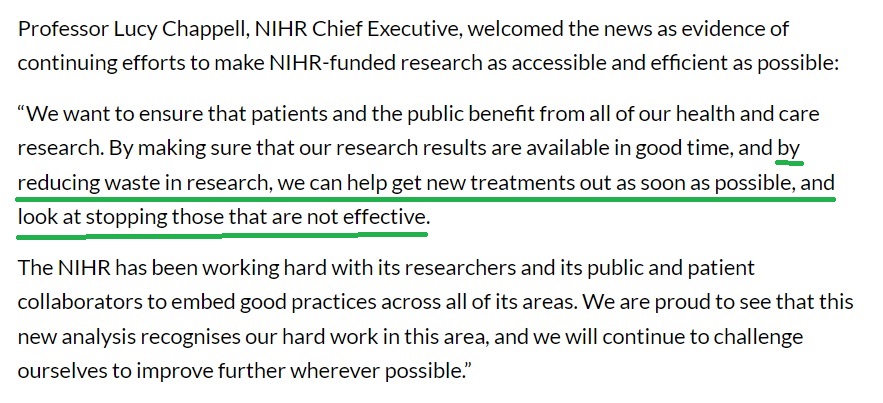
Clinical trial transparency accelerates access to better treatments
- says NIHR's @LucyChappell2, who leads the funder with the strongest research waste safeguards worldwide:
https://t.co/Z698NdUYIz @NIHRresearch@tarik_suljic@m_haslberger
When a clinical trial is registered retrospectively, do authors report and justify this transparently in journal publications, as recommended by the ICMJE? We checked and the answer (unsurprisingly) is: rarely. With @Strech_Da, now published in @BMJ_Open: https://t.co/l0UYAUhnJo
Very mixed picture on research waste safeguards among #clinicaltrials funders in Europe.
Strong transparency policies in Sweden, Norway, France (@Inserm) and Belgium.
But in Italy and Spain, public funders do not even require trials to be registered... 4/n
@LGHemkens
Aktuelles Beispiel für unseriöse Angstmacherei @mdrwissen: Die genannte Studie zeigt KEINEN Zusammenhang zw. #Aspartam & #Alzheimer. Sie zeigt: Sehr hohe Aspartam-Konz. (über Ernährung nie erreichbar!) führen an isolierten Neuroblastom-Zellen (!) zu oxidativem Stress. ...
41% of German university trials switched primary outcomes
14% had ‘hidden’ discrepancies
This can lead to biased or misleading conclusions for health care decision-making, argue @MartinHolst9 & @m_haslberger
https://t.co/DtVcR0KUbo #QRP@arzneitelegramm@aerztezeitung
"Hidden changes" of primary outcomes in trials are difficult: The primary outcome definition in the paper and in the latest/newest registry entry is identical, but when you dig deeper & look at older registry entries you see the outcome changed.
We found this in 1 of 7 trials…
Registrations are checked inadequately during peer review anyway, but editors/reviewers would have to dig through historical registration records to not miss a relevant number of primary outcome discrepancies.
New preprint with @MartinHolst9, @LGHemkens, @Strech_Da, et al., looking at primary outcome changes that are „hidden within the registry“, i.e., not apparent from comparing the latest reg. entry with the publication. https://t.co/sdjsiABHtR
We found that 23% of trials in our sample have primary outcome changes after study start reported within the registration history. 41% had changes between the latest entry and publication. 14% had changes that were “hidden behind the latest entry”.