“Self-inflation is the rule in life,” wrote Robert Trivers; hence his conclusion that we fool ourselves so as better to fool others. This explains a lot of why smart folks truly believe in toxic stress, ACEs, and complex PTSD despite the obvious lack of scientific evidence.
Your reminder that global trends for anxiety and mental health have largely been static. Same with suicide data. There's no global crisis of mental health among young people. Even in countries where suicide was high (and not just among young people) like the US, those numbers are improving.
Beware the moral panic clickbait.
Most mainstream discussions about teen depression reduce everything to “society,” “screens,” or oppression narratives.
Reality is more complicated.
I recently joined a 15-year-old podcast host on Positive World, Positive People to discuss:
· clinical depression vs ordinary unhappiness
· the major role of genetics in clinical disorder
· the role of moral status and identity development in normative unhappiness
· how AI might help
· how counseling can help
Impressive interviewer. Smart questions. Serious conversation.
27 minutes
https://t.co/OxP1OZ1SxI
Can you get a letter to the editor published in a psychology journal if it challenges the field’s dominant politics?
After 45 researchers published an editorial attacking Trump science policies, I submitted a different perspective. Eight months and five revisions later, the psychology journal finally published it. Apparently viewpoint diversity still requires endurance.
Scientific openness means little if only one political perspective passes peer review comfortably.
Link to open access:
https://t.co/pstceOA9Ng
The problem here is twofold:
First, the hypotheses of these studies are obvious to participants, so you get false-positive results.
Second, all meta-analyses of these studies find that, across studies, results are either null (Ferguson, 2025; Lemahieu et al., 2025) or "weak" (Burnell et al., 2025).
(and actually, related to #2, people tend to hype the studies that support public narratives and ignore those that to not).
So: nothing to see here. This is bad science supporting moral panic.
Recent guest appearance on The Resiliency podcast from Mission 22. We unpacked trauma science gone wrong: the myths of “the body keeps the score” and Complex PTSD, resilience vs genetic vulnerability, the failures of cross-sectional research, and how researchers’ worldviews fuel false—and harmful—trauma narratives.
https://t.co/SWhhYe97aO
Just got my favorite email: a trainee realized their grad program was teaching nonsense.
Goes rogue.
Found my work on PTSD treatment in young kids. Course-corrected.
Saving the world, one skeptical student at a time.
I think the confusion is due to this being the wrong question from the get go. Haidt conflated mental disorder with unhappiness and discontent. Those are very different things that Haidt has never addressed and I don't think he understands because he's not a clinical psychologist. Social media users are unhappy, they are not mentally disordered, but the data Haidt uses (self-report questionnaires) don't parse the two.
States that do not mandate universal school mental health screening are not in the clear. At least one-third of districts nationwide are already doing this.
States must PROHIBIT universal school mental health screening.
@SwipeWright@buttonslives Well put. This ‘petrol soaking’ has also been happening in research about fake trauma concepts but at a slightly less virulent level for three decades.
New study of 221 Ukraine youth (Skinner et al 2026) finds no association between cortisol and PTSD. This isn’t new—it reinforces decades of inconsistent evidence.
Meta-analyses (2007, 2012, 2017) repeatedly show no reliable cortisol–PTSD link: most studies find no difference, and results that do are inconsistent. Decades of negative cortisol findings make broad claims about toxic stress causing permanent neurobiological damage hard to defend.
@SwipeWright Replicability is always going to be poor in the social sciences unless you study only things with large effects. I think the bigger problem is interpretation bias by progressive hegemonies in most fields.
I appreciated reading Joe Rigney’s The Sin of Empathy. We’re both trying to rid progressive wokeism from our fields. A common denominator to the woke projects of the last decade is untethered empathy.
Do you not understand the purpose of the DSM? It's purpose is reliable communication for research and clinical work. Straw manning the DSM for not explaining disorders is like disapproving cars for not flying.
Spicy Take: the DSM is often merely a cluster of symptoms named with a thesaurus. Describing a cluster of behaviours in Greek doesn't explain it. Naming is not understanding. We've confused the two for fifty years and called it progress.
-Your therapist's favorite book is bullshit
-The Body Keeps the Score created the obsession with trauma
-It's HUGE- more Amazon reviews (80k) than A Game of Thrones
-Led to a $10,000,000 2nd book deal
-...it's bullshit - absolutely filled with shockingly bad scientific errors
@CJFerguson1111 In the wrong hands, both are rubbish. Meta-analysis aims to find a single value while often ignoring the quality of data, which usually sucks. Vote counting is best when analyzing the quality of data.
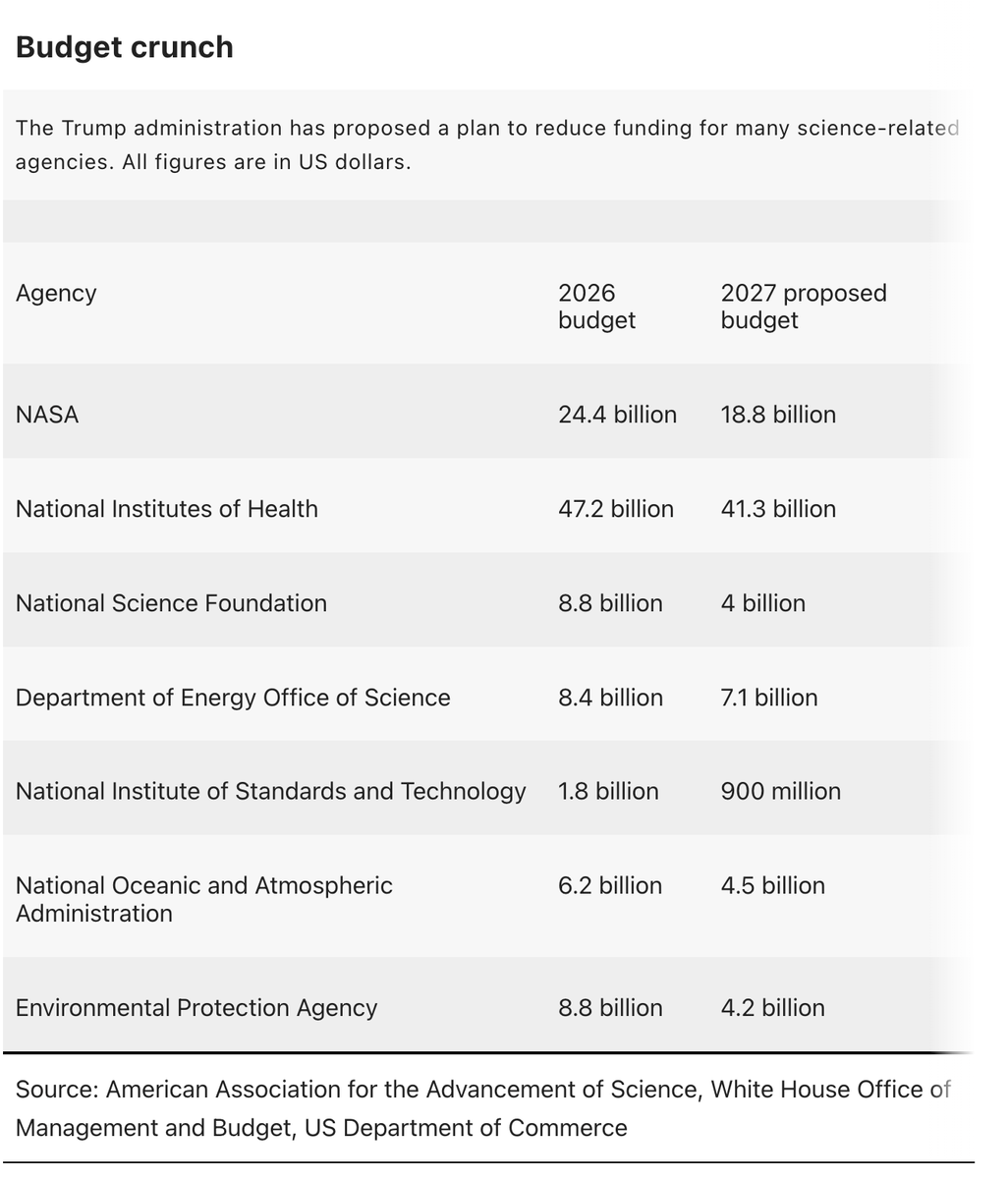
"Extinction-level" rhetoric is hyperbole. Focusing on NIH, the electorate voted for woke research to be defunded. This is good news for conservatives. Even if the cut is made (which it won't; it's a negotiation opening), the U.S. research budget is still more than double that of the five largest western nations combined.
NEWS: Massive budget cuts for US science proposed again by Trump administration
"It's an extinction-level event for science".
The US government is proposing massive cuts to almost every branch of science, from NASA to the National Institutes of Health. NSF would completely eliminate the social, economic and behavioral sciences directorate.
This would decimate the world's leading scientific system.
https://t.co/QtRa7L7Vo4
Trauma Researchers Assure World That After 204 Factor Analysis Studies of PTSD, Factor Analysis #205 Will Finally Reveal The Secret Structure.
(a parody).
With the world riveted in anticipation, the new analysis was published last month. They found a 7-factor model fit slightly better than 4- and 6-factor models!
This was, however, unsurprising considering that in prior studies the model with the most factors fits best 87% of the time because the ’best fit’ is a mathematical fit rather than a measure of construct validity.
Everyone, relax, the authors said. Despite validity concerns, the 7-factor model still “may have theoretical and psychometric value in capturing nuanced PTSD symptom dimensions.”
At press time, those values had not been disclosed.
Hidalgo JE, Burt KB, Davidson TM, Ruggiero KJ, Andrews AR, Contractor AA, Peck K, McGinnis EW, Ha J, Noble NC, Kim JN, Ramirez V, Price M. Posttraumatic stress disorder factor structure in hurricane-affected Puerto Ricans: A PTSD Checklist for DSM-5 comparison with non-Latiné White individuals. J Trauma Stress. 2026 Feb;39(1):44-56.
More fun facts in my review below: