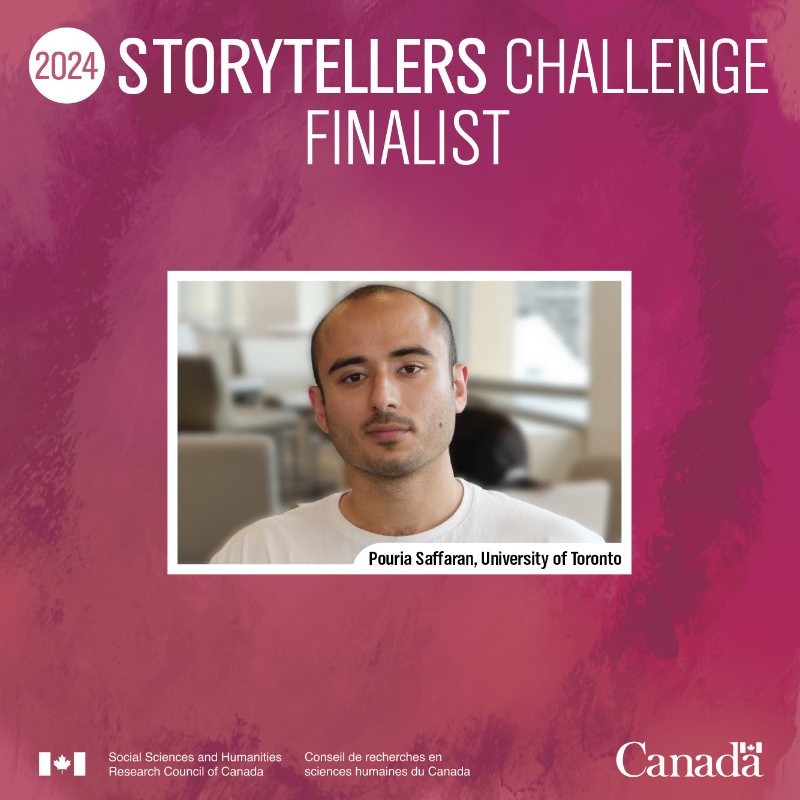
⭐Last but not least, cheers to our fifth group of #SSHRCStorytellers Challenge finalists!
Pouria Saffaran @UofT
Madeline Springle @UCalgary @m_springle
Katherine Todd @UofT
Aleah Wong @UBC @aleah_wong2
Click to find out why their SSH stories stood out: https://t.co/saLj1ZRFM⭐Last but not least, cheers to our fifth group of #SSHRCStorytellers Challenge finalists!
Pouria Saffaran @UofT
Madeline Springle @UCalgary @m_springle
Katherine Todd @UofT
Aleah Wong @UBC @aleah_wong2
Click to find out why their SSH stories stood out: https://t.co/saLj1ZRFM⭐Last but not least, cheers to our fifth group of #SSHRCStorytellers Challenge finalists!
Pouria Saffaran @UofT
Madeline Springle @UCalgary @m_springle
Katherine Todd @UofT
Aleah Wong @UBC @aleah_wong2
Click to find out why their SSH stories stood out: https://t.co/saLj1ZRFM⭐Last but not least, cheers to our fifth group of #SSHRCStorytellers Challenge finalists!
Pouria Saffaran @UofT
Madeline Springle @UCalgary @m_springle
Katherine Todd @UofT
Aleah Wong @UBC @aleah_wong2
Click to find out why their SSH stories stood out: https://t.co/saLj1ZRFM⭐Last but not least, cheers to our fifth group of #SSHRCStorytellers Challenge finalists!
Pouria Saffaran @UofT
Madeline Springle @UCalgary@m_springle
Katherine Todd @UofT
Aleah Wong @UBC@aleah_wong2
Click to find out why their SSH stories stood out: https://t.co/saLj1ZRFMa
I'm thrilled to share that my video submission is among the Top 20 for the #SSHRCStorytellers 2024 Competition!
Watch my 3-minute video on my MSc research to see how background cues influence asynchronous video interviews!
https://t.co/TuIKa00zx2
Learn about the rise of the irate customer through post-pandemic rudeness, and the importance of rediscovering patience as Adjunct Assistant Professor in Psychology, Laura Hambley and MSc student, Madeline Springle shed light upon it. Read more: https://t.co/cIyjEb1AIU
Have the lines between your personal & work life become blurred as we enter a post-pandemic era? Check out this article I co-authored with @m_springle for @careerwise_ca on "Building a sustainable work-life: Social overload in the ‘new normal’".
https://t.co/9VmNPiSXX2
@AadhiyaVasudeva causes other people to make social comparisons to our overly positive self, and then they post more positive content etc. etc. And the cycle continues. So essentially the USC are causing ppl to post more positive info to enhance their own self-concept!
I'm excited to present my psychology undergraduate thesis research from the Lockwood Lab at the University of Toronto for this year's virtual Ontario Psychology Undergraduate Thesis Conference 2020. #aoputc2020
@AadhiyaVasudeva Thanks Aadhiya, I appreciate it! So for our future directions, we were thinking that maybe there is a bit of a vicious feedback loop in that people make upward social comparisons on SM, which causes people to post more positive info to boost their self-concept, which in turn...
@GordonHodsonPhD this may cause us to think even less about how the audience will feel, and just care about our own group promotion. This is often where people can fall into trouble on SM, by forgetting that they're talking to real ppl at the other end of the line.
@GordonHodsonPhD want to promote our own group. I imagine that it is harder to perspective take at the group level on SM simply because the audience involves SO many people. It's different when we're posting to a group of audience who we (sort of) know, vs. posting with a group to a huge audience
@GordonHodsonPhD That's a great approach to apply this to the group level. I would argue that there is a lot of potential for this to be expanded to the group level mindset. For example, on one level SM is about finding the different groups that one connects and identifies with. As a result, we..
@AadhiyaVasudeva@EinsteinLabUofT Beautiful poster Aadhiya! I love the colour scheme! Your key findings in the pie chart/bubbles are so clear and easy to understand!
@GordonHodsonPhD ... because of the self reporting aspect, and that hopefully we can find a way to measure this independently of the writer's own ratings.
@GordonHodsonPhD So although my study isn't a dyad, it's a follow up to the dyad in that we conducted a very similar study but added email as a third condition, to hopefully determine that S.M. was a lot more positive than text and email. We didn't find that exactly, but we think it might be...
@GordonHodsonPhD ...different questions based on whether they made any social comparisons to their friend. What the lab found was that people did tend to exaggerate more on S.M. compared to a text message, but it's possible that text messages were negative (making it look like SM was more pos)...
@GordonHodsonPhD So interesting you should mention that, the previous thesis student in our lab conducted a dyad study where two friends came into the lab. One was randomly assigned to write an S.M post or text about an event, while the other read the message/post and answered....
@metzpsych ... and so passive social media scrollers end up feeling MORE isolated after going on S.M.
I tend to be a passive scroller, which has made me recognize that S.M. should be avoided when I'm feeling lonely!
@metzpsych Ahh, I think many people would agree with that! There's interesting research being down that looks at the difference between active vs. passive social media use. It looks active social media users (ppl who post stuff) fair better than those who just passively scroll through S.M..