Wideranging conversation of @Jacob_Hanna by @manuelAnsede in @el_pais in english: https://t.co/svEmX3PAnU Whether you agree or disagree, it will make you think; scientists don’t work in a vacuum. Whether you agree or disagree it will make you think
A thread on our recent paper with Vitelli and @squishycell1 labs. It’s got biology, physics, machine learning… a little something for everyone! It all started with a simple question:
Can we predict traction forces directly from images of proteins?
https://t.co/2K0P4UjELm
📣 Our fun journey continues - latest lab preprint is now out in @Nature
Check out in great detail how we derive Complete and Structured human day 14 post-implantation embryo models (SEMs) solely from unmodified HENSM naïve ESCs
@Beroldak@EmilieWildschu1@vlad_bndk@noashefi
https://t.co/NTGdYvsCKb
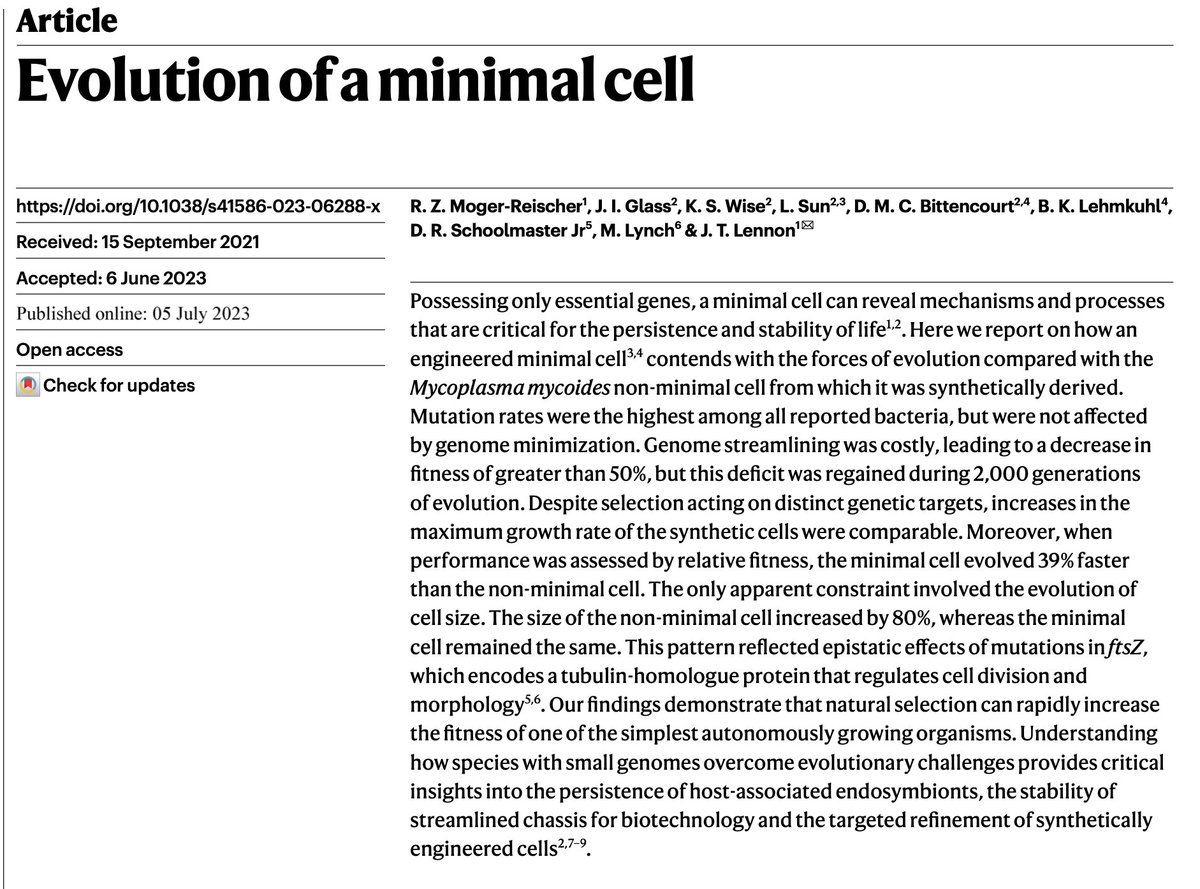
A mind-blowing paper has come out today in @Nature
In 2016, JC Venter Institute scientists trimmed a bacterial genome to its barest minimum required for life to synthesize what they called a "minimal genome" (https://t.co/Rk8oZJ0bUj).
Today, a group of scientists from Indiana University reports how that minimal genome evolved over 2000 generations in comparison to the non-minimal genome.
The authors found that even when you reduce a bacterial genome to its absolute minimum where every nucleotide matters, the genome undergoes mutational events generation after generation as much as the non-minimal genome. One simply cannot stop the evolution.
Just over 300 days of evolution (equivalent to 40,000 years in humans) the minimal cell has gained everything it lacked in fitness on day one in comparison to the non-minimal cell.
When comparing the evolved traits between the minimal and non-minimal cells, the scientists found something striking. The evolutionary process increased the cell size of non-minimal cells but not that of the minimal cell. But that is not the striking part.
The scientists were able to identify the key mutation that resulted in cell size evolution. And it turned out that the mutation that helped the non-minimal cells to grow bigger is the same that helped the minimal cells to stay smaller. Growing bigger had a survival advantage for non-minimal cells and not growing bigger had a survival advantage for minimal cells. So, the mutation had a context-dependent effect. This just demonstrates that the evolutionary effects on traits have no absolute direction. All that matter is what is beneficial for the organism's survival.
The conclusion of the paper is metaphorically a quote from the Jurassic Park movie:
“Listen, if there’s one thing the history of evolution has taught us is that life will not be contained. Life breaks free. It expands to new territories, and it crashes through barriers painfully, maybe even dangerously, but . . . life finds a way". (https://t.co/UlxRlb86CT)
https://t.co/zA9OAqSoAu
Traction force microscopy is challenging. A less quantitative but simpler approach is to analyze the alignment and remodeling of matrix fibers around contractile cells. Does it actually work, and how? Take a closer look at https://t.co/gpceSlsGJY
Our STEM CELL ZOO paper is out in @CellStemCell!
By using in vitro differentiation of ES/iPS cells, we recapitulated the segmentation clocks of mouse, human, rabbit, cow, marmoset, and even rhinoceros🐁🧍♀️🐰🐄🐒🦏
They showed species-specific clock periods!
https://t.co/POlOX54h2g
1/n New Hanna lab PREPRINT: "Transgene-Free Ex Utero Derivation of A Human Post-Implantation Embryo Model Solely from Genetically Unmodified Naive PSCs"
https://t.co/a3dKEE7adF
Un nuevo modelo de embrión de 14 días aclara el mayor enigma de la formación de un ser humano. El científico palestino @jacob_hanna logra imitar por primera vez una de las fases más desconocidas del desarrollo embrionario de una persona https://t.co/aaRWrfWBjO
After 7 years of experimentation, we are coming up with a story about what directs orientation of muscles in the body. We tried to understand what primes and refines the orientation of myoblasts prior to attachment to skeleton and following fusion.
https://t.co/ck4GLdj61V
In 1977, Jorge Luis Borges, one of the most influential 20th c. Spanish-language writers, told William F. Buckley (whose first language was Spanish) his reasons for feeling, age 78, that English was 'far finer' than his native tongue. Right or wrong, I love his savor for language
Ever wanted an interactive lightning-fast solver for models in physics, chemistry, or biology? Do you have a web browser?
I'm thrilled to announce https://t.co/aq0R29IQMW, built explicitly to solve PDE models interactively on most devices, written by @bj_w95@Pecnut and I.
The @Prevedel_Lab developed line-scan Brillouin microscopy, which allows fast 3D imaging of mechanical properties with low photo-toxicity. They demonstrate this in Drosophila and mouse embryos, as well as ascidians. @CarloBevil@embl
https://t.co/z4vUNbWY2v
Excited to share our newest article 👉
https://t.co/dOL9E3vqkl led by terrific @StefanHarmansa (expts) and Alex Erlich (theory). Growth and Form in developing wings.
Key finding: Geometric frustration due to mismatch in growth anisotropy of ECM and tissue drives shape changes 🤩