The biggest DEX in the world will have to swap between #Bitcoin and #Ethereum. After all, that is where the vast majority of spot volume is today (and prob always will be).
Any current DEX that doesn't pivot and engage with this mindset, will struggle to compete in the not too distant future.
Reach out to @THORChain and lets partner. @THORChain will not only expand the usefulness of your DEX with little work, but also earn you affiliate fees to generate more yield with every trade. Its a #WinWin.
I'm looking at you @Uniswap@1inch
@Sneaky_Intern @sommfinance Been dead for a while now. Not only the team has been silent, all the shillers too. @EffortCapital as one of the louder ones in the past, I wonder what‘s your view on it nowadays? TVL chart looks as bad as mcap.
@WillbBTC@THORChain@THORmaximalist@ChadThoreau@Plebs_eth@familiarcow@ErikVoorhees@CBarraford well, you posted a vision of the future showing a swap, not moving BTC around IBC
My point is, integrating just these swaps would earn yield for stakers by taking an affiliate fee on each trade. Effectively giving users more choices and boost taker fees
I don't see why not tbh
@fabo_web@indigotradess Here’s an idea: Integrate Thorchain swaps, earn fees on native BTC trades, increase real yiel for stakers, lower inflation, Osmo price go up.
@WillbBTC Any DEX or wallet can integrate Thorchain swaps and even earn affiliate fees on each trade going through its UI. Nothing is stopping Osmosis (or Keplr) if they wanted to integrate it
Your vision could be reality if Osmosis wasn’t in fact closing out TC, not the other way around
@sommfinance In ETH terms TVL hasn't been growing for many months, only the ETH price is going up. These all-time high posts are disingenuous marketing tactics imho.
It took me a while to get out of the bloody midcurve but I now see clearly that the top of the pyramid of the entire crypto economy are art NFT's, and in particular, deeply culturally-relevant and truly pioneering digital artists. They'll only get more expensive in time too...
@_ZRho_@GoldenStaking scroll down to 1) Token Transparency and 2) @CleargateC Scandal
sketchy af and probably a lot more shit like that behind the scenes they don't want to know us about.
https://t.co/ZrxOBsxd0P
The provided table represents a comparison of top-performing yield vaults across three DeFi platforms, focusing on key metrics such as TVL, APY, 30-day Average APY, and a proprietary metric that I refer to as Vault Score.
The Vault Score integrates both security, represented by TVL, and return potential, indicated by APY, into a single number. However, this calculation might not fully encapsulate the risk associated with each asset type. For instance, the YCRV vault from Yearn Finance, despite its high score, involves yCRV tokens, which may carry a different risk profile compared to something like ETH.
When assessing the Real Yield ETH vault by Sommelier versus Yearn's WETH vault, we can see that despite the latter's substantially higher TVL, the former offers a significantly better 30-day average APY, implying a superior return on investment, assuming similar risk levels. This highlights the idea that after reaching a certain threshold, increasing TVL yields progressively smaller security benefits, indicating that Sommelier's $40 million TVL is already adequately robust.
Reflecting on these insights, it becomes evident that Sommelier's approach in the market is not just about accruing larger TVL but also about ensuring optimal returns and security for its users. Sommelier's market share has grown significantly in the yield aggregator space on Ethereum, where it holds about 9.4% of the $700 million market, equating to roughly $66 million in TVL, according to DefiLlama. This success showcases its competitive edge against Yearn and Beefy and indicates its growing prominence in the broader sector.
Token Allocation
The total supply of tokens for the project is set at 500 million. A significant portion of this supply, amounting to 300 million tokens or 60% of the total, was allocated to the Sommelier Foundation. These tokens are subject to a vesting period ranging from 1 to 4 years, which is scheduled to conclude on June 30, 2025. The vesting is structured to occur on a monthly basis and potentially included a cliff period at the beginning.
Additionally, the Community Pool was allocated 150 million tokens, representing 30% of the total supply. This allocation is used to fund grants and incentive participation in new vaults with increased yield.
The remaining 50 million tokens, accounting for 10% of the total supply, was distributed to early participants .
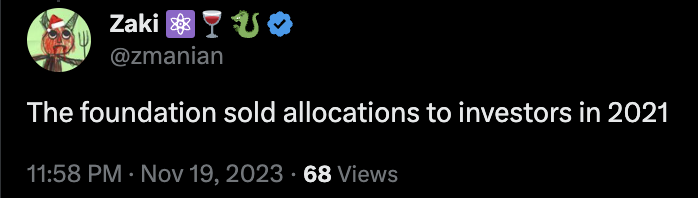
Now according to this tweet, the Sommelier Foundation sold allocations to investors in 2021.These tokens have been fully vested since August of 2023 so can be included in the circulating supply.
$SOMM Open Questions and Risk
1) Token Transparency
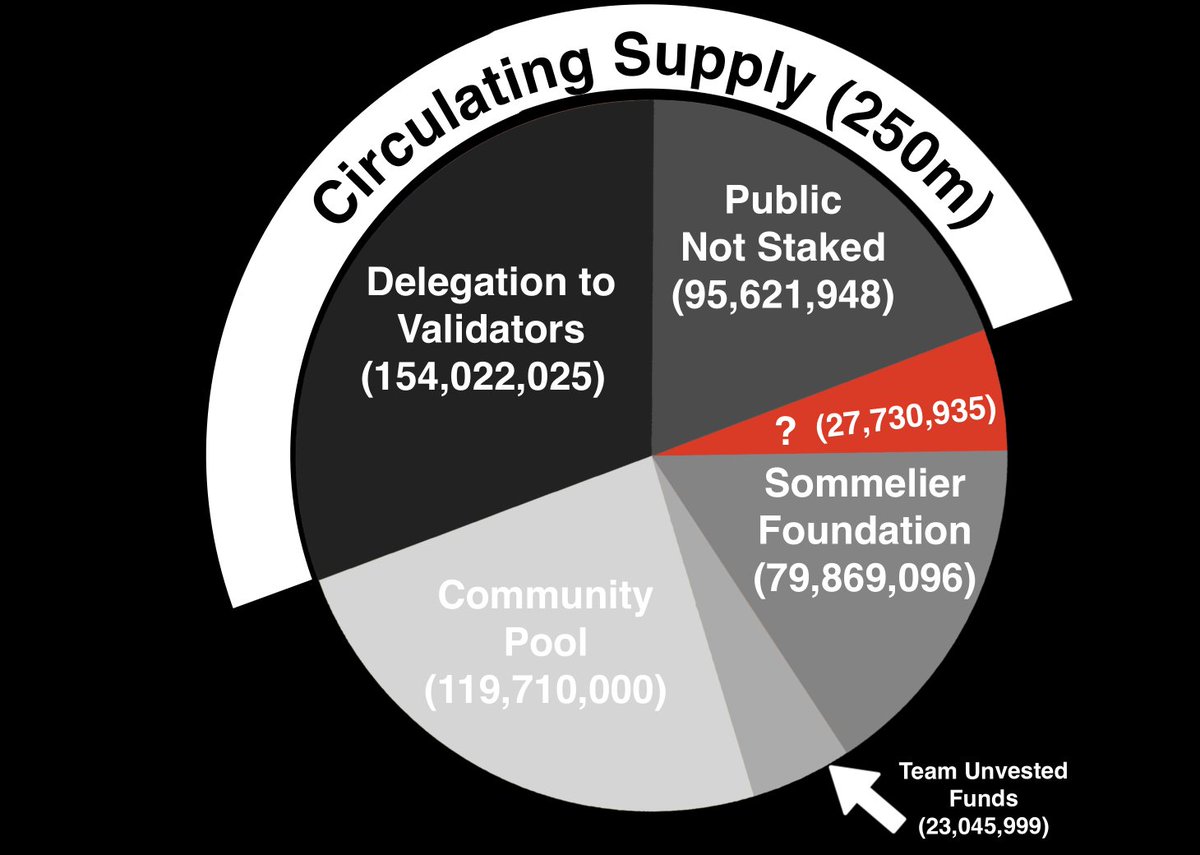
The current circulating supply of $SOMM is currently about 249.6 million. This includes the investors’ tokens (as they are fully vested), grants from the Community Pool, early participants, and tokens sold by members of the Sommelier Foundation. This means that there are still 119.71m tokens remaining in the Community Pool and 79.8m tokens controlled by the Sommelier Foundation. In reviewing Sommelier’s tokenomics documentation, which lists addresses still undergoing vesting, I observed that, according to their scheduled monthly vesting up until June 30, 2025, only about 23 million tokens are accounted for in the vesting process. This leaves approximately 27 million tokens unaccounted for. I raised this question in the community's Discord and Telegram channels but it has yet to be addressed. The current token allocation can be seen above.
On August 19, 2022, I found that Zaki wrote that “Ultimately our goal is to wind down the operations of the Sommelier Foundation sometime in 2023. These proposals are part of the critical process of moving from Foundation driven operation to DAO driven operation of Sommelier.” This discrepancy in token accounting highlights uncertainties about the Sommelier Foundation's management and the unclear future circulation of a significant portion of $SOMM's supply. All I know is that the Sommelier Foundation controls a massive amount of $SOMM, and no one has any idea how or when these tokens enter circulation.
Based on the vesting schedule of the team wallets listed in documentation, the total team allocation from periodic vesting is around 43.5 million tokens. Also it seems as if team members initially received 48x their periodic vesting amount in their wallets as delegated tokens, resulting in the total team allocation around 84.5 million tokens making up 17% of the supply. Securing the network with unvested tokens since genesis is considered by most bad practice and brings into question token value stability.
2) Cleargate Scandal
In August 2022, Cleargate, a strategy provider for Sommelier Finance, received a grant of 1 million $SOMM tokens with the expectation of delivering eight strategies within a year. However, the firm drastically fell short of expectations by releasing only two strategies, 'BTC Trend' and 'BTC Momentum,' both of which were soon removed from the platform.
Despite their obligations, Cleargate failed to adequately inform the community about their progress or developments, leading to a lack of transparency and accountability. Further research revealed that Cleargate's online presence was quickly established around the time of receiving the grant and soon became mostly inactive thereafter. The wallet holding the grant has almost entirely drained, converting SOMM to ATOM and transferring it to Kraken, suggesting a misuse of the allocated funds. Neither Cleargate nor the Sommelier team have adequately addressed the potential misappropriation of funds and evaded any real discussion. This situation has raised serious concerns about the governance and oversight within Sommelier.
Final Thoughts
Sommelier stands out by offering the best returns and maintaining a TVL high enough to be deemed secure, making it a preferable choice over its competitors in the decentralized asset management ecosystem. Theoretically, according to the $SOMM flywheel model, these factors should lead to an increase in the token price. However, the initial token allocation and current token vagueness raises concerns, particularly with a team controlling a large amount of the supply. My main reservation about investing in the token lies in the dynamic that if rumors are true and the team is dumping their tokens, their incentive to enhance the protocol and increase token value diminishes due to their reduced exposure. This behavior combined with their unknown token allocation and strategist scandal does not seem to lay the foundation for a successful long-term future for the protocol. Now although the idea of allowing anyone to participate in the benefits of something like a hedge fund is innovative and empowering, the drama and lack of transparency hurts company reputation.
That said, while I would use Sommelier for its high-yield asset management capabilities, I am hesitant to invest in their native token. If the team provides a detailed breakdown of token allocation and future plans for the Sommelier Foundation, my stance on investing in the token may shift. However, currently, the lack of clarity and transparency in their operations is personally a significant concern that cannot be overlooked.
NFA
@OriginalJakeW@EffortCapital@PossibltyResult@KamBenbrik there's more than 78m $SOMM tokens in the foundation wallet to yet hit circulation, so for now non-inflationary is just a meme.
Also nobody knows when that will be the case as there's no openly communicated plans, making it even less appealing than some known % of inflation.
The best report on @sommfinance I‘ve read so far 🔥
Explains the strengths of the protocol, but also calls out the intransparent token allocation and misappropriation of community pool funds by @CleargateC. 👀 Well done!