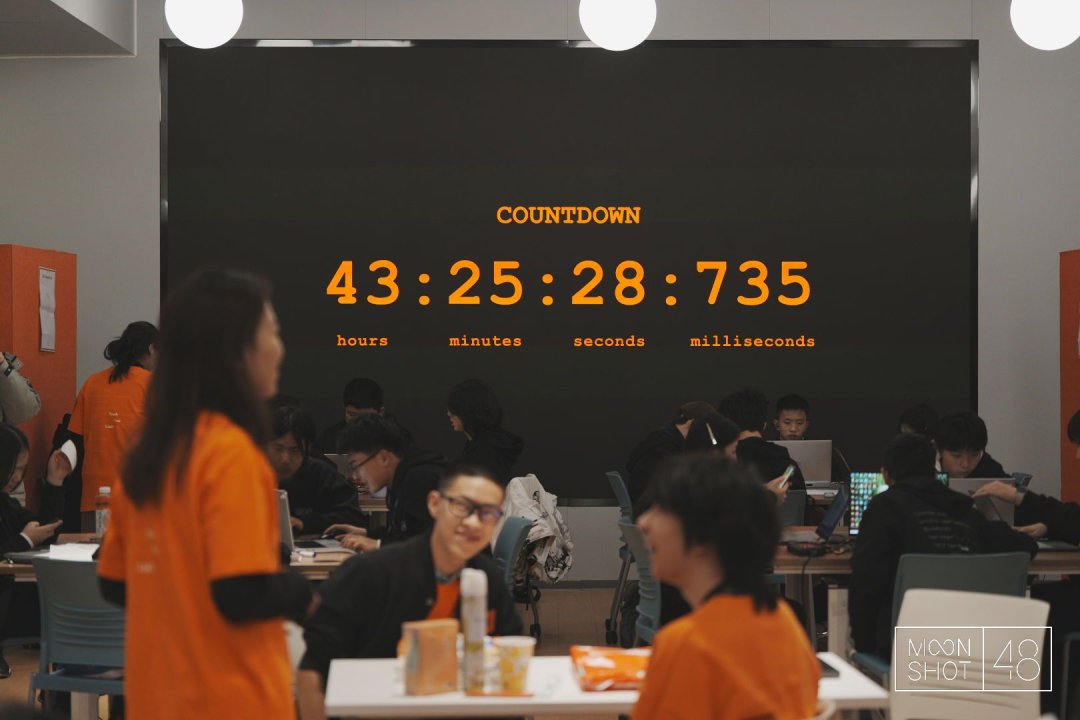
72 young builders. 48 hours. 18 prototypes. 🛠️
Earlier this year, we brought young people from across China together for the winter edition of Moonshot48, our 48-hour hackathon. The theme was AI and learning. Teams took it in some wonderfully different directions:
• AlexLib: personalized learning paths and a knowledge map for people figuring out what to learn next.
• Anchor: a learning-time recorder designed to give you an external reference for how a study session actually unfolded.
• A dialect project exploring how to digitize regional speech and make technology more accessible to people who speak it.
• An interview simulator combining repeated practice, AI analysis and peer feedback.
• And yes, an AI companion for learning how to understand and train your cat. 🐈
Getting from an idea to a demo involved plenty of changes. Teams revised plans after the mid-event pitches, worked through code at the technical support station, and prepared to explain what they had made at the final expo and presentations.
These were 48-hour prototypes, with plenty left to figure out. For us, M48 is a place to find people with different skills, try an idea together, and make something concrete enough for others to explore and question.
If you had 48 hours to rethink how you learn, what would you build?
A look inside our winter M48, including the projects (in Chinese):
https://t.co/taODwciG3c
One Small Step is our experiment in how young people learn and make things that matter in the AI era.
We bring together three parts. First, Self-Directed Learning (SDL) through English and math, our two core learning languages. Then “Puzzle of Human Civilization” (PHC), where learners explore big questions about the universe, life, and our place in the world. And in the Moonshot Entrepreneurship Lab (MEL), they take on real problems.
A MEL project starts with a need someone actually has. Learners choose a problem, make a usable prototype, test it, and iterate toward a result. Entrepreneurship is about more than starting a company. It’s about learning to define problems, spot opportunities, and create value through action, even when the path is uncertain.
For our 2026–27 cohort, we designed a “1 + X” path: one foundation year, followed by an X stage of one to three years, until learners meet our graduation requirements. That makes a two-to-four-year path. We reviewed the dedicated scholarship alongside applications and offered a limited number of awards covering 25–100% of tuition. For especially strong applicants, we could add support equal to housing fees on top of full tuition. Scholarship support could continue for up to three years in X.
Beijing is part of the opportunity. The city is home to many AI companies, so young people can learn in a place where new technology is being built. For anyone thinking about starting something, being here can create more chances to meet other builders, find potential collaborators, and explore how an idea might serve China’s large, diverse market. You don’t need a company or a perfect plan before you arrive; there’s room to study, experiment, and figure out what you want to build next.
We build alongside young people, and we’re learning too. If this sounds like your kind of experiment, reply here to connect with me, or apply through our official admissions channel. 🌱
https://t.co/Wnzr3OQMvn
@matthewashere0 Congrats on building something people are actually using 👀 What did you change most after launch: onboarding, the core feature, or how you explain the app?
@Code_Arjun Permission tiers, a kill switch, and a full action log are exactly the guardrails a PC agent needs 👀 What was the hardest part to make dependable: knowing when to act, or getting the right app state?
@LumixAutomation Fair! Seeing what other builders are trying is a great way to find a direction. What are you most curious to see right now: an AI tool, a game, robotics, or hardware? 👀
In Feb 2025, we held our first Moonshot48 in Beijing: 48 hours around AI + education. Young builders formed teams, built prototypes, and shared them. We still ask: what can young people make with time and room to experiment? 🎥 https://t.co/fCSwuyOkPI
14 yo asked how to write good essays. I asked if he meant the kind kids write in school, or actual good essays as written by adults. How strange that I have to ask that. If he asked how to solve a math problem, I wouldn't have to ask if he meant the school way or the real way.
14 yo asked how to write good essays. I asked if he meant the kind kids write in school, or actual good essays as written by adults. How strange that I have to ask that. If he asked how to solve a math problem, I wouldn't have to ask if he meant the school way or the real way.
a16z's Horowitz Andreessen Academy is a post-high-school fellowship planned for 2027–28. Different models, not partners or proof of results. For us, they raise a question: what room should young builders have? https://t.co/URoM1bqFeI
Alpha School describes 2 hours of AI-supported academics followed by life-skills workshops. Founders School (powered by Alpha) describes a 4-year high school centered on entrepreneurship. Official: https://t.co/kcpnQBNQBT https://t.co/Cvt8UUy8Ft
A peek inside Moonshot Academy and our One Small Step experiment in Beijing 🎥 Young people building products and working with real clients.
Thanks, Silicon Valley 101, for spending time with our community. In Chinese.
https://t.co/ZZ1m9T5Pn1
I like the moment an idea meets the real world: the first test, an unexpected snag, the choice to try again.
At One Small Step, we’re figuring this out alongside young people, one experiment at a time. 🧪
What are you trying to build?
@MaxParnian Curious what “3x speed” means in your test 👀 Same task measured end to end against a regular agent, or a different workflow? Looking forward to the write-up.