Excited to share my submission for @GergelyOrosz's "Pragmatic Engineer Essay Challenge". While it was not selected as a winner, I believe sharing a different perspective on AI from a Series A startup is a valuable perspective. https://t.co/GjopOxzJf3
I hate reading claudeish too, but i like to point out how much people struggle to communicate points clearly (let alone the inefficiencies of language). Happy to see some research in this domain!
Why is AI slop so frustrating to read?
AI writing often obscures main ideas and invents awkward phrases, making sentences more complex than necessary.
Many of these slop patterns violate writing principles established in English writing books.
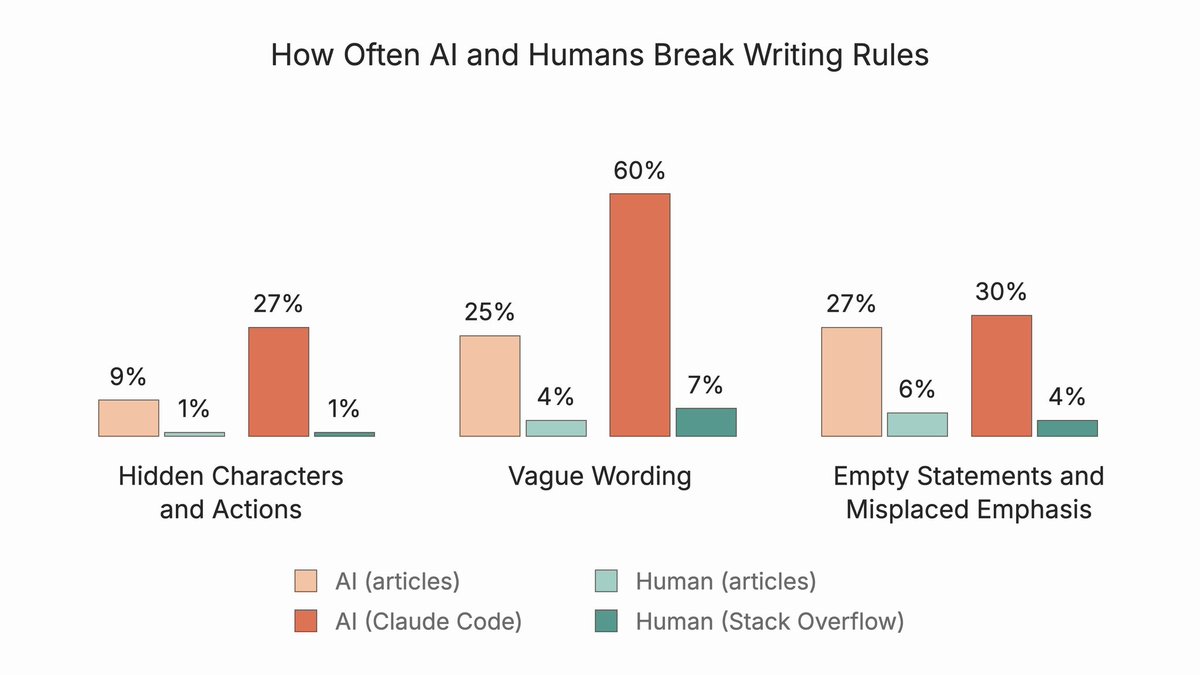
In our benchmark, AI writing breaks these principles far more often than human writing, with Claude Code replies by far the worst offenders.
We show examples of the most common slop patterns in this thread
mm, “supplanted” feels like the wrong word only because, dependent on the license, a large draw to OSS was the ability to fork only what you needed from it. agents are inherently good at building flexible software, for better or worse, but that doesn’t beget *all* software being built to be flexible.
if you post ai slop comments on my tl or any of my mutuals tls and i see it, i will add you to this list and you will be muted and blocked by hundreds of people who are sick of it
I’m wondering if there’s a skill à la “Bourdain”. Give me a chance to slow down and learn things, explore tradeoffs, and come to a first principles understanding on a solution.
Granted, he would find the entire notion of “AI driven anything” blasphemous, but I would at least feel some notion of progress if I learned something “the harder way” similar to how he appreciated the small tasks of folding laundry or doing dishes.
There’s 100% a kind of mania you can get into with coding agents, where it feels like you’re getting a lot done and working all the time but nothing is really happening.
I think it's often a form of avoidance of something else in life.
@astuyve i’m drafting an article related to this but tldr: on-call is dead. long live on-(api-)call*.
*for small enough teams with well defined security boundaries and blast radius
@cmuratori (i agree with you) something i’ve been thinking about is whether defensive solutions even exist anymore. offensive ones like data poisoning, gov. sanctions (however unlikely), honeypots, etc. have been discussed at length, but feel reactionary.
@astuyve my favorite irony is marketing statements with “pioneering/industry-leading/ever-forward” type language with internal/customer-facing use of the double space after period.
every dev I know has a callsign on PRs, ranging from the stock “LGTM” to extremely niche ones.
don’t know when or why, but I decided early on that mine is “💩 pudding”
…because “the proof is in the…”
@ankithharathi i’d imagine RH goes omni-market in the not so distant future. e.g. why go to DK/FD/UD when you can scrape money lines from all of the above and gamble on sports in the RH interface?
that isn’t a vote of confidence btw. monopolizing prediction markets is interference at best.
@ankithharathi engineer’s perspective: probably scaling compute and availability to 2-3x demand. but I agree, Jobs would have marketed this differently. it’s practically just a pre-order.
thanks! lmk if this should be a dm. these occurrences don't smell like crawlers. in both cases, these actors were legitimately trying to run a competition themselves and inputted (ostensibly) real data into the software. the software is open source, which could be another vector. ill continue investigating, just wanted to make sure im not missing something blatant :)
@astuyve Thank you! Good point of clarity I left out: stateful servers. That paper looks immensely helpful and gives me ideas for some node failure sims + corresponding fault tolerance mitigations.