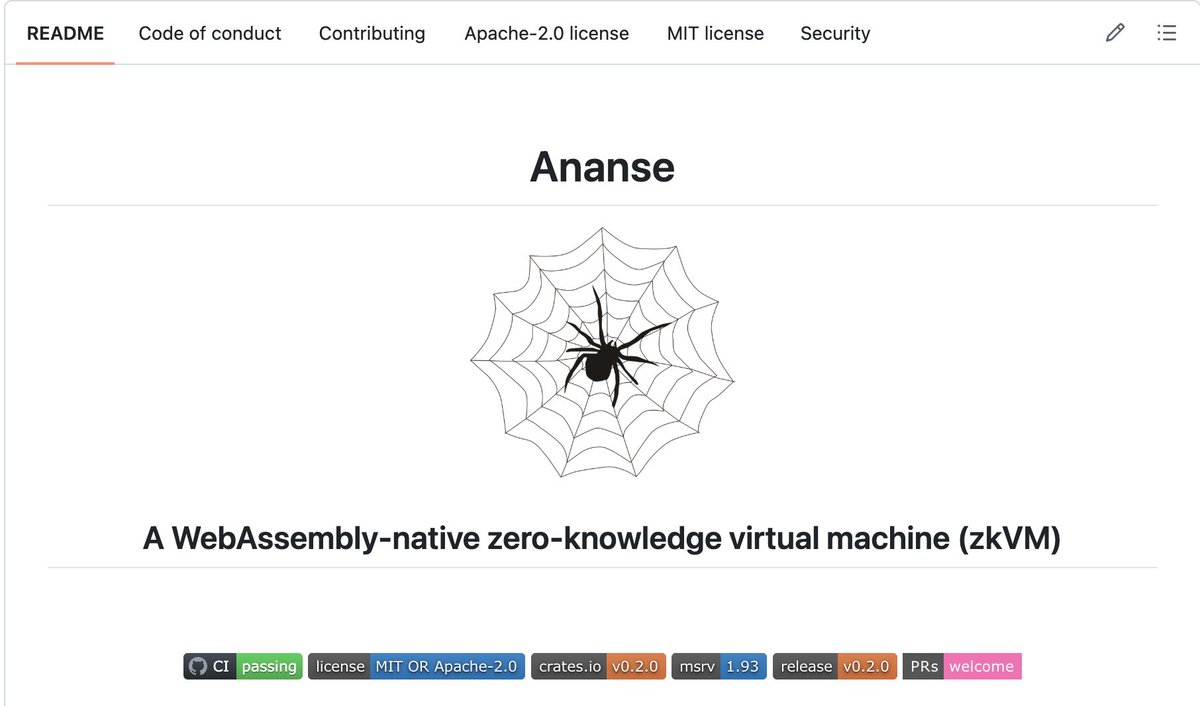
The proof system is a FRI-based STARK (scalable, transparent, no trusted setup, post-quantum secure). This v0.2.0 release ships the executable virtual machine and the register-shaped AIR (over the Goldilocks field).
ZK Rosetta catalogs zero-knowledge protocol specs or proposals and links to audited implementations where they exist, recording where they do not. It does not, however, implement, fork, or vendor any verifier, primitive, or curve operation.
Beyond cataloging entries, the project also demonstrates the Rosetta thesis executably: it drives audited verifiers over shared, ecosystem-neutral test vectors and shows that one statement verifies identically across ecosystems.
Maat source code "looks and feels" like Rust; if you already know Rust, you already know Maat. Your feedback and contributions are welcome!
https://t.co/X6r9xtY4Kr
We've reached a major milestone with Maat v0.19.0: zkSTARK proof generation and verification! The proof system is Facebook's Winterfell STARK prover/verifier over the Goldilocks field, with a stack-based trace-generating VM for both standard code execution and verifiable compute.
From here on out, in addition to the regular optimizations and bug fixes, a key feature we'll be working on is STARK-to-SNARK wrapping for succinct on-chain verification (via Groth16 over BN254).
9) Maat is early stage. Not audited. Not production-ready. But the foundation is solid and the direction is clear. Star it, try it, break it: https://t.co/X6r9xtY4Kr
1) Introducing Maat -- a Turing-complete programming language for writing zero-knowledge proofs. Rust syntax. ZK-only execution. If it compiles, it's provable. It's open source and ready for early adopters.
https://t.co/X6r9xtY4Kr
8) The long-term vision:
- Felt type for native field arithmetic
- Linear/affine types to prevent unconstrained witness bugs
- Effect system for provable purity
- STARK-to-SNARK wrapping for on-chain verification
- Dependent types for constraint invariants
- Self-hosting
Introducing Claude Code Security, now in limited research preview.
It scans codebases for vulnerabilities and suggests targeted software patches for human review, allowing teams to find and fix issues that traditional tools often miss.
Learn more: https://t.co/n4SZ9EIklG