LOGICAL COURSE OF EVENTS
Gulf states, including the UAE, are finding that Iranian protection is more effective & less #fragile than one by remote Western powers or, of course, by the state currently known as Israel.
📌📌📌📌📌📌
🚨🚨🚨🚨🚨🚨
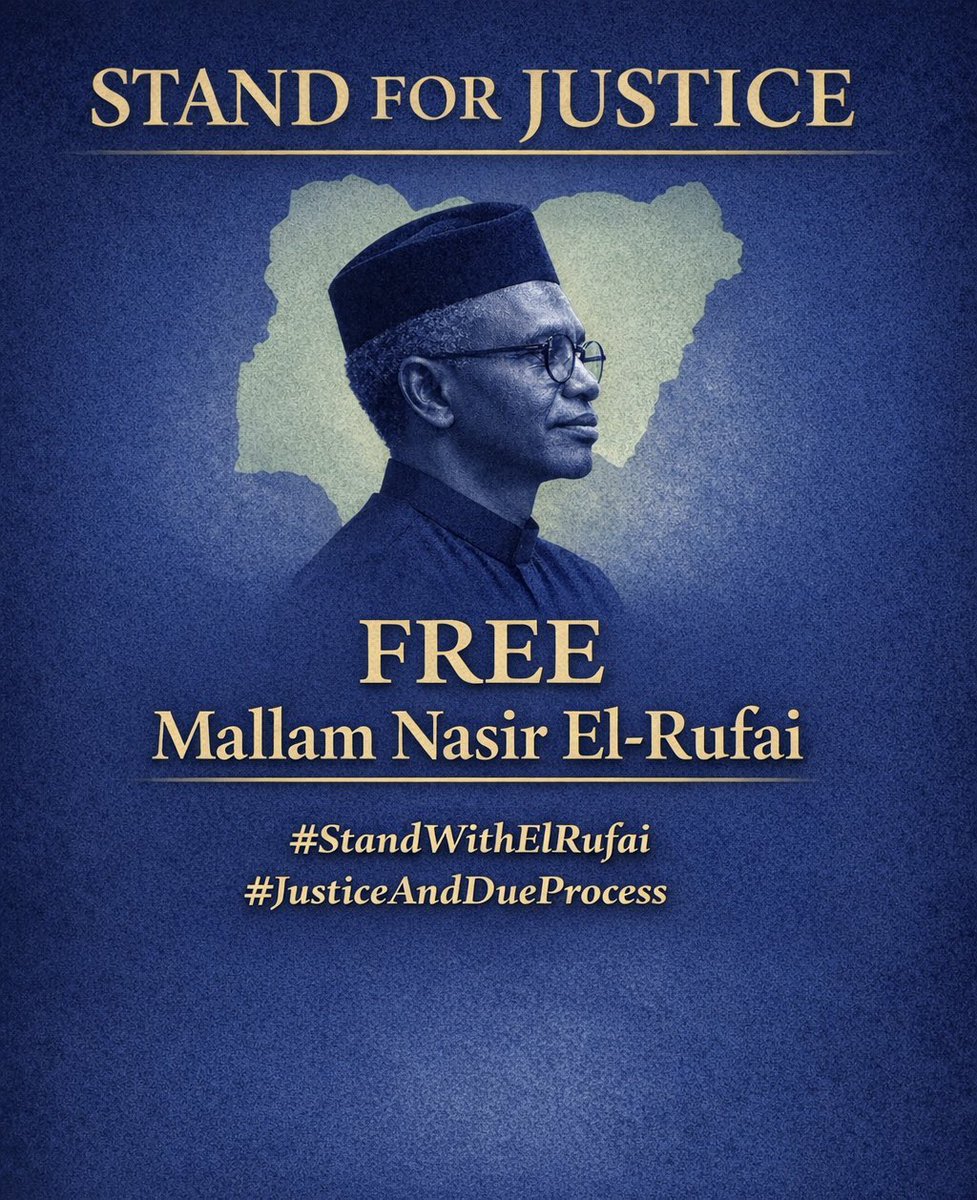
118 Days In Regime Captivity & Still Counting: The Case Of His Excellency Mallam @elrufai 💥💥💥💥💥
🔥If you are a Nigerian no matter your ethnicity, religion, political affiliation and have not spoken against this regime and @njcNig abuse of power you have been captured by T-Pain & Kudirat Kekere Ekun
🔥All Northern Emirs and Sultan, clerics and Governors are complicit and have no legitimate claim to the position of defenders of their people any longer
Go and ask the Ooni of Ife and Olubadan
🔥Even those that @elrufai took bullets for when a Governor held his neck can’t issue any press statement or pretend to be disturbed, the same people that were literally activist when PMB was president
🔥@atiku and his @ADCNig are not doing enough to secure the release of a man who with @raufaregbesola brought all of them together
The brilliant and intellectual power house who arguably was the first to publicly moot the idea of a powerful coalition to end this regime
What does it take to assemble a very powerful legal team to challenge the regime and take this case before the @IntlCrimCourt ?
#ReleaseElrufaiNow
#ReleaseElrufaiNow
#ReleaseElrufaiNow
📌📌📌📌📌📌📌
📌📌📌📌📌📌📌
Back To June 12th💥💥💥💥💥
@elrufai Spends 116 Days In Captivity & Still Counting
A regime that is persecuting @elrufai for demanding accountability and using the highly compromised judiciary to deny him bail can’t be talking of DEMOCRACY
General Sani Abacha was a better Democrat
#ReleaseElrufaiNow
#ReleaseElrufaiNow
#ReleaseElrufaiNow
The Iranian navy, which has been destroyed eight times, has apparently closed the Strait of Hormuz again, because the United States, for the seventh time, won the war that wasn’t a war, so now the United States has to open the Strait of Hormuz that was already open before the not-war began.
The not-war began because Iran had uranium that was totally, completely, beautifully obliterated, so they can’t build the nuclear bomb they weren’t building, which is why the United States had to start the not-war it definitely didn’t start.
Now the United States, which has nuclear weapons, is threatening to use nuclear weapons to stop Iran from getting nuclear weapons, because nuclear weapons are far too dangerous for countries with nuclear weapons to allow other countries to have.
If the United States saw the United States doing what the United States does in other countries, the United States would invade the United States to liberate the United States from the tyranny of the United States.
📌📌📌📌📌📌📌
Imagine spending this $2.34 to build a sustainable agriculture industry in one year
But few Nigerians were enriched through tax waivers to the detriment of our local farmers
Creating employment in foreign countries while destroying our economy and forcing farmers to go into the unemployment market
Araghchi absolutely RIPS at the BRICS Foreign Ministers' meeting in New Delhi.
A lesson to all BRICS and BRICS+ partners. Actually, a mini-manifesto:
"To virtually everyone in this room, our resistance against US bullying is not an unfamiliar battle. So many of us encounter slight variations of the same repugnant coercion. It is high time for us to jointly step up and work towards making clear that those practices belong in the dustbin of history. Today, our nations are closer to one another than ever before, and we cannot ignore the common and dangerous challenge we all face. History has shown that empires in decline will stop at nothing to arrest their inevitable fates. A wounded animal will desperately claw and roar on its way down."
YOU ARE YOUR OWN ENEMY:
1. Your economic policies lack human consideration
2. Your political (Mis) calculations are extremely divisive and inciting
3. Your resources allocations pattern are too sectional, too biased and discriminatory.
4. The way you practice democracy is strange even in the animal kingdom.
5. The way you violate our constitution makes every other offender INNOCENT.
6. The way and manner you incur expenditure and Debt compel many to begin asking whether you truly have Nigeria at heart.
7. The way and manner you ignore public outcry with ignominy and contempt shows your lack of respect for Nigerians.
8. No wonder you called yourself a " STUBBORN POLITICIAN"
Please carry your cross alone. Your claim of enemies working against you is imaginary and self manufactured.
INSECURITY IS REAL IN NIGERIA.
READ THE DAILY SECURITY REPORTS ON YOUR TABLE.
The continued detention of Mallam Nasir El-Rufai has created a growing public perception that justice is being overshadowed by external pressure and political considerations. In any democracy, that perception alone is deeply damaging.
Courts must be guided only by law, evidence, and constitutional principle. When a prominent opposition figure and leading voice within a political coalition remains in custody amid unresolved bail issues, many citizens will understandably question whether the process is truly independent, balanced, and free from interference.
No court should allow itself to appear as an instrument of partisan interests. The judiciary exists to protect liberty, restrain abuse of power, and stand above political contests. Where detention appears prolonged without compelling legal necessity, confidence in the system is weakened.
Mallam El-Rufai, like every Nigerian citizen, is entitled to the presumption of innocence, fair treatment, and impartial adjudication. His political relevance should neither advantage nor disadvantage him before the law.
We therefore call for an urgent, transparent, and strictly lawful review of his continued detention and all pending bail matters. Justice must not only be done; it must be seen to be done.
If courts bend to pressure, democracy bends with them.
If courts stand firm, the Constitution stands firm.
Nigeria deserves courts that answer only to the law.
Our attention has been drawn to a story in circulation that the African Democratic Congress (ADC) is in talks with another political party, specifically the Peoples Redemption Party (PRP), in anticipation of its court judgment.
We would like to state categorically that this is not true.
The coalition leadership is not having any such conversation with any political party at the moment.
We are fully committed to ensuring that the illegal action taken against our leadership by INEC and other agents of the ruling party is upturned. We believe that this is the only path to safeguarding the rule of law and ensuring that multiparty democracy survives in Nigeria.
While we are open to expanding the coalition to bring all opposition elements in the country together to rescue our country, we remain clear about the responsibility that this moment has imposed on us. We will not abdicate that responsibility.
Therefore, any suggestion that we are considering abandoning the ADC is preemptive and speculative, and should be ignored.
Notwithstanding the flagrant bastardisation of democratic institutions, the ADC leadership remains confident that the judicial institutions will, at this defining moment, resist the pressure to be complicit in undermining Nigeria's democracy.
The Strait of Hormuz Shuts Again: A New Phase in a Deepening Global Contest
The closure of the Strait of Hormuz has once again pushed the world toward a moment of profound uncertainty. This narrow waterway, through which a significant portion of the world’s energy supply flows, has become the symbolic center of a much larger geopolitical struggle. The latest shutdown did not emerge from a single event but from a convergence of unresolved tensions that have been building beneath the surface for months.
Three major developments triggered this renewed crisis. First, Israel continued its military operations in Lebanon despite the terms of the ceasefire agreement. Second, the Iranian Revolutionary Guard publicly rejected any suggestion that Iran should scale back its nuclear ambitions. Third, Iran, along with several Gulf states, announced a formal shift toward selling oil in yuan rather than dollars. Each of these developments alone would have been enough to strain regional stability. Together, they have created a moment of global consequence.
At the heart of the problem is a fundamental misunderstanding between the parties involved about what the future of the ceasefire should look like. Israel views its security through the lens of long term strategic depth. In that context, Hezbollah represents a major geopolitical threat to its long term objectives. From Israel’s perspective, the ceasefire was never a permanent solution but a temporary pause that allowed it to recalibrate its military posture.
On the other side, the Iranian Revolutionary Guard sees its nuclear program as essential to Iran’s sovereignty and long term security. For them, any suggestion of abandoning that program is unacceptable. Yet at the same time, Iran faces pressure from the United States to reopen the Strait of Hormuz in order to stabilize global markets. The United States wants the strait open because global energy flows directly influence the strength and demand for the dollar. A stable market means a stable dollar.
However, when Iran agreed to reopen the strait, it did so with a condition that fundamentally challenged the existing global financial order. Iran and several Gulf states announced that oil sales would be conducted in yuan rather than dollars. This move struck at the core of the United States economic influence. For decades, the global energy market has been anchored in the dollar. Any shift away from that structure is seen in Washington as a direct challenge to its financial leadership. This is a red line for the United States.
The ceasefire period, rather than creating space for diplomacy, became an opportunity for all sides to rearm and reposition. The United States moved a large contingent of military equipment into the region, with a significant portion directed toward Israel. Nearly fifty thousand American troops were deployed across various bases in the Middle East. This buildup signaled that Washington was preparing for the possibility of a wider conflict.
Iran responded in kind. Over the past forty eight hours, four large military cargo aircraft from China landed in Iran, carrying supplies that Iranian officials described as essential for national defense. Additional shipments arrived from Russia, and overland routes through Pakistan saw increased movement of military equipment. The Iranian Revolutionary Guard placed its ground forces on high alert and ordered the closure of certain markets and schools as a precaution against potential escalation.
These developments suggest that the temporary ceasefire is nearing its end. The United States and Iran may soon find themselves drawn into a second phase of confrontation, one that neither side openly desires but both seem to be preparing for. The situation is no longer confined to regional rivalries. It has evolved into a contest over the future structure of global power.
The shift toward selling oil in yuan is not merely an economic decision. It represents a broader realignment in global alliances. China has positioned itself as a central player in this emerging order, offering economic partnerships and military cooperation to states seeking alternatives to the traditional Western dominated system. Russia, facing its own geopolitical pressures, has strengthened its ties with Iran as part of a broader strategy to counterbalance Western influence.
The United States, meanwhile, is determined to maintain its leadership in global financial and security structures. The dollar remains its most powerful instrument of influence. Any challenge to that system is viewed as a threat to its long term strategic interests. This is why the decision by Iran and several Gulf states to shift toward the yuan has such profound implications.
The closure of the Strait of Hormuz is therefore not simply a regional dispute. It is a reflection of a world in transition. The old pillars of global power are being questioned, and new ones are emerging. The conflict in the Middle East has become one of the arenas where this transformation is unfolding.
The coming months will likely determine whether the world moves toward a new equilibrium or deeper instability. If the ceasefire collapses completely, the region could enter a period of prolonged conflict with global consequences. Energy markets would face severe disruptions. Financial systems would experience new pressures. Alliances would be tested and reshaped.
This war, in its various phases, will not end until the major powers involved have redefined their positions in the global order. The struggle is not only about territory or ideology. It is about the future configuration of international power. The decisions made now will shape the world for decades to come.
Adamu Garba II
Nigeria Is Bleeding From Within
It is deeply troubling to read recent World Bank reports indicating that, while Nigeria’s Federation Revenue surged to ₦84 trillion in just three years, a staggering 41% —amounting to ₦34.44 trillion —never reached the Federation Account. This sum exceeds the combined ₦34 trillion earmarked for capital projects in the 2024 and 2025 Appropriation Bills, a comparison that underscores the gravity of the situation and signals that something is fundamentally wrong.
This is not a mere oversight; it points to institutionalised corruption on a massive scale. In 1994, when the Okigbo Panel reported about $12.4 billion from the Gulf War oil windfall as unaccounted for, Nigerians were outraged and the nation shook with indignation. Today, an even more troubling situation appears to be unfolding, yet it is met with a disquietening silence.
We are trapped in a lethal paradox: Earning more as a nation, yet having less to invest in healthcare, education, and infrastructure. From 2025, systemic “deductions” have allowed agencies to capture more resources than entire states and even critical ministries.
These leakages explain why countries with fewer resources are out-performing us across key development indices. With such a broken system, how can we fix power, strengthen our schools, build resilient healthcare, or develop critical infrastructure?
Nigeria has no business being poor. We must stop these leakages through disciplined, transparent leadership driven by character. It is time to redirect our hijacked resources back to the people and move Nigeria into the league of developed nations.
With our collective resolve to change this corruption-infested system, a New Nigeria is POssible. -PO