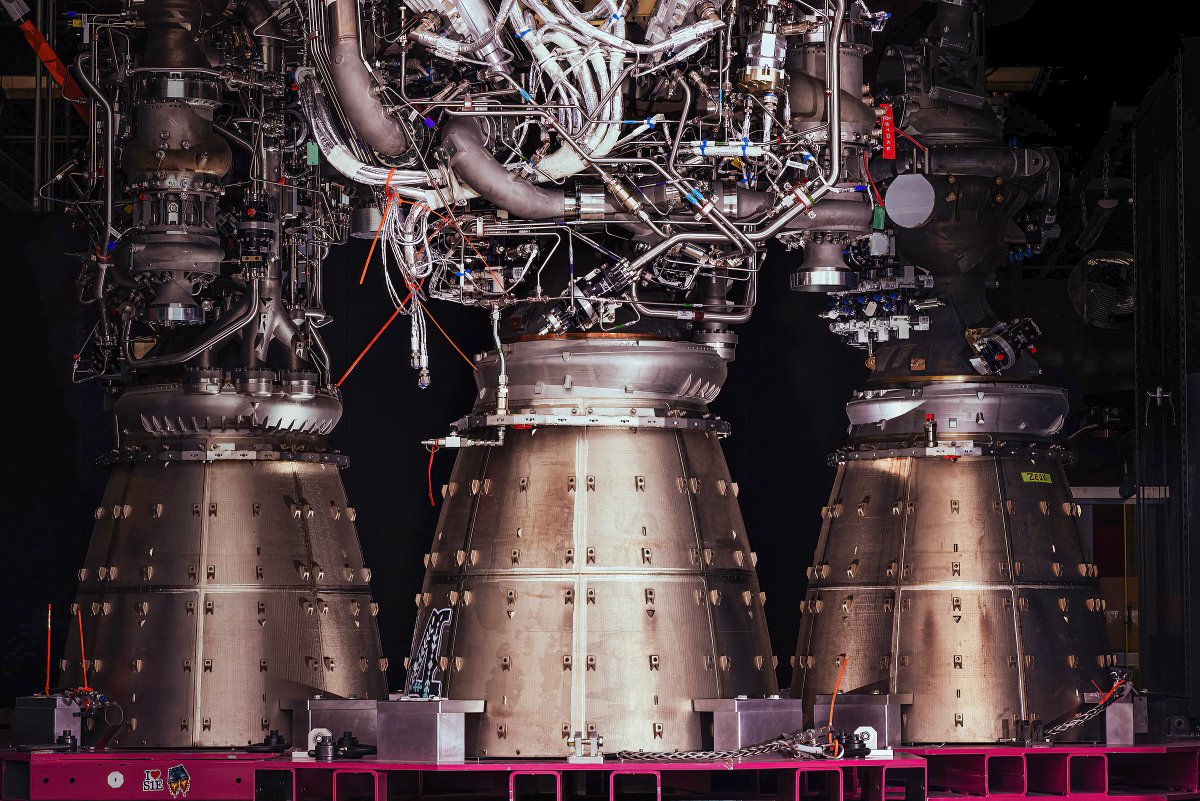
Super exicted for this. Stoke’s success would prove an alternative method (to SpaceX) for second-stage rocket reusability. It de-risks the hardes problem in launch for everyone.
The first three of our flight one engines are designed, built, and ready for testing. ✅
Stage 1 Zenith engines ZE14, 15, and 16 are ready to ship from our shop floor in Kent, WA to Moses Lake for hot fire acceptance testing.
Getting our Zenith engines through qualification testing is no small feat, and trusted vendors like Performance Sealing Inc. - who can iterate at industry-leading speeds - are key to keeping our work on time and on track.🙏🙌
Following our agreement to acquire @Globalstar, we've filed with the @FCC to deploy the Leo D2D System—up to 5,105 new satellites that will bring voice, data, messaging, and emergency services directly to compatible mobile devices. The new system is a core part of our long-term vision for Amazon Leo, bringing high-speed connectivity to more people in more places around the world.
Learn more: https://t.co/Fv2qxoWwu3
Amazing analysis on orbital data centers. Although the is goes deep into the feasability of the idea, my back of the envelope math wasn’t far off. Eric models SpaceX’s full 1 million satellite vision, mine just does 1 GW (~8,300 satellites), but results are smiliar.
Tried to put some cost numbers on SpaceX's plans for a 1-million satellite constellation of orbital data centers. One thing is absolutely clear: Unless Starship works very well, the business case is impossible.
https://t.co/1VVZzh2bA4
His feasibility analysis on the satellite mass needed was something I hadn’t accounted for. Mostly gets evened out with Eric projecting lower launch costs.
I’m going to go out on a limb and say this:
@SpaceX should consider selling/licensing Falcon 9 operations.
1) Falcon 9 is arguably the greatest launch vehicle ever built. But SpaceX’s future is no longer Falcon. It’s Starship, Starlink, AI infrastructure, and the Moon (which drives most of the company val).
2) Every year SpaceX continues operating F9, it commits some level of mgmt attention, engineering resources, manufacturing capacity and org complexity to a mature platform. If transferring some of that brings Starship forward by even 6-12 months, the value created could dwarf F9's annual profits
3) F9 is still essential to the space ecosystem. But that doesn’t mean SpaceX has to be its long-term operator. A trusted operator could continue manufacturing and flying F9 while SpaceX builds the next phase of space infra.
4) If the orbital compute thesis is real, the capital need is front-loaded and massive. F9 prints cash but is worth more as a lump sum than harvested over decades. Converting a derisked asset into billions of dollars to accelerate Starship, Starlink and AI infra will create more value than continuing to own 100% of Falcon.
5) Yes, I know: “Elon would never do this.” It would obviously have to be to a friendly and an operator he deeply respects (this is the hardest part).
It doesn’t have to be an outright sale. Could be an opco licensing agreement.
– SpaceX retains IP + gets royalties
– Can terminate if standards aren’t met
– Newco gets exclusive license to manufacture and operate F9 + technical support via an efficiently carved out team
– Long-term Starlink launch commitment from SpaceX anchors newco demand through the Starship transition...this makes this financeable
→ The commercial space industry needs F9. This would be a big win for the ecosystem and allow SpaceX to focus entirely on the platform that defines the future.
I agree, if launch prices don’t fall significantly, vertically integrated companies like SpaceX, Blue Origin and Rocketlab will be better off than those dependent on launch. Question is, what will launch look like in the next 5 years.
SpaceX employee #13 @_Eric_Romo:
"The idea that launch prices are going to fall significantly in the next 5 years is nonsense."
"There are an awful lot of business models that are predicated on 'when Starship allows me to launch for $200 a kilogram…'"
"I think they’re all broken, and all those companies are going to fail."
"We’ve seen this play out already with Falcon 9 and the pricing around it, where the costs of Falcon 9 allowed SpaceX to deliver the Starlink constellation at a cost per CapEx that made them profitable."
"But they set the price in the market at something that just barely made it an okay investment to think about OneWeb or Kuiper or anything like that."
"They’re going to do the same thing on Starship, because why wouldn’t they?"
"Their internal costs on Starship are going to be whatever they need to be to deploy Starlink and orbital data centers, but they’re going to set the price so that anybody trying to do comms, anybody trying to do orbital data centers—the price is going to be too high."
"If you’re a third party relying on them for a lower price of access to space, I think you’re hosed."
@elonmusk
Recorded at @NYSE x @payloadspace Space Summit
@PhilipJohnston@Starcloud_ $/kg matters, but the more interesting case for orbital compute is that earth-side bottlenecks (grid queues, equipment shortages, permitting) likely won’t go away.
On Defence and pure-play space partnerships: Defense primes are increasingly partnering with and outsourcing to pure-play space startups. It’s one of the most productive shifts the industry has made.
Startups are simply better at building fast in a fast-growing industry. The legacy defense companies are slower. Let the ones built for speed do the building. Im not talking about all the defence companies, mostly the legacy ones.
@payloadspace@SpaceX Companies like SpaceX, Rocket Lab, and True Anomaly already straddle the asset and operational layer. Who are the pure-play operational players most worth watching right now?
SpaceX’s biggest legacy might be its founder factory. Impulse Space, Relativity Space, Firefly, Varda, Apex Space, K2 Space, Epsilon3, Castelion and many more — all founded by SpaceX alumni. IPO liquidity will likely encourage more, feels a lot like the PayPal Mafia.
Everywhere you look in climate tech there’s a former Tesla or SpaceX doing something cool.
@MattZeitlin and @emilypont surveyed the Musk Mafia for their takes on how the experience shaped them and what it was like working for Elon:
https://t.co/ZtA75QMIyX
@reddit_lies An inevitable decrease in launch and satellite costs, plus continued bottlenecks for terrestrial datacenters can make orbital data centers viable in the near future. I would say before 2029.
"We expect Starship to be flying more than once per hour down the road."
"We think we can get to a million tons to orbit per year in about 3 years."
For context: SpaceX did ~2,500 tons in 2025. A 400x jump in 3 years would have a huge impact in building orbital infrastructure.
Caveats — this math leaves out: chips (the biggest cost, but similar on both sides), operation costs, and the extra hardware needed to survive radiation in orbit — but none change the story
SpaceX's AI1 satellite gives us the real numbers to evaluate orbital data centers. Here's the back-of-envelope math for a 1 GW constellation vs. a terrestrial campus. 🧵
So space loses today: $26B vs $17B. Why could it still be viable? Simple: launch and satellite costs are falling fast, while building on Earth is getting harder — grid queues, equipment shortages, and permits now make an energized gigawatt take 4–7 years.