.@Microsoft's support for Europe always has been and always will be steadfast. Today we launched five new European Digital Commitments to sustain customer trust, help create jobs, promote economic opportunity, and strengthen security on both sides of the Atlantic. https://t.co/JPB66FoXKX
Microsoft and Atom Computing are coming together to ultimately build the world’s most powerful quantum machine. Learn more on how we are advancing the future of quantum computing: https://t.co/Q6sI09NGIK #AzureQuantum#MSIgnite
From elementary school to college and university, students at every level of education are using generative AI to unlock new avenues for learning.
Explore the ways AI tools are being embraced in the classroom. https://t.co/4uWN2fQj0b
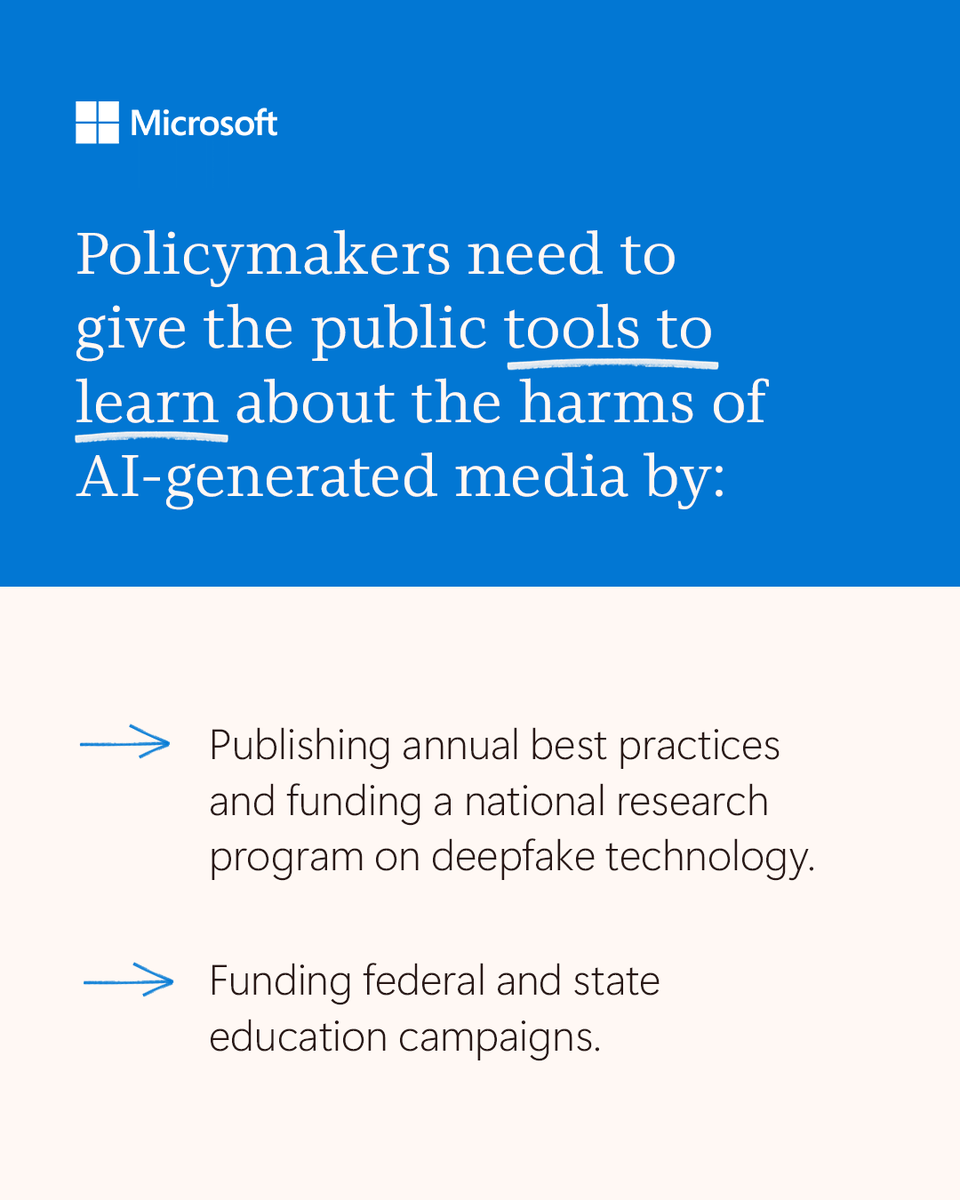
As synthetic content evolves, so do its threats. 🚨 We’ve outlined tools that policymakers can give the public to increase education and awareness about harmful AI-generated content.
Στη συνάντηση με τον Πρόεδρο της Microsoft @BradSmi συζητήσαμε για τις πρωτοβουλίες που έχει αναλάβει η κυβέρνηση στο πεδίο της τεχνητής νοημοσύνης, καθώς και τη δυνατότητα κοινών πρωτοβουλιών για την αντιμετωπιση της παραπληροφόρησης στον τομέα αυτόν. #WEF24
A piece of glass that stores data for 10,000 years might seem like a concept from a sci-fi movie, but it could soon be a reality. 🤖
Learn how Microsoft Research’s Project Silica is using cutting-edge technology to make data storage more sustainable: https://t.co/ULXDpUmbsS
The world needs clear standards to help ensure the safe and responsible development and use of powerful Frontier #AI models globally. Microsoft looks forward to work with Chris Meserole as the first Executive Director of the Frontier Model Forum, and the creation of the new AI Safety Fund. https://t.co/2UoDXQVCZ3
Today we’re sharing our 5-point blueprint for governing AI in India. Our proposal addresses current and emerging issues while offering ideas for public-private partnerships that ensures AI serves people everywhere. https://t.co/4AcsZ1tKCq
AI will accelerate economic growth in Europe. As we embrace the opportunity, we must manage its challenges. Our 5-point blueprint for governing AI addresses issues while offering ideas for public-private partnerships to help ensure AI serves all Europeans.
https://t.co/u76Ol1zstO
We remain committed to tracking and reporting Russian cyberattacks targeting Ukraine and its allies. Today, we’re sharing more on activity we’ve observed so that governments and our customers can protect themselves. https://t.co/gfLCyImPh5
In 1944, a group of students resided in a small Greek village, which was under the occupation of the Axis Powers during World War II. From April 1941 to October 1944, Greece endured the oppressive presence of these occupying forces, resulting in severe repercussions for the country. The Greek economy was devastated, and the civilian population suffered immensely. The occupation led to the widespread destruction of various vital aspects of Greek society. The industrial sector, for instance, experienced an overwhelming 80% reduction, while 28% of the country's infrastructure was left in ruins. Ports, roads, railways, and bridges were particularly affected, with an estimated 90% of them destroyed. Additionally, Greece's forests and other natural resources were depleted by 25%. The loss of civilian life was also substantial, with an estimated 7.02-11.17% of the population succumbing to the hardships of occupation.
Instead of slowing innovation, we think a better approach is speeding up safety through strong technology standards and effective government regulation.