Oxford grad studying mating. "Macken Murphy is able to condense vast chunks of information into engaging and digestible episodes." — The New York Times
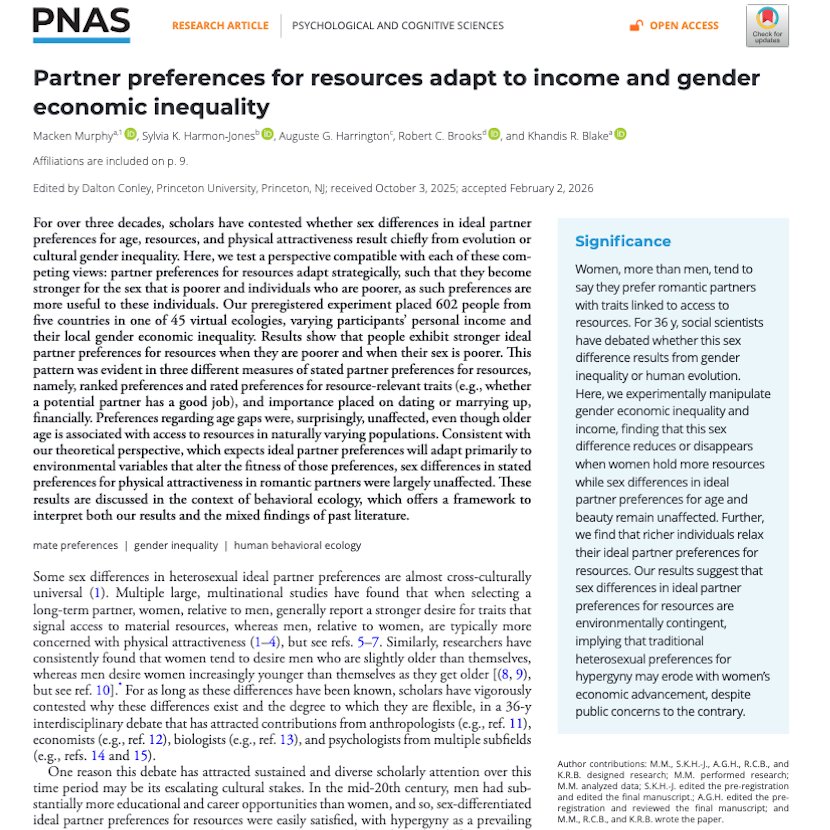
Partner preferences for resources adapt to income and gender economic inequality.
When women make more money than men, the sexes are equally inclined towards hypergamy.
New from the Evolution Lab. (1/15)
Kadınlara aynı erkeğin 3 farklı araba önündeki fotoğrafları gösterildi.
Ortalama olarak, kadınlar lüks Mercedes'in önünde çekilmiş fotoğraftaki erkeği daha çekici buldu.
I was listening to Megan Thee Stallion this morning and I heard her ask: “Do you want a begging ass b*tch or a rich one? Do you want a b*tch with some motion or a stiff one?”
This is part of a larger trend I’ve noticed wherein modern women’s rap music frequently involves flexing access to resources in a mating context.
Now, the conventional evolutionary psychological interpretation might be that this is essentially a failure of cross-sex mind reading. I.e., “women care about a man’s income when dating, so they wrongly infer that men must care about a woman’s income.”
But I am not sure if this view is up to date with the modern mating market. In 16 American cities (including NYC/LA) young women out-earn young men, who are struggling in school and stalling economically. The strategic landscape has shifted, and for many men, a woman without her own money is a financial liability.
I’ll put it flatly: A perk of dating women with money in 2026 is that they aren’t as expensive to date. For men with financial concerns, that may be attractive. And it seems to match the mate value signal in lyrics like this, which isn’t that she’ll provide, but that she won’t cost.
As Latto promises, “I got money, too, so I barely ever ask.”
Read also the authors response to all 43 commentaries
I am pretty proud of how they described our ideas.
"Costello, Thomas, Reynolds, & Buss offer the most comprehensive set of novel evolutionary explanations, addressing each specific sex-differentiated outcome...For each outcome, they provide additional theoretical and empirical evidence consistent with their claims, covering literature we did not cover in our article."
😎
https://t.co/tgiC6rD3Zs
For what it’s worth, Witmer et al. (2025) tested this using a dating app study and found that women’s swiping behavior was influenced by facial attractiveness about 12 times more than height.
@WilltoCapital Facial preferences are also non-linear FWIW. Once you look good, looking better doesn’t make as much of a difference. (Same as “once you’re tall being taller isn’t that big of a deal.”)
For what it’s worth, Witmer et al. (2025) tested this using a dating app study and found that women’s swiping behavior was influenced by facial attractiveness about 12 times more than height.
@WilltoCapital I share your intuition that this is an obvious result, but it’s a necessary study given how much time people spend “optimizing” their bios and how much people discuss height in relation to online mating.
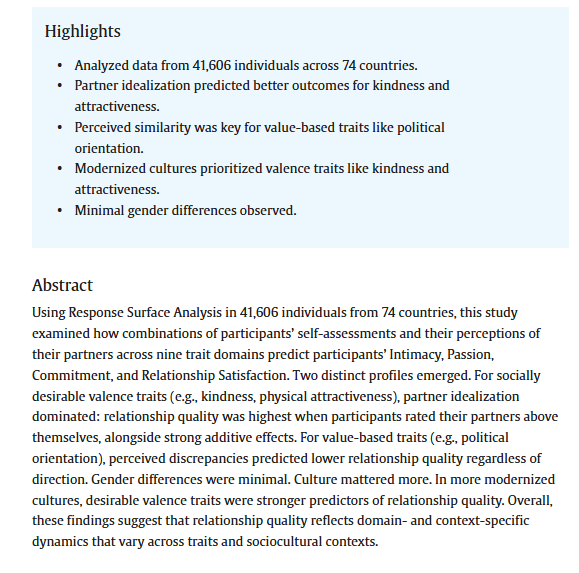
1/3 Is it better to idealize your partner or see them as similar to you? The analysis of data from 41,606 people across 74 countries provided evidence that for socially desirable traits (e.g., kindness or physical attractiveness) idealization wins.
@Beobachter5764 I was just thinking that it made a lot of sense. Less "personal," (facial appearance is tied to unique identity much more than height) and it's way harder to deny. You can have cognitive distortions that your face is attractive (most men do), but not that you're tall.
On dating apps, looks matter 7-20x more than any other factor.
The effects of biography text, height (!), occupation, and intelligence are dwarfed by comparison.
And look: as with most revealed preference data, women value looks just as much as men.
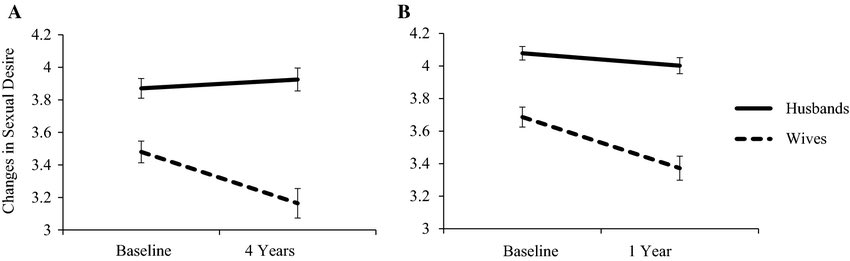
I should know this: Is there a standard evo psych explanation for why women’s sexual desire declines faster than men’s within monogamous pairbonds? 🤔
My intuition is that if it were the other way around, that would accord better with sexual strategies theory.